
How AI Property Marketplace Software Redefines Brokerage
Short answer
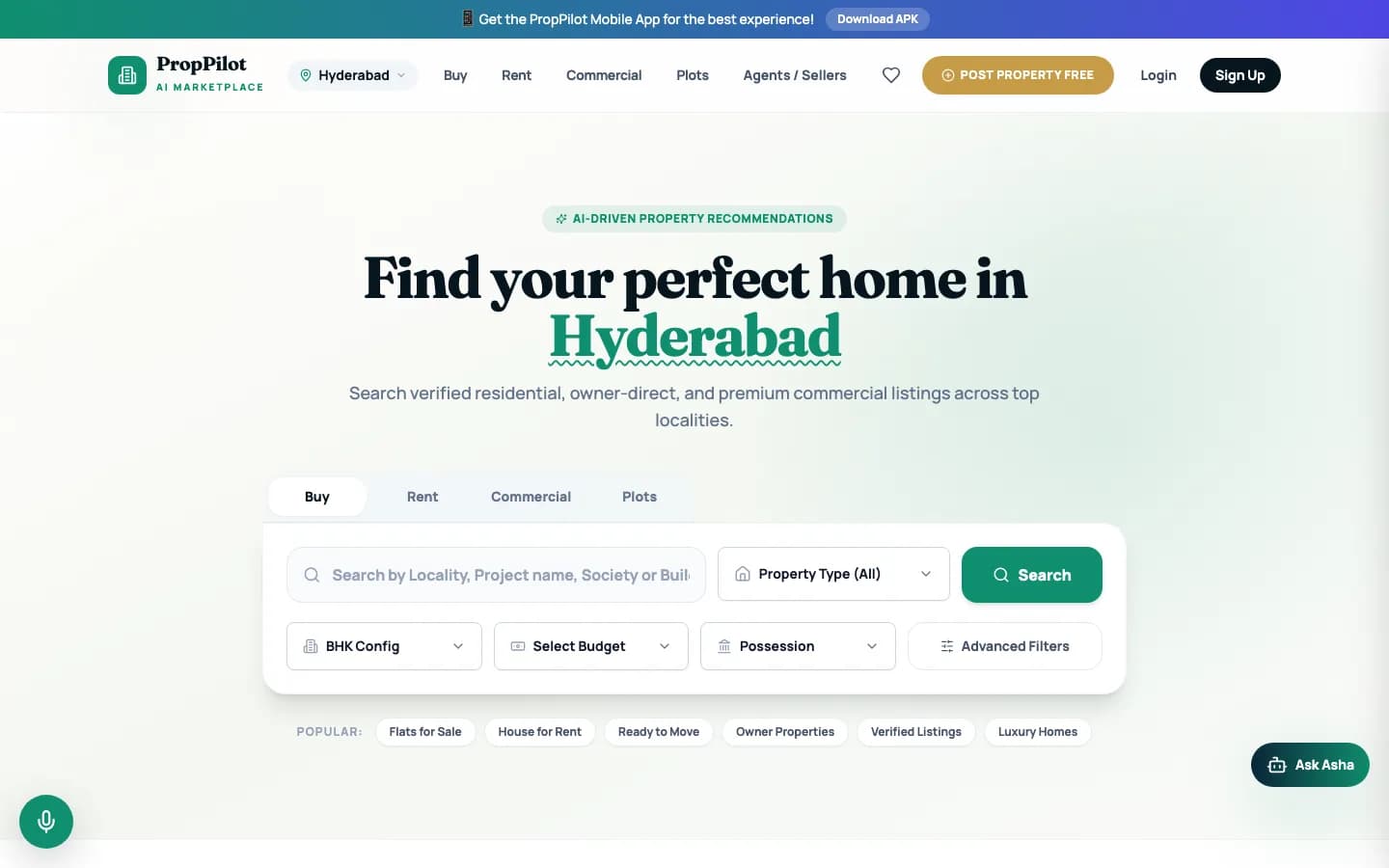
Traditional property portals are dropdown filters: pick a location and price band, then scroll. AI property marketplace software understands intent-based queries such as "quiet apartment near the metro with natural light", ranks by relevance rather than exact matches, and answers buyer questions automatically instead of returning an empty result set.
Traditional real estate portals are database filters: buyers select location and price, then scan through standard lists. If a buyer has a specific context—like 'show me a quiet apartment close to metro with natural light under $600k'—traditional databases return empty results. AI property marketplace software solves this by implementing semantic vector search.
By utilizing conversational AI engines linked to property records, you provide a digital assistant that acts as a 24/7 client broker, explaining nearby schools, layout histories, and pricing variables.
| Search Type | Keyword Filters (Old Way) | AI Semantic Search (PropTech) |
|---|---|---|
| Query Intent | Strict fields (exact match) | Natural language (understands context) |
| Result Quality | Returns 0 or 100s of generic items | Returns 3 highly relevant matches with summaries |
| Engagement | User leaves if filter returns empty | User chats and gets guided to list visits |
| Lead Capture | Standard contact form | AI qualifies budget and books calendar slot |
Core Modules of PropertyApp
- Semantic Vector Database: Stores listings as mathematical vectors, checking semantic similarity.
- Site Visit Scheduler: Integrates with agent calendars to assign, confirm, and alert site visits.
- Seller & Owner Portal: Verified owners upload media assets, details, and map markers.
What Changes for a Brokerage
The measurable differences are narrow and specific. Everything else marketed as AI in property is either one of these or nothing:
| Capability | What it replaces |
|---|---|
| Natural-language search | Dropdown filters that return zero results and lose the buyer |
| Relevance ranking | Exact-match queries that hide near-perfect listings |
| Automated enquiry answering | Agents repeating price, size and availability all day |
| Lead qualification | Calling every enquiry to find the few with budget and timeline |
| Listing description drafting | Manual writing for each new property |
Listing Data Is the Real Prerequisite
Relevance ranking and automated answers are built directly on your property records. If listings have missing attributes, inconsistent locality names, stale availability or three photos, no amount of AI improves the result — it produces confident answers from bad data, which is worse than no answers. Fix the data before buying the feature.
Budget real time for the data clean-up before launch. Most brokerages arrive with listings spread across spreadsheets, WhatsApp forwards and an old portal export, with inconsistent locality names and missing carpet areas. Semantic search amplifies whatever it is given: clean structured listings produce useful matches, while duplicated or half-filled records produce confident nonsense that erodes buyer trust faster than no search at all.
- Consistent locality and project naming, so "near the metro" can resolve to anything.
- Complete attributes: size, configuration, floor, facing, furnishing, amenities.
- Accurate availability, marked promptly when a property goes off market.
- Enough photographs, correctly associated with the right listing.
- A defined update process, because listing data decays weekly.
Where the Human Takes Over
Define the handoff explicitly. Automated systems should handle discovery and routine questions; a named agent should own site visits, negotiation and closing. Buyers making the largest purchase of their lives notice when they are being kept away from a person, and the reaction costs more than the efficiency gained. Label automated replies honestly and make the route to a human obvious.
Draw the line at commitment. Software is good at discovery, qualification, scheduling and record-keeping; it is poor at negotiating a price, reading a family's hesitation during a site visit, or judging whether a title document is worth pursuing. The practical division is that the platform should deliver an agent a qualified buyer with a confirmed budget and a booked visit, and leave every judgement after that to the agent.
See PropertyApp for a ready-made implementation, property and rental software for the category, and RAG chatbot development for grounding answers in your own listing data.
Step into modern PropTech. Explore specifications on our PropertyApp Real Estate software page.
Frequently Asked Questions
How does the AI assistant avoid making up pricing details?
We utilize RAG (Retrieval-Augmented Generation), forcing the AI to only output coordinates and details present in your listing index.
Can we assign different permissions to agents?
Yes. Role-based access control divides roles between global admin moderations, agent leads, and seller listings.
Explore Next
- See our PropertyApp AI real estate platform
- Learn about our AI agent development services
Need Setup or Custom Coding?
Get in touch to rebrand or customize our ready-made products, or discuss custom development services. All quotes are customized and private.
Related Articles
Selecting Restaurant Ordering Software with Table Booking
Compare aggregator costs with direct ordering costs. Discover the benefits of launching a contactless QR ordering and reservation platform.
Why Startups Choose Ready-Made School Management Software
Launch a custom-branded school management portal. Discover why educational startups and academies choose deployable school ERP systems.