 Loading TechDinoLoading TechDinoLoading TechDino
Dino Inventory — AI-Native Inventory Management Software
AI-native inventory management software for products, purchasing, receiving, stock balances, sales fulfillment, warehouse transfers, stock counts, FEFO lot and serial traceability, reporting and a permission-scoped multi-agent AI assistant.
Built for: Distribution & Wholesale Trading, Pharmaceutical & Healthcare Supplies, Food, Beverage & Perishable Goods, Multi-Branch Retail & Distribution Operations
Frontend, backend, admin dashboard and database schema for the agreed scope — handed to you, not rented.
Business name, logo and app icons, Brand colour palette and typography, Your own domain and SSL certificate, Login, email and notification templates and more — applied before handover.
A standard branded deployment is estimated at approximately 2 weeks after the scope, brand assets, hosting access and required service credentials are confirmed. The estimate covers agreed branding, environment setup, supported integration configuration, supplied-data migration, testing and handover. Actual timing depends on product scope, data readiness, client approvals and third-party dependencies. Custom modules and new integrations are quoted separately; the written project schedule governs delivery.
Dino Inventory is AI-native inventory management software for branch-wide stock control, not bin-level warehouse execution: purchase requests, receiving, putaway, balances, reservations, backorders, transfers, counts and FEFO lot, expiry and serial traceability. A multi-agent AI assistant answers from live records under the asker's own permissions. Buyers receive complete source code, white-label branding, deployment and migration assistance, plus three months of technical support. Setup is estimated at approximately 2 weeks.
Dino Inventory is a ready-made, white-label inventory operations application for distributors, wholesalers, multi-branch retailers, manufacturers and any team that buys, stores and ships stock. It is distinct from Dino WMS and Dino Business OS: Dino WMS runs bin-level warehouse execution with pallets, zones and 3PL workflows, Dino Business OS is the full ERP with HR, payroll and finance, and Dino Inventory is the stock-control layer between them, from purchase request to putaway and reservation to dispatch, across branches rather than inside one warehouse. The live product follows the work from a purchase request through approval, RFQs and supplier quotations, purchase orders, goods receipts, quality inspection, putaway and purchase returns. Stock balances show available, reserved and in-transit quantities by warehouse, and every figure traces back through the inventory ledger to the receipt, dispatch, transfer or approved adjustment that produced it. Sales work runs on reservations, partial picking, packing, shipments and visible backorders. Branches, warehouses and storage locations carry transfer approvals, dispatches, partial receipts and discrepancy records, while assigned stock counts compare physical quantities against a frozen snapshot before variances are posted. Lot numbers, expiry dates, FEFO allocation, expiry alerts, batch recalls, serial histories and warranty references keep traceability attached to the same records. Live reports drill from inventory summaries into ledger, expiry, backorder and transfer rows, and report views save to the account. A multi-agent AI assistant answers operational questions in plain language: a supervisor routes each question to one of six domain specialists, each reading live records through the same API and permissions as the person asking, citing the records and policy documents it used. AI providers and models are configured per capability with backups. Hosting, AI provider usage, integrations and any new workflows are confirmed in the written project scope.
Distributors, multi-branch retailers, manufacturers and operations teams in India, Hyderabad, the UAE and global markets that need purchase-to-dispatch inventory records with expiry and serial traceability and an AI assistant scoped to each user's permissions.
Dino Inventory is delivered with the complete source code included in the agreed product scope — frontend, backend, admin dashboard, database schema and any applicable mobile application code. Source-code access, licensing rights and ownership terms are set out in the applicable purchase or licence agreement, so the delivered application can be maintained and extended by your own team.
Source-code access, copyright and licensing rightsDino Inventory runs on hosting you control — your own VPS, cloud account or existing infrastructure — rather than on a vendor platform. Deployment, database setup and migration assistance are included, and there is no mandatory monthly platform fee attached to the software itself. Third-party services such as payment gateways, SMS providers and hosting are billed by those providers directly.
Self-hosted deployment optionsDino Inventory can use your name, logo, colour scheme, domain and applicable templates; app-store assets apply where a mobile application is in scope. A standard branded deployment is estimated in approximately 2 weeks after scope and required assets are confirmed, subject to client approvals, data readiness, third-party dependencies and the written schedule.
What white-label customization coversAgencies, studios and IT partners can take Dino Inventory to their own clients under their own brand. Licensing terms for reselling, the number of deployments permitted and any ongoing support arrangement are defined in the applicable agreement before the engagement starts.
Reseller and partner arrangementsDino Inventory is delivered as the 6 applications below. Each one is part of the purchase scope.
A standard branded deployment is estimated at approximately 2 weeks after the scope, brand assets, hosting access and required service credentials are confirmed. The estimate covers agreed branding, environment setup, supported integration configuration, supplied-data migration, testing and handover. Actual timing depends on product scope, data readiness, client approvals and third-party dependencies. Custom modules and new integrations are quoted separately; the written project schedule governs delivery.
Scope confirmation, logo, colour palette, domain, company details and the integration credentials you want configured.
Brand identity, theme colours, typography, app icons, email and notification templates applied across every included interface.
Server or cloud deployment, domain and SSL, database setup, payment gateway, SMS, email and maps configuration.
Migration of supplied data, walkthrough testing, source-code handover, documentation and admin training. Three months of technical support starts here.
Every module below ships pre-built and is configurable during white-label setup.
Product records, warehouse balances and stock movements stay connected, so available, reserved and in-transit quantities trace through the inventory ledger back to the receipt, dispatch, return or approved adjustment behind them.
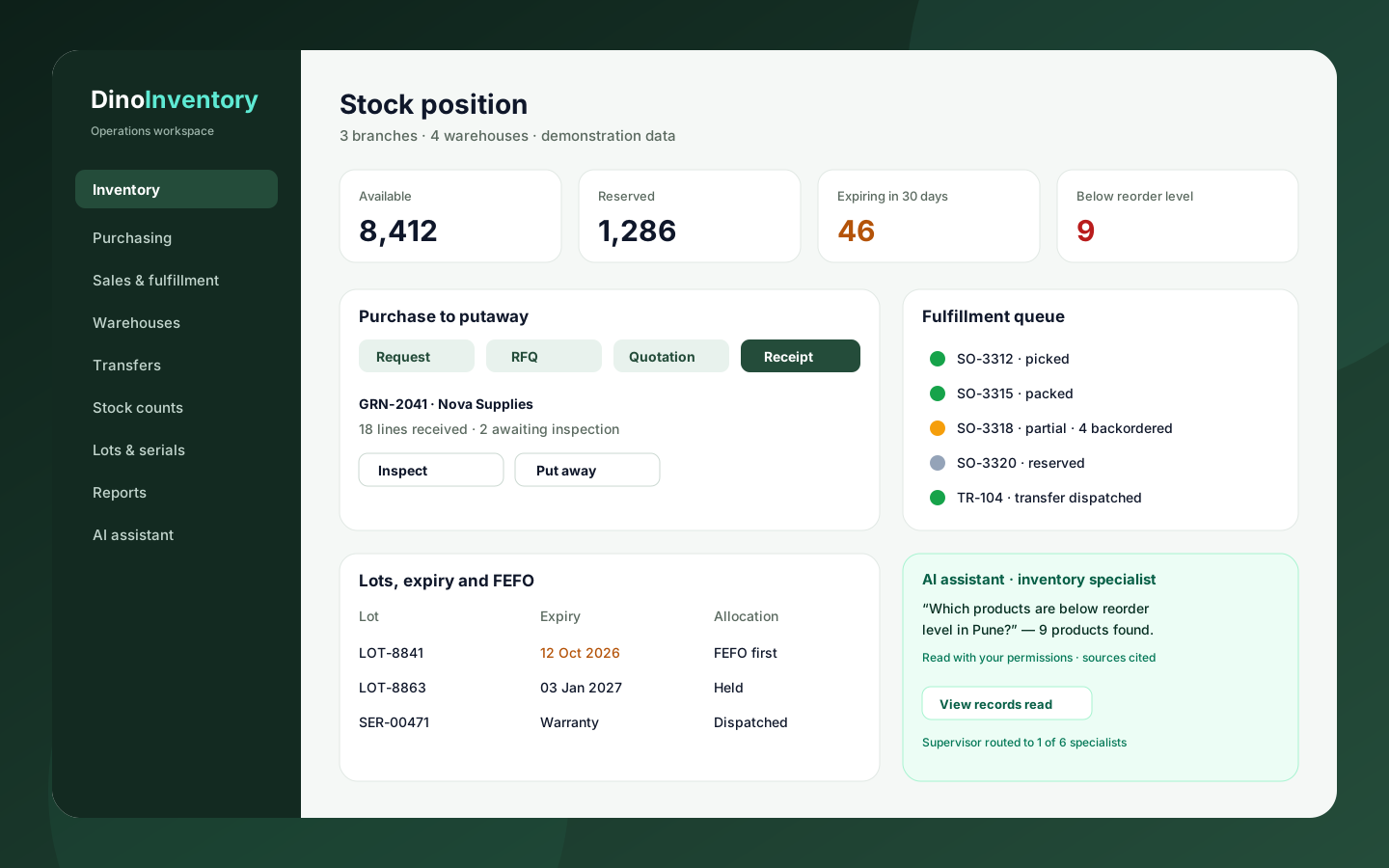
Purchase requests, approvals, RFQs, supplier quotations, orders, goods receipts, quality inspection with accepted and failed quantities, putaway and purchase returns run in one workspace.
Reservations, pick lists, packing slips, shipments and backorders record the quantities actually picked, packed and dispatched while outstanding demand stays visible on the order.
Branches, warehouses and storage locations with transfer approval, dispatch, partial receipt and discrepancy records, plus location transfers for movements inside a single warehouse.
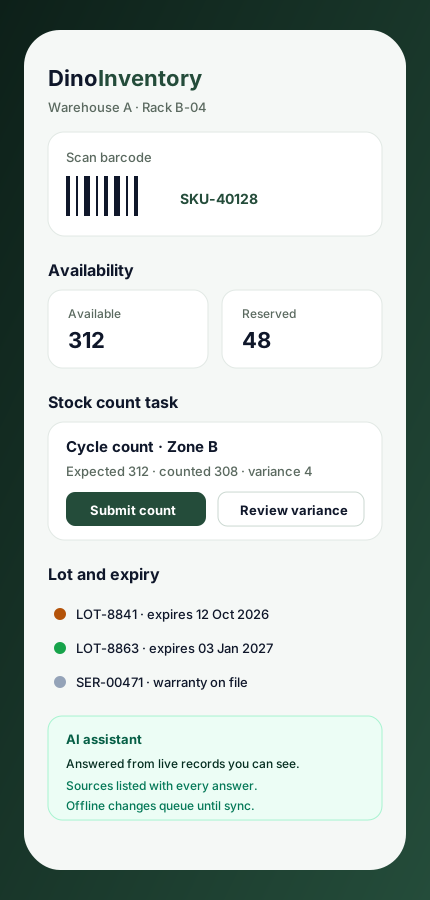
Assigned counts work against a frozen snapshot of expected quantities, giving reviewers a fixed baseline for variances before an approved posting writes the adjustment and its ledger movement.
Lot numbers and expiry dates drive FEFO allocation that skips expired and recalled stock, alongside expiry alerts, batch recalls and serial history with location and warranty reference.
A supervisor routes each question to the specialist that owns it — inventory and warehouse, procurement, sales and CRM, finance, manufacturing or policy — and each reads live records through the same API and permissions as the person asking.
Connect one provider, then assign a primary and a backup model to each capability — chat, embeddings, reranking, speech and transcription — from free and paid options listed with their pricing.
Click any image for a full-resolution preview.
Operations overview illustration, not a live screenshot. Open the live product site for current application screens.
Browser interface illustration at a mobile viewport; native Android and iOS applications are not listed as included.
End-to-end workflow across Workspace Administrator, Operations Manager, Purchasing Team, Warehouse Team, Assigned Stock Counter, Custom roles with branch and warehouse scope defined by the administrator.
Workspace Administrator, Operations Manager, Purchasing Team, Warehouse Team, Assigned Stock Counter, Custom roles with branch and warehouse scope defined by the administrator
Inventory Control, Balances & Ledger, Purchasing, RFQs, Receiving & Inspection, Sales Reservations, Picking, Packing & Shipments, Branches, Warehouses, Locations & Transfers, Stock Counts, Variances & Adjustments, Lots, Expiry, FEFO, Recalls & Serial History, Products, Suppliers, Customers & Barcode Scanning, Reports, Drilldowns & Saved Views, AI Assistant with Six Domain Specialists, AI Provider & Per-Capability Model Configuration, Notifications, Background Jobs & Offline Queue, Users, Roles, Warehouse Scope & Audit History
AI model provider connected with your own key, with models chosen per capability, Qdrant vector search for policies, procedures, product, partner and lot records, Speech and transcription model slots configured alongside chat, embeddings and reranking, Barcode scanning workflows for identifying stock inside the workspace, Event notifications and scheduled background jobs such as expiry scans, Accounting, e-commerce, carrier or ERP connections scoped separately
Live Inventory Summary by Warehouse, Inventory Ledger Movement Drilldown, Available, Reserved and In-Transit Balances, Expiry and Lot Alert Report, Backorder and Outstanding Demand Report, Warehouse Transfer and Discrepancy Report, Saved Report Views Held Against Your Account
After purchase, you receive the complete source code for the agreed project scope. Branding, basic setup, deployment and migration assistance are included as agreed. A standard branded setup is estimated at approximately 2 weeks after required assets and access are confirmed, subject to the written schedule and third-party dependencies. Three months of technical support starts on the confirmed delivery date.
TechDino provides basic migration and deployment assistance to help move the application to the customer's server, VPS, cloud hosting or supported hosting environment. This includes environment setup guidance, database migration, application build guidance and basic deployment verification.
Every TechDino project includes three months of technical support from the confirmed delivery date. This support covers installation guidance, deployment-related assistance, configuration help, clarification of the existing codebase and correction of verified issues within the delivered project scope.
Additional development, custom features and support after the included three-month period can be provided under a separate support or development agreement.
The customer receives the complete source code included in the agreed product scope. The application can be deployed under the customer's brand, domain and hosting environment. The customer can maintain, extend and customize the delivered application according to the applicable purchase or licence agreement.
Scope for Dino Inventory: Applicable source code for the operations web application, the public site it shares, the Node API service, the MySQL schema and migrations, the supervisor and six specialist agent workflows, and setup documentation included in the agreed purchase scope. Licence type: Commercial License / Software Grant.
Usage, copyright and resale termsDino Inventory is client-hosted, so each deployment can be scoped around the buyer's currency, timezone, warehouse processes, data-hosting preference and local integration requirements. These market notes describe planning considerations, not a local office or completed client claim.
Nothing ships carrying the TechDino name. Every surface a customer or staff member sees is rebranded to your business before handover, and because the source code is yours, your own team can change anything afterwards.
Toggle between our base demo branding and a customized client launch build.
Custom Corporate Palette
Client Custom Domain
Published Under Your Account
Evaluating ready-made software against custom development from scratch or recurring monthly SaaS subscriptions.
Delivery is coordinated remotely from Hyderabad. Currency, language, hosting and payment requirements are reviewed against this product’s included scope.
Scope INR billing, tax fields, gateway credentials and India hosting requirements for this product. Only the integrations listed in the agreed scope are included.
India Market DetailsReview USD/CAD billing, payment-provider eligibility and your preferred hosting country. Gateway and infrastructure choices depend on the product and agreed scope.
USA Market DetailsConfirm AED/SAR billing, language requirements, supported gateways and the exact hosting country. Arabic interfaces and new integrations are separately scoped where not included.
UAE Market DetailsReview GBP/EUR billing, payment providers, export needs and the required hosting country. Hosting alone does not establish regulatory compliance.
UK Market DetailsConfirm AUD/SGD billing, gateway availability and your required hosting country. Payment and deployment options are reviewed for the actual application.
Australia Market DetailsExplore target markets and discuss payment, tax, timezone and hosting requirements for your deployment.
Dino Inventory is an AI-native inventory operations application from TechDino for businesses that buy, store, move and ship physical stock. One workspace holds products, purchasing, sales fulfillment, branches, warehouses, storage locations, transfers, stock counts, lot and serial traceability, reporting and a multi-agent AI assistant that reads live records under the signed-in user's own permissions.
Dino Inventory is stock control across branches; Dino WMS is execution inside a warehouse. Dino Inventory starts earlier — purchase requests, RFQs and supplier quotations — and adds FEFO allocation, recalls, backorders and frozen-snapshot stock counts. Dino WMS goes deeper into the building with zones, aisles, bins, pallets, putaway strategies and 3PL workflows. Distributors running multi-branch stock choose Dino Inventory; a single large warehouse or a 3PL operator choose Dino WMS.
Dino Inventory covers four connected chains: purchasing, sales fulfillment, warehouse movement and traceability. Purchasing runs purchase requests, RFQs, supplier quotations, purchase orders, goods receipts, quality inspection, putaway and purchase returns. Fulfillment runs reservations, picking, packing, shipments and backorders. Movement covers branches, warehouses, storage locations, transfers with partial receipts and discrepancies, and assigned stock counts with variance review. Traceability covers lots, expiry, FEFO, recalls and serial history, with reports, saved views, notifications, search and audit history throughout.
A supervisor agent routes each question to one of six domain specialists — inventory and warehouse, procurement, sales and CRM, finance, manufacturing or policy — so a stock-ledger question is not answered from a picking record. Each specialist calls the same API endpoints the interface calls, and the tool calls and records it read stay visible beside the answer, so you can check the working.
No. The assistant reads each record with the signed-in user's own credentials, so role, branch and warehouse scope limit it exactly as they limit the interface. It keeps no separate copy of your operations and carries no elevated access, so an answer can only be as current and as permitted as the screen the person asking is already allowed to open.
Yes. The application models branches, warehouses and storage locations, and scopes each user's access to the ones their role covers. Stock balances stay separated by warehouse rather than pooled, and moving stock between sites runs through a transfer with approval, dispatch and receipt records. Movements inside a single warehouse are handled as location transfers.
Yes. Sales orders can reserve only the quantity available at the fulfilling warehouse, then progress through pick lists, packing slips and shipments for the quantities actually handled. Outstanding demand stays visible as a backorder instead of the order being treated as complete, and it can be reserved and shipped again once replenishment arrives. Transfers likewise record partial receipts and discrepancies.
Yes. Lot records carry lot numbers, warehouse, available quantity and expiry dates, and FEFO allocation prioritises eligible stock with the earliest expiry while excluding expired and recalled lots. Expiry alerts surface batches that need a decision, recalls are recorded against the lot, and serial records keep each unit's location, history and warranty reference for later investigation.
Whichever you connect. An operator adds their own provider key once, then chooses models per capability — chat, embeddings, reranking, speech and transcription — with a backup model for each slot, so a refusal or provider error falls through instead of failing the conversation. Free and paid models are listed with their pricing. Provider keys are encrypted before storage and shown only by their last four characters.
Yes, and queued offline changes replay when the connection returns. The application includes a scanning workspace for identifying stock by barcode and moving straight into the relevant inventory task, plus search across product, partner and lot records. When a request cannot reach the server, supported changes are queued locally and replayed after the connection returns. Replay is not automatic acceptance: each queued change still needs valid access and must pass the server's current business rules, so failures are flagged for review.
Yes, report filters and column selections save to your account. Live inventory summaries drill down into the inventory, ledger, expiry, backorder and transfer records behind each total, so a number can be followed to the rows that produced it. Expiry, backorder and transfer reports are meant for finding the records that need follow-up, and a saved view keeps its filters and selected columns for the review you run every week.
Yes. Dino Inventory can be scoped for Indian distribution, wholesale and multi-branch retail operations, including INR quotations, any GST or tax fields added as scoped work, timezone, local hosting preference and the notification or accounting integrations you need. It is delivered remotely from Hyderabad by TechDino, and the written scope confirms the configuration, the data to be imported and anything quoted separately.
Yes. UAE, Gulf and international deployments review currency, timezone, language, branch and warehouse terminology, the country the data is hosted in, and which AI provider is acceptable, before implementation. Arabic interfaces, new integrations and regulatory or accounting work are separate scope items unless the written agreement includes them. The application itself is browser-based, so distributed branches work from the same records.
Yes. TechDino applies your name, logo, colours, domain, terminology and document branding, then assists with deployment on infrastructure you control. Applicable source code for the agreed scope, the database schema and setup documentation are included, with permitted use defined in the written commercial agreement. A standard branded setup is estimated at approximately two weeks after scope, brand assets, hosting access and required provider credentials are confirmed; three months of technical support starts at delivery.
Yes. Basic setup, deployment and database migration assistance is included for moving the application to a supported hosting environment.
Three months of technical support is included from the confirmed project delivery date.
No. Hosting, domain registration, SMS, email, maps, payment gateways and other paid third-party services are separate.
Yes. New features and major customizations can be developed under a separate quotation based on the required scope.
No. Every purchase is quoted on scope: product, branding, deployment target, integrations and customisation. Share your requirement on WhatsApp or the contact form and TechDino returns a written quotation after a walkthrough.
Dino Inventory ships as a web and progressive web application. Native mobile builds are an optional add-on quoted separately, so mobile source code is delivered only when the agreed package includes it.
Source code for the agreed scope, migration assistance and three months of technical support, delivered by TechDino.
Or Chat Directly on WhatsAppTell us what you want to launch. Prepare a WhatsApp message for Nayesh. Response time depends on availability.