
Customer 360 Account Hierarchy and Recurring AMC Billing in Modern CRM
Short answer
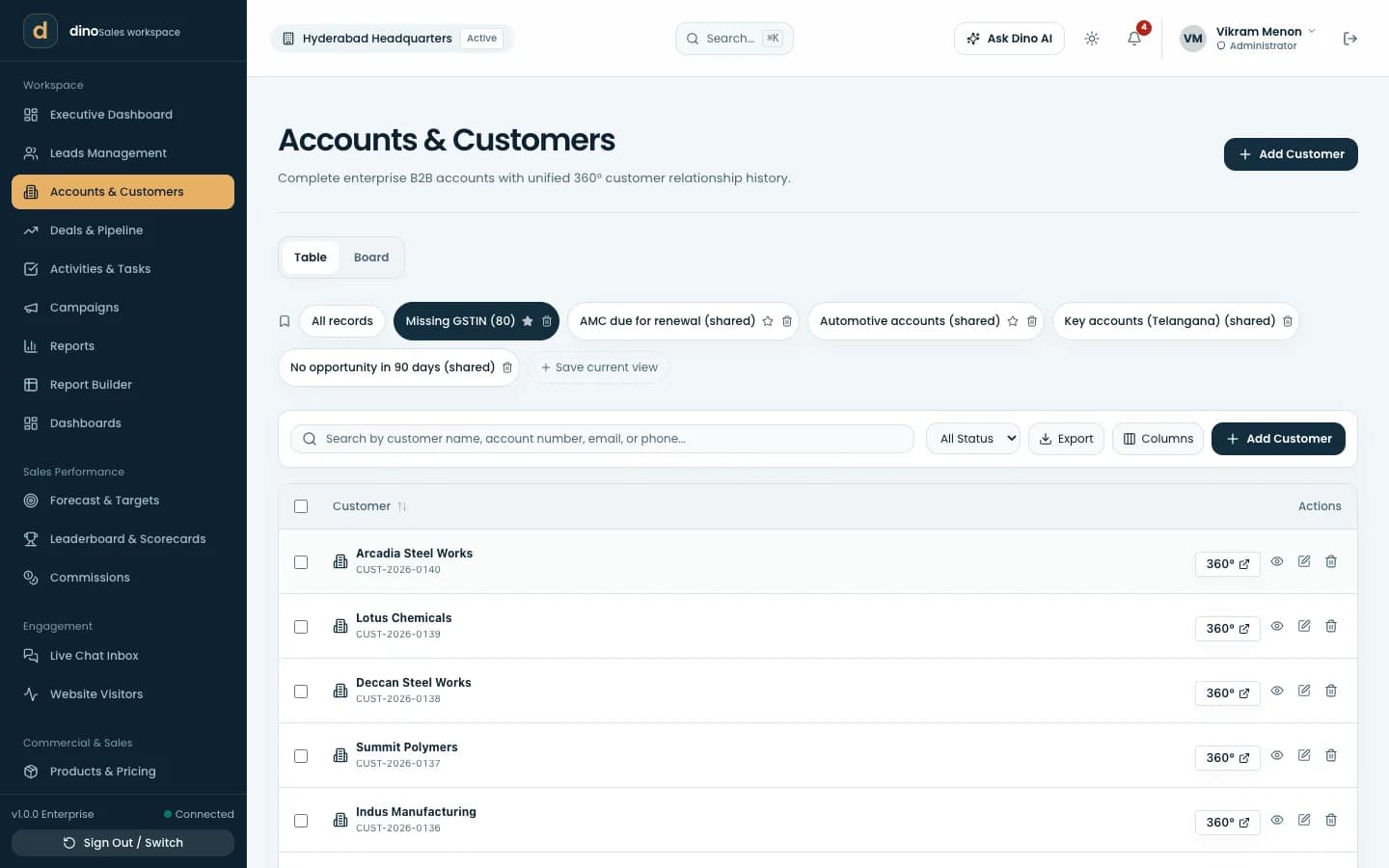
A Customer 360 account hierarchy links parent holding groups with operating subsidiaries, aggregating communication histories, contracts, service tickets, and outstanding receivables under one centralized profile. Integrating annual maintenance contract (AMC) billing into this hierarchy enables automated milestone invoicing, renewal reminder sequences, and aging ledger reconciliation across complex organizational structures.
The Complexity of Multi-Entity B2B Relationships
Enterprise B2B clients rarely operate as single isolated companies. They typically consist of holding entities, regional branches, regional subsidiaries, and decentralized procurement departments. When a CRM treats every incoming contact or branch as an unrelated company record, account managers lose visibility into cumulative buying power, active service commitments, and credit exposure.
A true Customer 360 platform establishes relational parent-child hierarchies that model real-world business structures. This unified data layer allows sales, operations, and finance teams to collaborate on expansion deals while ensuring recurring commitments—such as Annual Maintenance Contracts (AMCs)—are billed and renewed systematically.
Structuring Enterprise Parent-Child Account Hierarchies
Implementing a clean account hierarchy requires clear data separation between organizational parent entities and operational branch sites:
| Hierarchy Level | Managed Data Entities | Roll-Up Metrics |
|---|---|---|
| Parent Holding Group | Master contracts, enterprise payment terms, credit limits, executive contacts | Total contract value, cumulative receivables, group-level deal pipeline |
| Regional Subsidiary | Local procurement officers, tax registration IDs, branch office addresses | Regional revenue contribution, localized quoting history, branch SLAs |
| Operating Facilities / Sites | Field contacts, hardware asset serial numbers, maintenance schedules | Active ticket counts, site visit logs, maintenance renewal dates |
Automating Annual Maintenance Contracts (AMC) and Renewals
For equipment suppliers, industrial distributors, and software vendors, recurring maintenance contracts represent high-margin, predictable cash flow. However, managing renewals through calendar alerts or offline sheets often results in expired contracts that go unbilled.
The Automated AMC Renewal Lifecycle
- Contract Instantiation: When a primary sales order concludes, the system creates the associated AMC record with contracted coverage dates, scheduled visit milestones, and billing terms.
- Milestone Invoicing: The billing engine automatically generates periodic invoices (quarterly, biannually, or annually) with configured tax rules and sends payment notifications.
- Preventive Maintenance Scheduling: Creates automated calendar tasks and field tickets for assigned service engineers prior to scheduled inspection dates.
- Renewal Notice Sequences: Triggers automated renewal proposals 60, 30, and 15 days before contract expiration, prompting clients with pre-calculated renewal terms.
By tying maintenance contracts directly to the parent account and individual branch assets, Dino Sales CRM ensures service engineers never deliver unauthorized work to out-of-warranty accounts while safeguarding recurring subscription revenue.
Unified Interaction Timeline for Cross-Functional Visibility
When an account executive visits an enterprise client, they should immediately see recent technical support tickets, payment statuses, and logged field visits. Dino Sales CRM consolidates email exchanges, meeting transcripts, support ticket resolutions, and invoice receipts into a chronologically ordered Customer 360 activity feed.
This end-to-end transparency prevents embarrassing sales scenarios—such as pitching an expansion upsell while the customer has an open critical support escalation—and strengthens client retention.
Frequently Asked Questions
Frequently Asked Questions
Can AMC billing handle multi-tier tax structures and e-invoicing?
Yes. Dino Sales CRM supports localized sales tax, GST, VAT rules, and e-invoice IRN tracking for statutory compliance across multiple regional entities.
How does account hierarchy prevent exceeding company credit limits?
The CRM can enforce credit limit guardrails at the parent group level, blocking new quotations across all subsidiaries if unpaid invoices exceed specified thresholds.
Can service tickets be linked directly to specific contracted equipment?
Yes. Support tickets associate directly with customer asset registers, showing maintenance history and warranty coverage status during triage.
Is source code included for on-premise deployment?
Yes. TechDino licenses ready-made solutions with complete source code for the agreed scope, allowing self-hosting on private cloud servers.
Need Setup or Custom Coding?
Get in touch to rebrand or customize our ready-made products, or discuss custom development services. All quotes are customized and private.
Related Articles
Inbound Lead Scoring, Data Enrichment, and SLA Routing in B2B CRM
Discover how inbound lead scoring, firmographic enrichment, automated round-robin routing, and response SLA clocks maximize B2B sales pipeline conversion rates.
B2B Sales Quoting and Discount Approval Workflows: Architecture and Automation
Learn how to build resilient B2B sales quoting workflows with multi-currency price books, margin floor protection, multi-tier discount approvals, and instant sales order generation.