
How Real Estate Businesses Can Use AI Property Software
Short answer
AI property software lets buyers search in plain language — "quiet two-bedroom near the metro with natural light" — instead of dropdown filters, and answers routine questions about price, configuration and location automatically. For builders and brokers that means fewer hours on repeat enquiries and better-qualified site visits.
The real estate market is highly competitive. Buyers browse dozens of property websites, while agents spend hours answering basic questions about pricing, configurations, and location details. PropTech upgrades allow builders and brokers to filter leads and schedule visits automatically.
Conversational Semantic Search
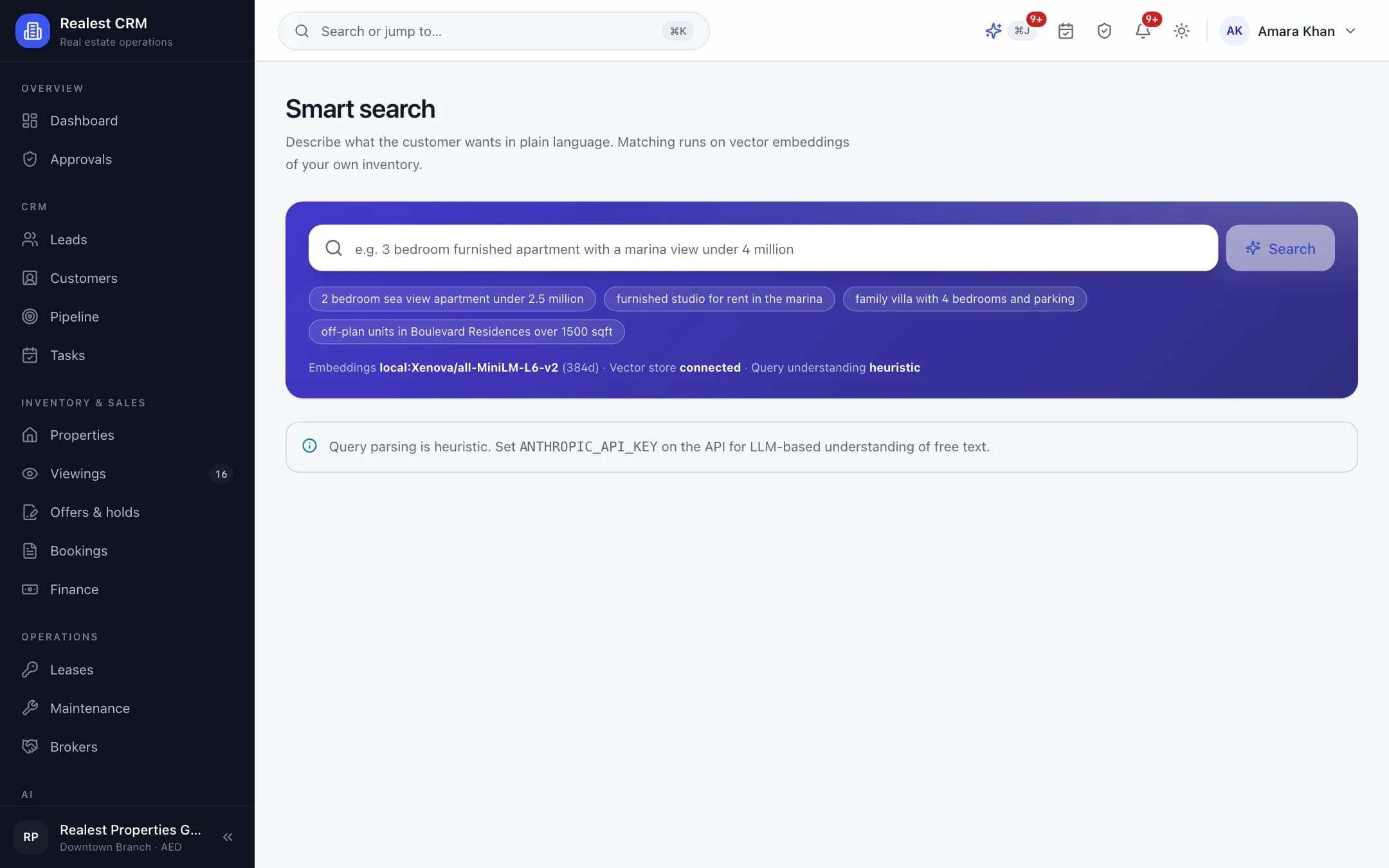
Standard property websites only allow users to filter by price or bedrooms. An AI Property Assistant allows buyers to type requirements like: 'Show me a quiet 3 BHK apartment near a park under $500k'. The AI searches listing vector databases to recommend matching properties instantly, explaining key highlights.
Seamless Site Visit Scheduling
Getting a lead is only the first step; closing requires a physical site visit. Having an integrated visit calendar allows buyers to select free slots, assign them to local agents, and receive automated WhatsApp directions and calendar invites, minimizing no-shows.
Empowering Sellers & Agents
A property marketplace must balance buyer and seller needs. With separate consoles, independent property owners and builders can upload photos, specify details, track buyer messages, and analyze views, while administrators verify listings before they go live.
If you're looking to update your property brokerage operations, inspect the live features of our PropertyApp Product Page.
Where AI Actually Helps in Real Estate
Stripped of marketing language, there are four places AI changes the economics of a property business — and a long list of places it does not:
Read the table as a sequence rather than a menu. Semantic search and enquiry qualification pay back first because they work on listings you already hold, and neither needs new data collection. Valuation guidance and demand forecasting only become trustworthy once you have several hundred closed transactions with clean prices, so most brokerages reach them in year two rather than at launch.
| Use | What changes |
|---|---|
| Natural-language search | Buyers describe what they want in a sentence; results rank by relevance instead of returning nothing on an exact-match filter |
| Automated enquiry handling | Routine questions on price, size, availability and location are answered instantly, at any hour |
| Lead qualification | Budget, timeline and intent captured in conversation, so agents call the buyers worth calling |
| Listing preparation | Draft descriptions generated from structured property data, then edited by a human |
Why Filter-Based Portals Lose Buyers
A conventional portal is a database query. Ask for a quiet two-bedroom near the metro with good light under a set budget and it returns nothing, because "quiet" and "good light" are not columns. The buyer assumes nothing matches and leaves. Relevance ranking returns the closest options instead of an empty page — which is the difference between a lead and a bounce.
The deeper problem is that filters force a buyer to translate a lifestyle question into database fields. Someone who wants a quiet two-bedroom within walking distance of a metro station and a decent school has to guess a locality, a budget band and a BHK count, then repeat the guess when the results disappoint. Semantic matching keeps the original sentence and ranks against it, so the buyer edits intent instead of re-guessing parameters.
What to Put in Place First
- Clean structured listing data. AI ranking is only as good as the property records underneath it.
- Complete photos and accurate locations — incomplete listings rank badly however smart the search is.
- A defined handoff point where the system stops and a human agent takes over.
- Honest labelling of automated replies. Buyers dislike discovering they were talking to software about a large purchase.
- Response-time and conversion tracking, so you can tell whether any of it worked.
See PropertyApp for a ready-made implementation, and RAG chatbot development for how enquiry answering is grounded in your actual listing data rather than generic knowledge.
Frequently Asked Questions
How does AI help a real estate business?
In four concrete places: natural-language property search, instant answers to routine buyer enquiries, lead qualification that captures budget and timeline before an agent calls, and drafting listing descriptions from structured data. The rest is largely marketing.
What is AI property search?
Search that understands a buyer's sentence rather than requiring dropdown filters. Instead of returning nothing when no listing matches exactly, it ranks the closest options by relevance — which keeps the buyer on the site instead of bouncing off an empty result page.
Will AI replace real estate agents?
No. It removes the repetitive front end — answering the same questions and filtering unqualified enquiries. Negotiation, site visits, local judgement and closing remain human work, and those are where the commission is earned.
What data do I need before adding AI to a property portal?
Clean, structured listings with complete photos, accurate locations and consistent attributes. Ranking and automated answers are built on that data — poor listing quality produces poor results regardless of the model used.
Should buyers be told they are talking to AI?
Yes. Property is a high-value, high-trust purchase, and buyers react badly to discovering the disclosure was hidden. Label automated replies clearly and define the point at which a human agent takes over.
Explore Next
- See our AI property marketplace software
- Learn about our RAG chatbot development
Need Setup or Custom Coding?
Get in touch to rebrand or customize our ready-made products, or discuss custom development services. All quotes are customized and private.
Related Articles
AI Property Marketplace Software: Integrating Intelligent Search, Valuation, and Lead Matching
How real estate portals leverage conversational AI agents, algorithmic property valuation, and semantic search to connect buyers and brokers faster.
How AI Agents Can Help Small Businesses
Learn how small business owners can leverage custom AI agents and copilots to automate customer support, qualify leads, and manage data entry.