
How to Automate Inbound Lead Qualification with Conversational AI Agents
Short answer
Automating inbound lead qualification with conversational AI agents replaces static contact forms with intelligent 24/7 interactive dialogues. AI agents ask contextual qualifying questions, evaluate prospect requirements against your service criteria, calculate lead scores, verify budget and timeline fit, and directly schedule sales calls in your team's calendar while logging structured data into your CRM.
Static web contact forms suffer from high abandonment rates and produce low-context inquiries that require hours of manual sales triage. When high-value commercial prospects land on your website, they expect immediate technical answers and real-time validation of their project scope rather than waiting days for an email reply.
How Conversational AI Qualification Works
An autonomous qualification agent operates beyond basic pre-scripted decision trees by utilizing Retrieval-Augmented Generation (RAG) and structured function calling:
- Contextual Technical Q&A: The agent references your private service documentation, past case studies, and technology stacks to answer complex prospect questions accurately.
- Dynamic BANT Qualification: Intelligently assesses Budget, Authority, Need, and Timeline through natural conversational prompts rather than rigid form fields.
- Real-Time CRM & Webhook Sync: Qualified prospect profiles, requirements summaries, and conversation transcripts are automatically pushed to HubSpot, Salesforce, or custom SQL databases.
- Automated Calendar Booking: Embeds instant scheduling links to book meetings directly with your technical lead when qualification thresholds are satisfied.
Static Web Forms vs Autonomous AI Qualification Agents
| Metric | Autonomous AI Agent | Static Contact Form |
|---|---|---|
| Prospect Response Time | Responds within the chat session, at any hour | Depends on staff availability and email turnaround |
| Engagement & Completion Rate | Completion depends on workflow; measure your own baseline | Conversion depends on traffic and form design; measure confirmed enquiries |
| Data Quality & Context | Rich conversational needs analysis | Minimal 2-sentence generic description |
| Meeting Scheduling | Direct in-chat calendar booking | Friction-heavy back-and-forth emails |
Forms also select for the wrong visitors. A long form filters out everyone unwilling to type their budget into eight fields, which includes plenty of serious buyers who simply wanted one question answered first. A conversational agent inverts the order — answer the question, then qualify — which is why it typically collects more complete information from more people.
Explore our dedicated AI Agent Development Services and RAG Chatbot Engineering to implement private, enterprise-grade AI assistants on your cloud infrastructure.
Architecture of an Enterprise AI Sales Agent
A robust sales AI agent pipeline consists of three core components: an LLM reasoning model (such as Claude 3.5 Sonnet or GPT-4o), a vector database (PostgreSQL with pgvector) indexing company offerings, and structured tool-calling functions to validate emails, check calendar availability, and dispatch CRM webhooks.
Constrain the agent to a fixed set of questions and a fixed output shape. A qualification agent that free-forms its way through a conversation produces leads your CRM cannot sort, while one that must fill budget, timeline, use case and contact fields before handing off produces a record a salesperson can act on. The conversation can be flexible; the output should not be.
Lead Scoring and Routing Logic
The AI agent assigns automated numeric lead scores based on budget thresholds and urgent deployment timelines. High-intent enterprise prospects are instantly routed to high-priority calendar links, while exploratory inquiries are sent comprehensive whitepapers and product catalogues.
Keep scoring rules visible to the sales team and reviewable monthly. An opaque score is ignored the first time it ranks a bad lead highly, and trust never returns. Publishing the weights — budget band, stated timeline, company size, product fit — lets the team argue with them, and those arguments are usually the fastest route to a model that reflects how deals actually close.
Frequently Asked Questions
Deploying AI Qualification for Your Pipeline
Stop losing qualified inbound leads to slow response times. Contact TechDino to scope a custom conversational AI qualification workflow tailored to your product or service catalogue.
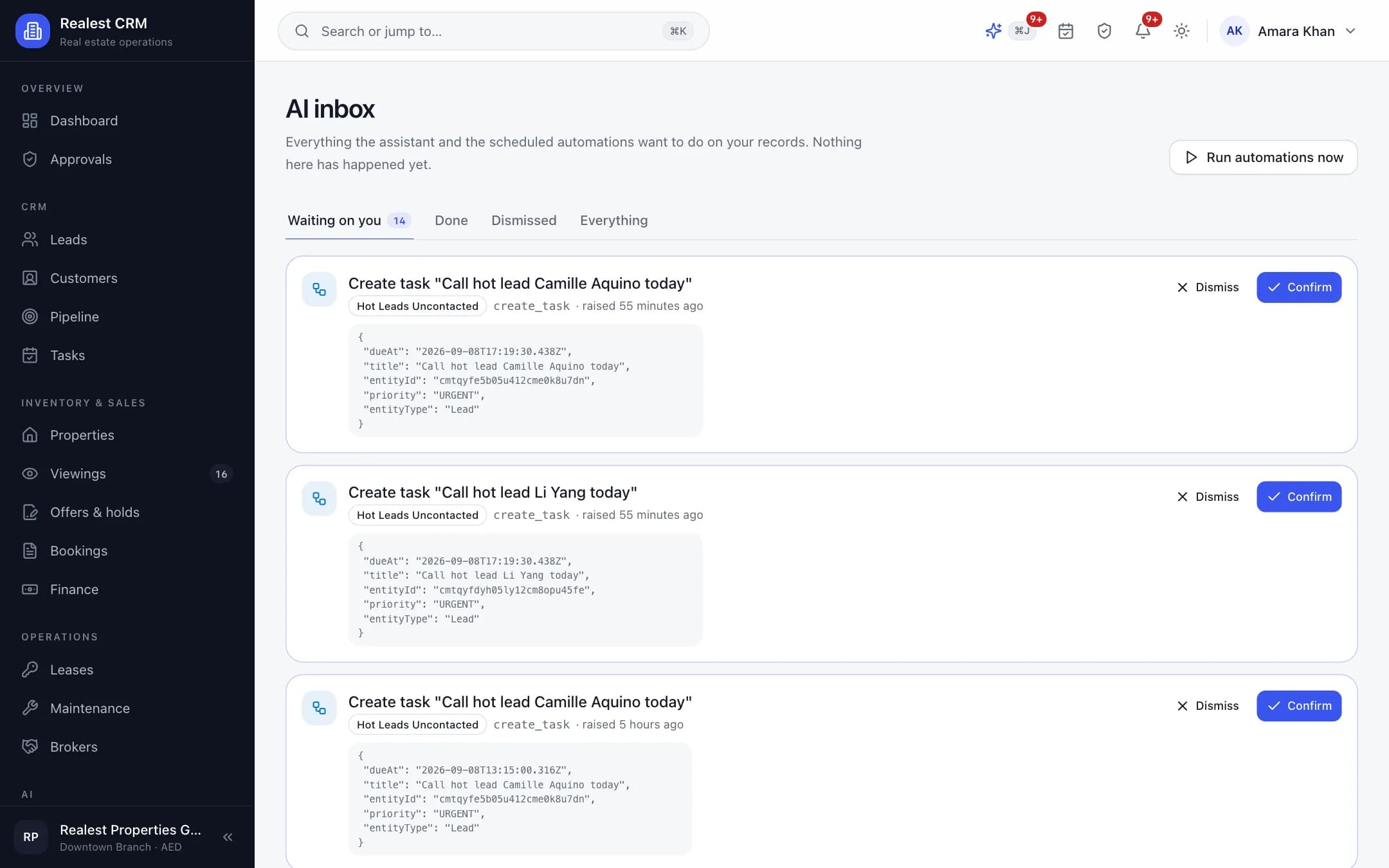
Realest CRM applies this pattern to property enquiries, and Dino Business OS applies it across the sales pipeline — both self-hosted, with the agent logic included in the source code.
Frequently Asked Questions
How does the AI agent prevent hallucinations about pricing and capabilities?
Prompts and retrieval do not establish factual accuracy. Use permission-filtered retrieval, source checks, exact database lookups for prices, missing-evidence refusal and human escalation. Evaluate unsupported, stale and conflicting facts before deployment.
Can the AI agent qualify leads across multiple channels like WhatsApp and Web Chat?
Yes. The backend architecture supports omnichannel deployment, integrating seamlessly with your website widget, WhatsApp Business API, and CRM portals.
Where is customer conversation data stored?
All chat transcripts, lead contact details, and embeddings reside in your client-controlled PostgreSQL database with full data encryption.
What happens when a prospect asks an out-of-scope question?
The agent gracefully handles edge cases by clarifying the inquiry and seamlessly escalating the conversation to a human specialist with full chat history attached.
Need Setup or Custom Coding?
Get in touch to rebrand or customize our ready-made products, or discuss custom development services. All quotes are customized and private.
Related Articles
AI Property Marketplace Software: Integrating Intelligent Search, Valuation, and Lead Matching
How real estate portals leverage conversational AI agents, algorithmic property valuation, and semantic search to connect buyers and brokers faster.
Deploying Enterprise RAG on Private Business Documents: Architecture, Vector Databases, and Guardrails
A technical blueprint for deploying enterprise Retrieval-Augmented Generation on private internal documents with pgvector, hybrid search, and hallucination guardrails.