
Southeast Asia HRMS & Payroll: Eliminating Per-Seat Cloud SaaS Fees Across Singapore and Malaysia
Short answer
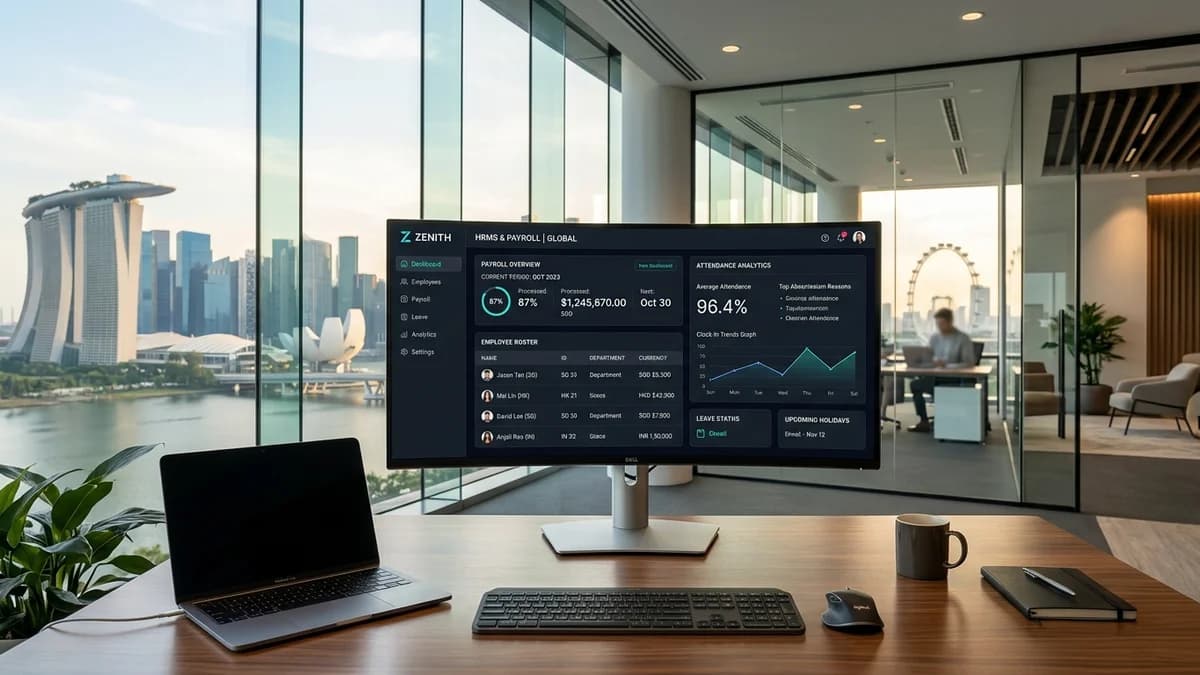
Mid-sized enterprises in Singapore and Southeast Asia frequently pay 6 to 14 USD monthly per employee for cloud HRMS subscriptions. Deploying a self-hosted HRMS on private servers eliminates recurring seat fees while automating statutory compliance for Singapore CPF and IRAS AIS, alongside Malaysian PCB tax rules, under an owned database model.
The Financial Model of Per-Employee SaaS in Southeast Asia
Regional enterprises operating across Singapore, Malaysia, and Indonesia face compounding software licensing costs as headcounts expand. Commercial cloud human resource management systems (HRMS) enforce monthly per-employee pricing structures typically ranging from $8 to $14 USD per user. For an organization scaling from 150 to 350 team members across retail, logistics, or engineering divisions, annual software expenses escalate from $18,000 USD to over $45,000 USD without adding core operational features.
Self-hosted HRMS software deployed on private cloud virtual machines shifts this cost curve to a fixed infrastructure model. A single-tenant installation hosted on an AWS Singapore or local regional instance costs under $60 USD monthly in raw compute and storage, decoupling headcount growth from enterprise software licensing.
| Cost Component | Multi-Tenant Cloud SaaS (300 Staff) | Self-Hosted Dino HRMS (Flat Deployment) | 3-Year Cumulative Savings |
|---|---|---|---|
| Monthly Software Fee | $3,000 – $4,200 USD ($10–$14/seat) | $0 USD (Perpetual License) | $108,000 – $151,200 USD Saved |
| Cloud Hosting & Database | Included in vendor mark-up | $45 – $75 USD/month (AWS / VPS) | $1,620 – $2,700 USD Invested |
| Annual Statutory Updates | Included with vendor roadmap delays | Handled internally or via maintenance | Immediate rule adjustment |
| Employee Records Custody | Shared multi-tenant vendor cloud | 100% Private dedicated database | Complete data sovereignty |
| 3-Year Total Cost of Ownership | $115,000 – $162,000 USD | $14,500 – $19,500 USD (All inclusive) | $95,500 – $142,500 USD (85% reduction) |
Navigating Singapore CPF, IRAS AIS, and Malaysian Statutory Rules
Statutory payroll calculation in Southeast Asia demands localized compliance logic that generic global software rarely handles accurately. In Singapore, payroll engines must automate tiered Central Provident Fund (CPF) contributions based on employee residency status, age thresholds, and ordinary wage ceilings, alongside Skills Development Levy (SDL) and ethnic self-help fund deductions (CDAC, MBMF, SINDA, ECF).
Furthermore, the Singapore Inland Revenue Authority (IRAS) Auto-Inclusion Scheme (AIS) requires generating formatted XML files for Form IR8A and Appendix 8A every tax season. In Malaysia, the payroll module must calculate Inland Revenue Board (LHDN) Monthly Tax Deductions (Potongan Cukai Bulanan - PCB), Employees Provident Fund (KWSP/EPF), Social Security (PERKESO/SOCSO), and Employment Insurance System (EIS) contributions.
- Automated IRAS AIS export: Direct generation of validated electronic tax filings for Singapore employees.
- Tiered CPF computation: Age-based statutory rate adjustments and additional wage cap monitoring.
- Malaysian statutory schedules: Real-time calculation of PCB formulas, EPF statutory tiers, and SOCSO categories.
- Indonesian BPJS & PPh 21: Flexible tax withholding calculations for multi-regional corporate branches.
- Direct banking integration: Formatted electronic bank text files for GIRO, FAST, PayNow Corporate, and DuitNow payroll batches.
Private Data Residency and Multi-Currency Financial Controls
Under the Singapore Personal Data Protection Act (PDPA) and regional banking standards, storing unencrypted employee records, national registration identities (NRIC/FIN), and bank routing numbers on offshore third-party servers presents compliance exposure. Self-hosting Dino HRMS inside an AWS Singapore (ap-southeast-1) virtual private cloud ensures sensitive wage data remains strictly within corporate jurisdictional control.
Multi-currency ledger functionality allows regional corporations headquartered in Singapore to manage cross-border teams with payouts configured in SGD, MYR, IDR, or USD, reconciling currency exchange rates at each month-end close directly against central accounting software.
Frequently Asked Questions
Frequently Asked Questions
Does Dino HRMS support Singapore IRAS Auto-Inclusion Scheme (AIS) filings?
Yes. Dino HRMS includes automated export utilities that generate validated IR8A and Appendix 8A tax files matching IRAS format specifications for annual electronic submission.
Can the system process multi-country payroll for cross-border Southeast Asian teams?
Yes. The platform supports multi-entity corporate structures with independent statutory calculation profiles for Singapore (CPF, SDL), Malaysia (PCB, EPF, SOCSO), and regional entities in SGD, MYR, and USD.
Where is employee payroll and attendance data stored?
All records reside entirely in your designated private database (such as PostgreSQL or MySQL) on your own cloud virtual server, ensuring full data sovereignty under regional data protection laws.
Explore Next
- See our Dino HRMS enterprise software
- Learn about our white-label software development
Need Setup or Custom Coding?
Get in touch to rebrand or customize our ready-made products, or discuss custom development services. All quotes are customized and private.
Related Articles
Qatar & UAE Enterprise Operations: Reducing Asset Tracking Expenses with Self-Hosted Software
Eliminate recurring per-asset cloud software fees in Qatar and the UAE. Manage IAS 16 depreciation, QR audits, and facilities on private cloud servers.
Saudi & UAE WMS: Meeting ZATCA Phase 2 E-Invoicing Without Multi-Tenant SaaS Overhead
Wholesalers and 3PL providers in Riyadh and Dubai need WMS platforms compliant with ZATCA Phase 2 and FTA e-invoicing. Self-hosted WMS delivers barcode dispatch and cryptographic invoice signing.