
Answer Engine Optimization (AEO): Formatting Content for Conversational Search
Short answer
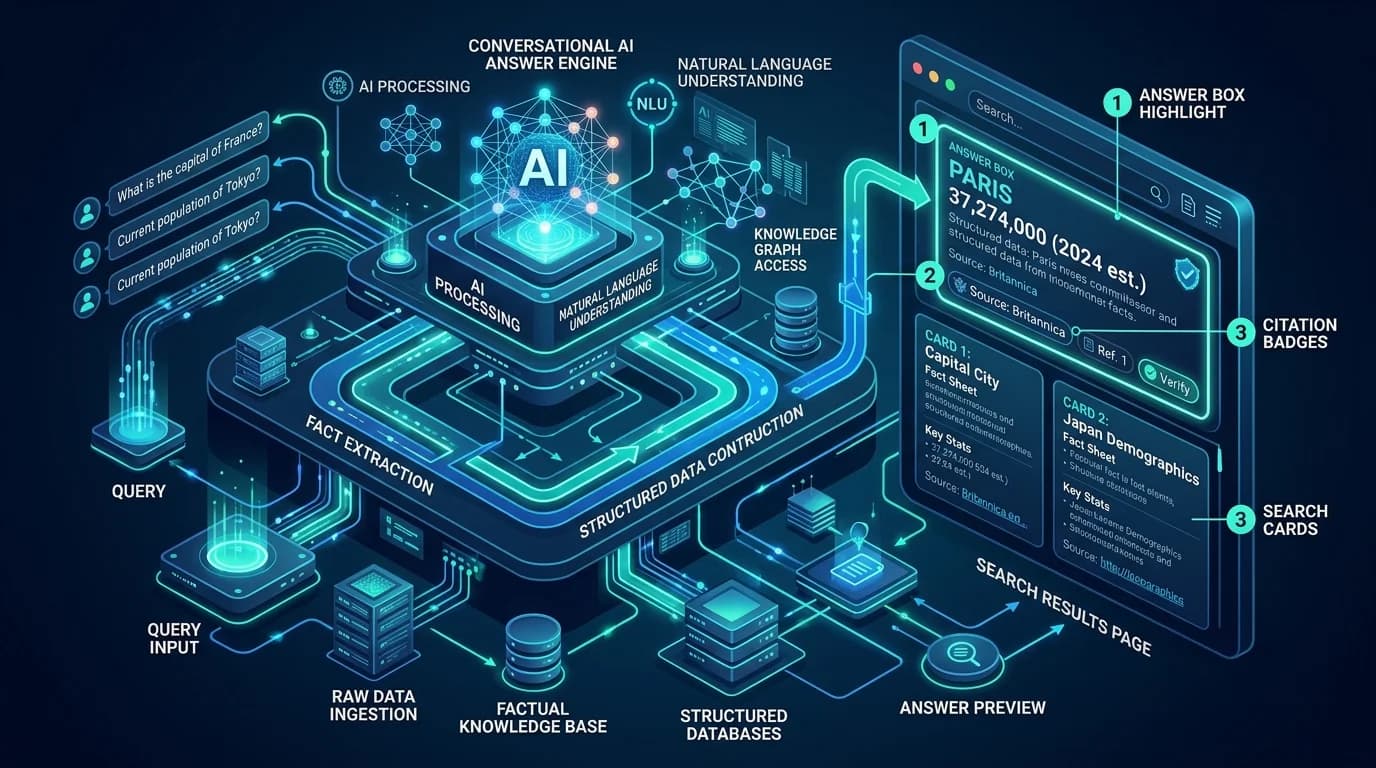
Answer Engine Optimization (AEO) formats web content so artificial intelligence assistants like ChatGPT, Perplexity, Claude, and Google AI Overviews can extract concise answers to user queries. AEO relies on answer-first introductory summaries of forty to seventy words, strict semantic heading trees, FAQPage schema markup, and fact-dense tables that allow AI engines to quote direct answers without parsing long narratives.
How Answer Engines Select Quotable Sources
Answer engines function fundamentally differently from classic ten-blue-link search result pages. When a user asks an informational or commercial question, conversational models like Perplexity, ChatGPT Search, and Gemini do not send the user to scan multiple articles. Instead, the model summarizes the consensus answer in real-time, displaying footnotes and citations to the primary web documents that supplied the factual statements.
To be selected as a citation, your document must pass a strict citability threshold: it must contain direct answers situated immediately under clear question headings, supported by verifiable data points and unambiguous semantic markup.
The 40 to 70 Word Direct Answer Formula
Answer extraction algorithms favor concise answer paragraphs positioned directly beneath primary topic headers. If an article forces an LLM to parse 800 words of background history before answering the core query, the retrieval engine will favor a competing page that provides an immediate, standalone 40 to 70 word definition.
This pattern mirrors how human subject-matter experts communicate in technical documentation. By resolving the query first, you establish immediate credibility for human readers while providing embedding models with an ideal chunk size for vector storage and semantic retrieval.
Structuring Question Headings and Conversational Intent
Conversational search users formulate full queries rather than brief keyword fragments. Organizing subheadings around natural inquiries such as 'How does licensing differ from subscriptions?' or 'What are the technical hardware prerequisites?' enables semantic parsers to align user prompts directly with your section answers.
Structured Data and Comparative Matrices for AEO
Beyond paragraph summaries, answer engines heavily index markdown tables and structured FAQ schemas. Comparing software options or technical architectures within clean markdown tables provides high-confidence tokens for AI reasoning engines:
| AEO Component | Primary Function | Implementation Standard |
|---|---|---|
| Answer-First Box | Direct citation candidate for top answer snippet | 40–70 word self-contained paragraph directly below H1 |
| Semantic H2/H3 Questions | Matches user conversational query phrasing | Target natural language search prompts and intent |
| Comparison Tables | Enables LLMs to extract feature matrices | Clean Markdown table structure with explicit column headers |
| FAQPage Schema | Provides machine-verifiable Q&A pairs in JSON-LD | Full schema.org compliance embedded in server-side HTML |
Frequently Asked Questions About AEO
Frequently Asked Questions
What is the primary difference between SEO and AEO?
Traditional SEO targets ranking high on search engine results pages to generate organic clicks. AEO formats information so conversational AI engines extract and cite your content directly in synthesized responses.
How long should an AEO answer box be?
An effective AEO direct answer contains between 40 and 70 words. This provides sufficient technical depth while remaining concise enough for an AI model to quote without truncation.
Do tables and bullet points help Answer Engine Optimization?
Yes. Structured tables, bulleted lists, and step-by-step procedures give AI engines structured tokens that can be mapped directly into user query answers with high semantic confidence.
Can AEO drive qualified business inquiries?
Yes. Answer engine citations operate as high-intent recommendations. Users who click through from an AI summary have already validated their interest and seek implementation details.
Need Setup or Custom Coding?
Get in touch to rebrand or customize our ready-made products, or discuss custom development services. All quotes are customized and private.
Related Articles
LLM-First SEO: How to Rank in Modern Search and AI Retrieval Engines
A technical guide to LLM-first SEO: structuring web applications for dual discovery across search engine crawlers and large language model ingestion pipelines.
Generative Engine Optimization (GEO): Citations, Entities, and Knowledge Graphs
Understand Generative Engine Optimization (GEO) principles: establishing entity authority, knowledge graph connections, and high-frequency citations in generative AI models.