
Generative Engine Optimization (GEO): Citations, Entities, and Knowledge Graphs
Short answer
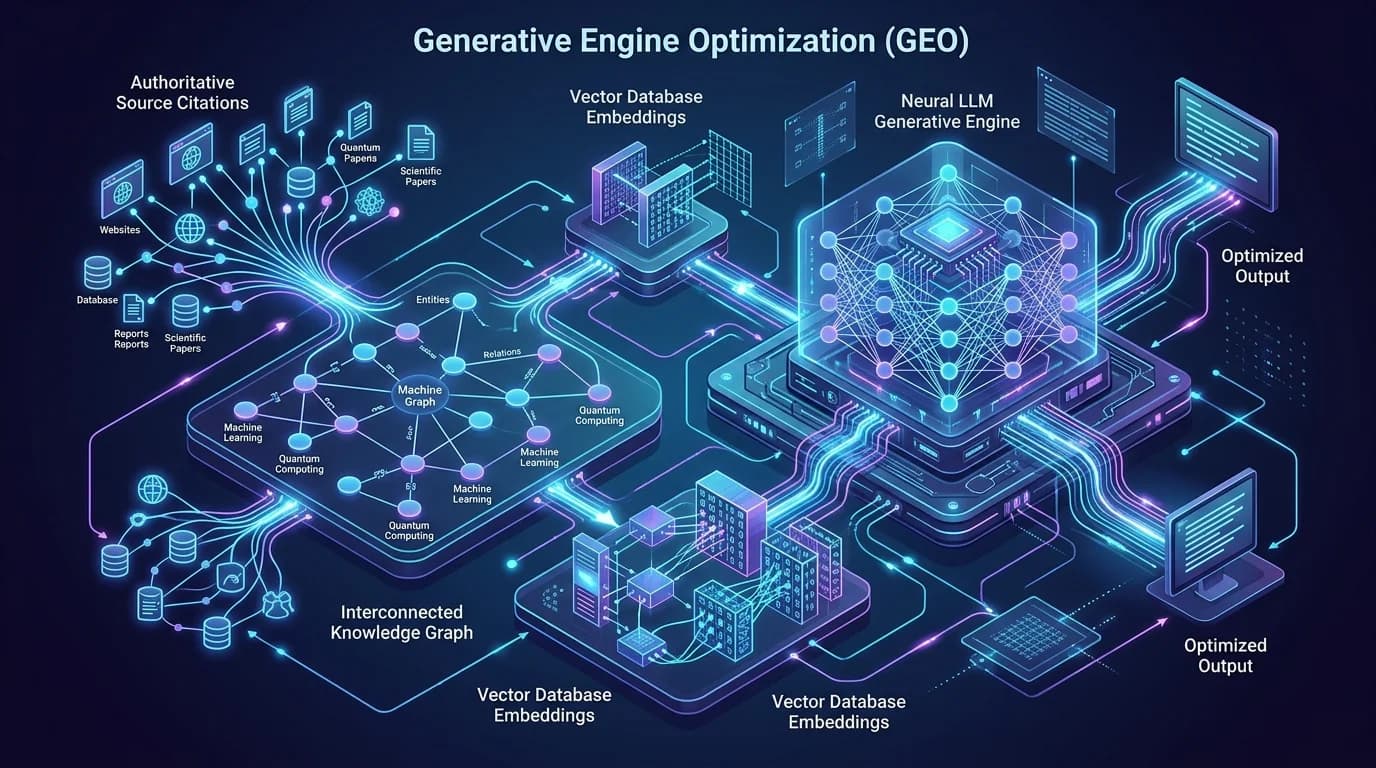
Generative Engine Optimization (GEO) organizes a website's entity architecture and statistical facts so generative AI engines recommend and cite the brand in synthetic responses. GEO moves beyond basic keyword matching by reinforcing knowledge graph relations, structured numerical benchmarks, author attribution, and third-party citation consistency, establishing authoritative topical authority across vector retrieval systems and generative models.
What Is Generative Engine Optimization?
Generative Engine Optimization (GEO) represents the next frontier beyond traditional keyword ranking and answer-box extraction. When users interact with multimodal foundational models, the AI does not simply look up an isolated sentence; it references an internal parametric knowledge graph augmented by dynamic retrieval.
GEO focuses on making your brand, software solutions, and technical frameworks canonical entities within the training datasets and retrieval indices that power generative AI.
The Three Tenets of High-Authority GEO
Academic research into Generative Engine Optimization highlights three foundational techniques that increase source attribution rates in generative search engines:
- Cite Sources and Statistical Quotations: Articles that cite empirical figures, verifiable industry benchmarks, and concrete data points achieve significantly higher recommendation frequency in AI generation.
- Entity Density and Disambiguation: Establishing clear schema linkages (such as sameAs links to Wikidata, GitHub, and professional profiles) connects web content to established global entity databases.
- Fluency and Semantic Authority: Writing authoritative, jargon-free technical guides that answer multi-step enterprise workflows establishes topical authority in the model's vector space.
GEO Performance Matrix: Optimization Strategies
| Strategy Dimension | Tactical Execution | Impact on Generative AI Output |
|---|---|---|
| Statistical Backing | Include exact percentages, costs, latency numbers, and deployment times | Increases model confidence and reduces hallucination risk |
| Entity Association | Define explicit relationships between software modules and business roles | Ensures brand inclusion in category-wide recommendation prompts |
| Author E-E-A-T | Single canonical Person node with verified credentials and public profiles | Reinforces source trust score during RAG reranking passes |
| Citation Quotability | Write standalone, fact-dense statements with zero promotional fluff | Allows clean extractive summarization in generated synthesis |
Building Enterprise Knowledge Graphs and Entity Maps
Every software platform or enterprise service should be defined in linked data as a discrete entity. Linking parent organizations, founder identity profiles, product capabilities, and technical documentation creates a connected semantic web that AI models can traverse without ambiguity.
When web properties reinforce entity relationships across multiple digital surfaces—including repository metadata, developer documentation, and public structured data—generative models recognize the brand as an authentic topic authority rather than an isolated commercial brochure.
Frequently Asked Questions About Generative Engine Optimization
Frequently Asked Questions
How does GEO differ from traditional SEO?
Traditional SEO optimizes for crawler indexes and SERP clicks. GEO optimizes for brand inclusion, entity authority, and citation frequency within generative responses synthesized by AI models.
What types of content get cited most by generative AI engines?
Generative engines cite factual content backed by technical benchmarks, verified statistics, clear comparison matrices, and unambiguous semantic markup with explicit author attribution.
Can you track traffic originating from generative AI search engines?
Yes. Web analytics can monitor incoming referral headers and UTM parameters from platforms like ChatGPT, Perplexity, Claude, and Gemini to quantify GEO traffic attribution.
Does entity disambiguation require external knowledge bases?
Yes. Connecting internal schemas to external identifiers like GitHub profiles, Wikidata entities, and official registry entries validates your entity claims against global knowledge bases.
Need Setup or Custom Coding?
Get in touch to rebrand or customize our ready-made products, or discuss custom development services. All quotes are customized and private.
Related Articles
Generative Engine Optimization (GEO): Technical Architecture for AI Search Engines
Learn how Generative Engine Optimization (GEO) structures content, JSON-LD schemas, and citability for Perplexity, ChatGPT Search, Claude, and Gemini.
Answer Engine Optimization (AEO): Formatting Content for Conversational Search
Discover Answer Engine Optimization (AEO) strategies to position your business as the cited answer in ChatGPT, Perplexity, Claude, and Google AI Overviews.