
B2B Wholesale Ecommerce Platforms: Bulk Invoicing, Tiered Pricing, and Credit Terms
Short answer
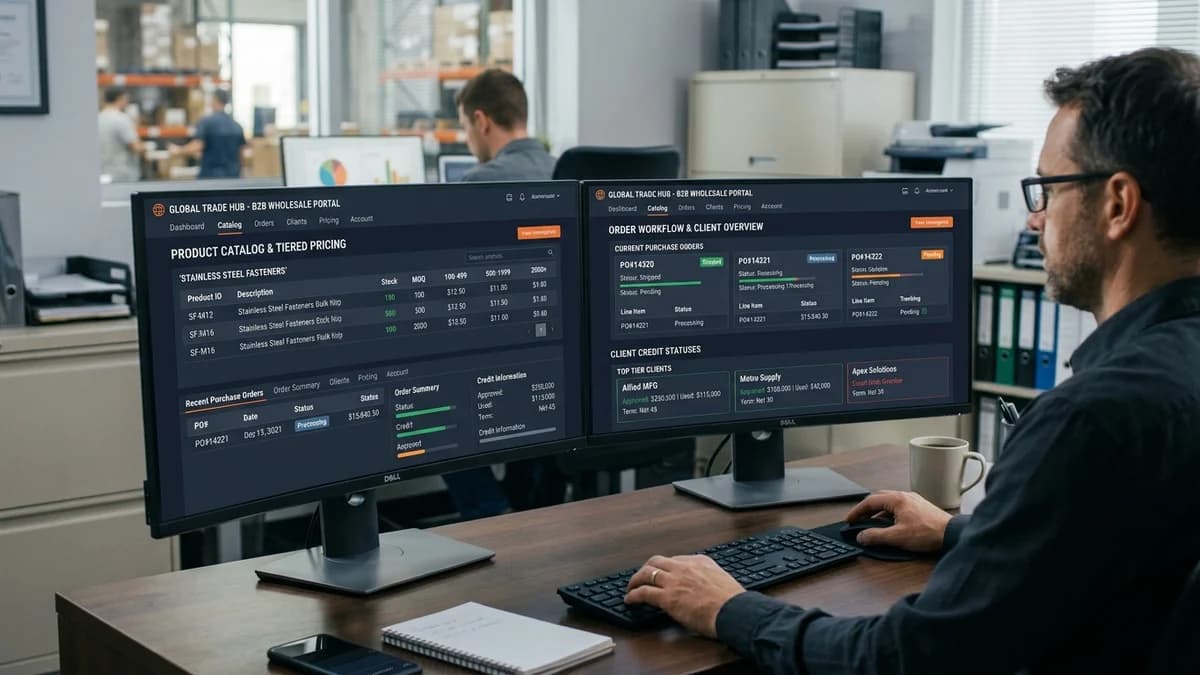
B2B wholesale ecommerce platforms cater to trade purchasers rather than standard retail shoppers. Key capabilities include account-level wholesale pricing tiers, minimum order quantities (MOQs), net-30 credit terms, and draft quotation approvals. Unlike consumer storefronts, B2B portals handle complex multi-currency tax exemptions, bulk SKU uploads, and commercial invoice generation directly from the administrative order pipeline.
Software discussed: DinoCommerce · Try the live demo
Applying standard consumer retail ecommerce software to wholesale commercial trade operations creates severe operational bottlenecks. Wholesale purchasers do not pay via credit card for individual retail units; they negotiate contract-specific pricing tiers, purchase in pallet quantities, and require formalized commercial credit terms.
Architectural Essentials for B2B Trade Portals
A commercial B2B ecommerce platform supports intricate transactional workflows across the buyer lifecycle:
Account structure is the foundation everything else sits on. A B2B buyer is an organisation with several users, different permissions and often multiple delivery addresses, so the portal must separate the company account from the people who order on its behalf. Consumer platforms model one user as one customer, and that assumption is what breaks first when a purchasing team logs in.
- Account-Specific Price Catalogs: Different corporate buyers see custom pre-negotiated discount rates on identical SKUs upon logging in.
- Minimum Order Quantities (MOQ) & Increments: Enforces bulk volume constraints (e.g., must order in multiples of 50 or meet a minimum $1,000 order total).
- Trade Credit Terms & Invoicing: Verified trade accounts checkout using Net 30 or Net 60 payment terms against an approved credit limit balance.
- Bulk CSV & Matrix Quick Orders: Enterprise buyers order hundreds of variant combinations (colors, sizes, voltage) simultaneously using matrix entry grids.
- Quote Request & Negotiation Workflow: Buyers assemble custom carts and submit them for bespoke sales team discount approval before payment commitment.
B2B Wholesale Portal vs Consumer B2C Storefronts
| Operational Factor | Dedicated B2B Wholesale Portal | Standard Consumer B2C Storefront |
|---|---|---|
| Catalog Visibility | Protected behind trade account verification login | Publicly visible to all web search visitors |
| Pricing Model | Negotiated account tiers and volume discount ladders | Single static retail price for all shoppers |
| Checkout Workflow | Purchase orders, trade credit, wire transfer, net terms | Immediate retail credit card or mobile wallet payment |
| Order Volumes | Bulk cases, cartons, and pallet packaging units | Individual retail pieces and single consumer units |
| Tax & Invoicing | Tax exemption certificates, GST/VAT reverse-charge | Standard consumer sales tax calculated at point of sale |
The deepest difference is that price is not a property of the product. In B2B the same SKU carries a different rate per buyer, per slab and per contract period, so the catalogue must resolve a price at render time against the signed-in account. Retrofitting that onto a B2C platform usually means overriding the cart at checkout, which is where tax, discount and credit logic then quietly disagree.
Explore our ready-made DinoCommerce Multi-Vendor Engine and ClothCart D2C/Wholesale Platform for enterprise commerce.
Credit Management and Risk Mitigation
Extending trade credit without rigorous software enforcement creates cash-flow vulnerabilities. The platform tracks credit limits, outstanding balances, and aging receivables in real time. When an overdue invoice exceeds configured grace thresholds, automated system locks pause new credit orders until past-due balances are reconciled.
Credit control belongs in the order flow rather than in a monthly report. A portal that checks outstanding balance and credit limit before accepting an order prevents the exposure; one that flags it afterwards leaves the collections team negotiating with a customer who already has the goods. Ageing buckets, blocked-account rules and a documented override path are the three pieces that make this workable without stalling genuine orders.
Frequently Asked Questions
Scale Your Wholesale Trade Distribution
Streamline bulk ordering and enhance corporate customer relationships. Discover the TechDino Ecommerce Solutions or get in touch to review white-label B2B architecture.
Frequently Asked Questions
Can retail consumers and wholesale buyers use the same ecommerce platform?
Yes. Hybrid B2B/B2C architectures show standard retail prices to public visitors while dynamically unlocking wholesale tiers for approved corporate accounts.
How are tax exemptions verified for commercial trade accounts?
Buyers upload tax exemption certificates during registration, which administrators review and approve before granting tax-exempt checkout status.
Does the platform support multi-warehouse inventory allocations for regional dispatch?
Yes. Orders can automatically split and route to fulfillment warehouses closest to the customer's delivery destination.
Can corporate buyers manage multiple staff sub-accounts under one parent company?
Yes. Corporate accounts support multi-tier permissions, enabling junior buyers to build carts while requiring senior manager approval to finalize orders.
Software in this article
DinoCommerce
Launch a fast, multi-tenant e-commerce storefront SaaS platform featuring 100+ industry templates, 6 interchangeable style engines, 1-tap WhatsApp checkout, zero-fee UPI QR payments, custom domain DNS automation, and printable PDF lookbooks.

ClothCart
Apparel and fashion ecommerce platform with size charts, variant selection, checkout, and inventory panel.
Explore Next
- Learn about our API & payment gateway integration
Want DinoCommerce Under Your Brand?
Rebrand DinoCommerce with your logo and domain, or have it customized for your workflow. All quotes are customized and private.
Related Articles
Global Multi-Tenant E-Commerce SaaS Platform: Launching Scalable Storefronts Worldwide
Learn how modern digital agencies and enterprise operators launch multi-tenant e-commerce platforms powering thousands of global storefronts with complete source code.
Production VPS Hardening for Next.js & Node.js: Nginx, SSL, UFW, and PM2
A comprehensive DevOps guide to hardening a Linux VPS for production Next.js and Node.js applications: firewall configuration, reverse proxy setup, and process management.