
Cross-Functional Sprint Planning, Workload Balancing, and Capacity Forecasting
Short answer
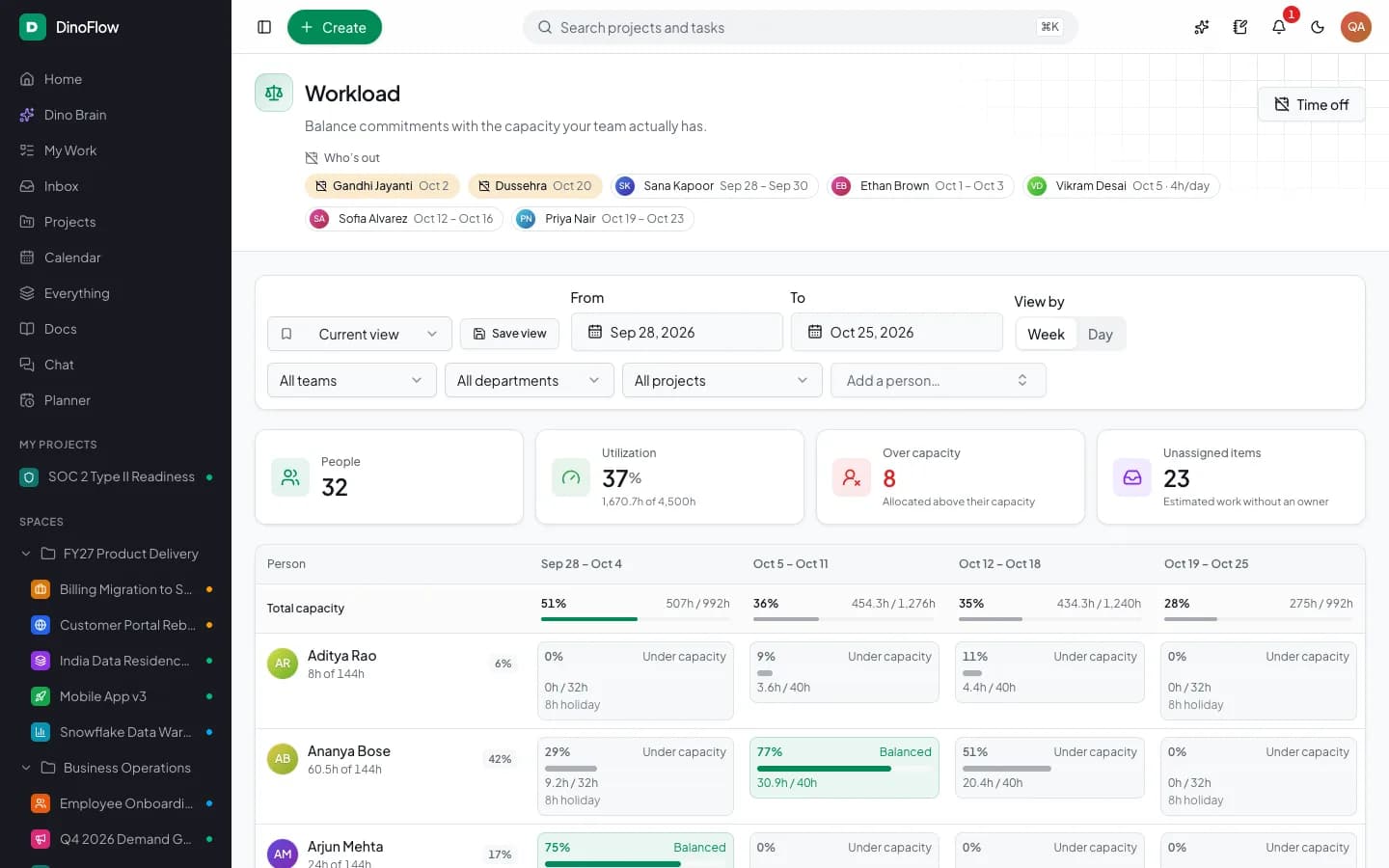
Cross-functional sprint planning coordinates product backlogs, design sprints, and engineering tasks by balancing story point allocations against real-time member availability. Capacity forecasting engines account for individual working hours, approved leaves, and company holidays, presenting interactive workload heatmaps that prevent team burnout and identify scheduling bottlenecks before sprint execution begins.
The Pitfalls of Disconnected Sprint Planning
Agile teams often plan two-week sprints based on theoretical velocity assumptions. Project managers pull story points from backlogs assuming full-time developer availability, only to discover mid-sprint that two senior engineers have scheduled paid time off, a third is committed to urgent customer support escalations, and the design mockups are incomplete. The sprint stalls, unfinished tasks spill over into subsequent iterations, and delivery dates slip.
Effective sprint execution requires unified work management where task estimation, team capacity, leave schedules, and project dependencies intersect in real time. Rather than relying on guesswork, teams achieve dependable delivery schedules by balancing story point commitments against true team capacity.
Calculated Capacity: Factoring PTO, Holidays, and Focus Time
Raw working hours do not equal engineering delivery capacity. A realistic capacity forecasting model subtracts non-development operational overhead from gross hours:
| Capacity Factor | Calculation Methodology | Operational Impact on Sprint |
|---|---|---|
| Base Working Hours | Standard contracted working hours (e.g., 40 hrs/week per person) | Maximum theoretical baseline for team availability |
| Statutory Holidays & PTO | Deducts approved leaves from integrated HR and team calendars | Direct reduction in available sprint story point capacity |
| Ceremony & Meeting Tax | Accounts for daily standups, backlog grooming, and retrospective meetings (15-20%) | Protects realistic deep-work time for complex engineering tasks |
| On-Call & Support Buffer | Allocates 10-15% buffer for production bug fixes and live triage | Prevents unplanned customer escalations from derailing primary sprint goals |
| Net Available Capacity | Base hours minus PTO, ceremonies, and operational buffers | The true capacity limit against which sprint points must be committed |
Visual Workload Balancing Across Cross-Functional Roles
Sprints involve multiple functional roles—product managers, UI/UX designers, backend engineers, frontend developers, and quality assurance testers. A sprint may have healthy aggregate story point numbers while hiding severe bottlenecks in a single specialization.
Preventing Departmental Bottlenecks
- Interactive Heatmap Views: DinoFlow displays a real-time capacity bar for each team member. When a frontend developer is assigned 45 hours of work in a 32-hour net availability week, their bar turns amber and flags over-allocation.
- Role-Specific Dependency Chains: Identifies when backend API endpoints must be completed before frontend components can be styled, preventing idle wait times.
- Drag-and-Drop Work Reallocation: Enables project leads to drag tasks from over-allocated team members to peers with available bandwidth before finalizing the sprint commitment.
Dino Brain AI Assistance for Sprint Backlog Grooming
DinoFlow features Dino Brain, a supervisor agent that coordinates specialized project assistants. During sprint planning, project managers can prompt the planning agent to evaluate the proposed sprint backlog against historical team velocity.
The agent highlights unestimated tasks, flags stories with missing acceptance criteria, and suggests splitting complex epics into manageable subtasks, significantly reducing backlog grooming time.
Frequently Asked Questions
Frequently Asked Questions
Can DinoFlow import project backlogs from Jira, Trello, or Asana?
Yes. DinoFlow provides spreadsheet import tools and REST APIs that map tasks, members, statuses, and custom tags during workspace setup.
How does capacity forecasting handle part-time contractors?
Each team member profile allows custom weekly hour baselines, enabling accurate capacity math for both full-time staff and part-time contributors.
Does DinoFlow track historical sprint velocity over time?
Yes. The analytics engine generates automated sprint velocity charts, burn-down diagrams, and cumulative flow metrics across successive sprint cycles.
Can team members log actual time spent against estimated tasks?
Yes. DinoFlow includes native time tracking with start-stop timers and manual timesheet entry linked directly to individual task cards.
Need Setup or Custom Coding?
Get in touch to rebrand or customize our ready-made products, or discuss custom development services. All quotes are customized and private.
Related Articles
Deterministic Workflow Automations vs AI Agents in Enterprise Task Management
Compare deterministic trigger-condition-action automations with autonomous AI agents in enterprise task management, exploring architectural strengths, safety guardrails, and hybrid patterns.
Real Estate Portal Lead Deduplication, Ingestion, and Site Visit Scheduling
Learn how to build high-velocity webhook ingestion for real estate portals, eliminate lead duplication across brokers, and automate property site visit scheduling.