
Deterministic Workflow Automations vs AI Agents in Enterprise Task Management
Short answer
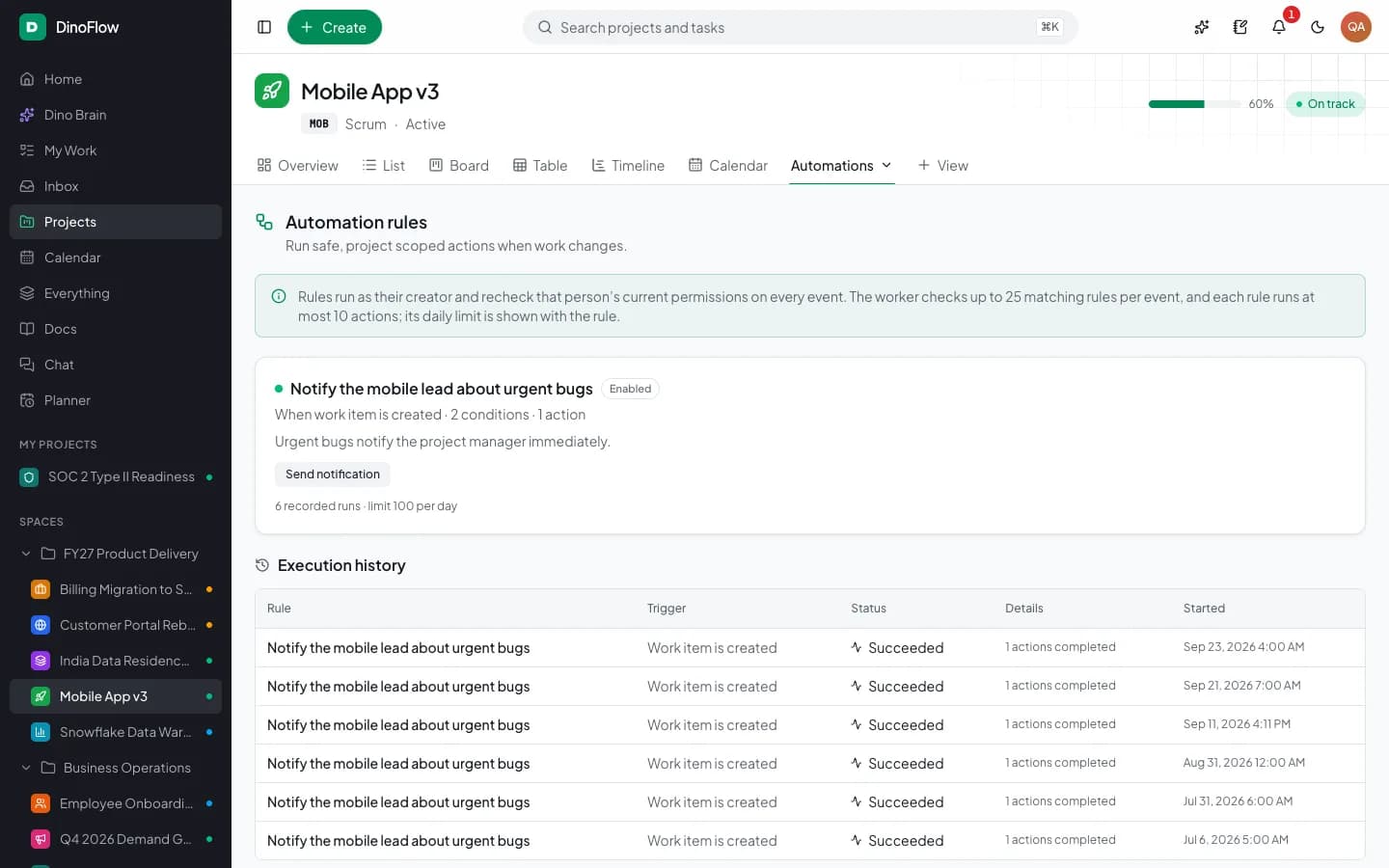
Deterministic workflow automations follow strict trigger-condition-action rules to execute predictable operations like status transitions, notifications, and field updates with zero latency or token cost. In contrast, AI task agents analyze unstructured context to draft requirements, decompose tasks into subtasks, and suggest sprint allocations, operating within user-defined permission boundaries with human confirmation queues.
The Evolution of Enterprise Work Management Systems
As organizations scale, managing hundreds of daily tasks, sprint items, customer bug reports, and cross-team dependencies becomes impossible without automation. For years, the gold standard for task management was deterministic workflow automation: rigid 'when this happens, if these conditions match, execute this exact action' rules. While reliable, these rules struggle when confronted with ambiguous, unstructured information.
The advent of Large Language Models (LLMs) and autonomous agent frameworks has introduced a second paradigm: probabilistic AI agents capable of understanding context, writing code summaries, and decomposing goals. However, relying entirely on AI agents without deterministic guardrails introduces unpredictability and token expense. Modern enterprise work platforms combine both architectures strategically.
Comparing Deterministic Automations and AI Task Agents
Understanding when to apply deterministic rules versus AI agents is fundamental to building a reliable productivity infrastructure:
| Capability Dimension | Deterministic Automation | AI Task Agents |
|---|---|---|
| Execution Mechanism | Hardcoded conditional logic (If X then Y) | LLM reasoning and tool-calling over unstructured data |
| Reliability & Variance | 100% predictable; zero behavioral variance | Probabilistic; requires evaluation prompts and output schemas |
| Execution Latency | Sub-10 millisecond execution | 1 to 5 seconds depending on model provider and token length |
| Cost Profile | Negligible compute; zero API token costs | Incurs token costs per reasoning call and tool invocation |
| Handling Ambiguity | Fails or requires exact syntax matches | Excels at understanding messy requests, docs, and human context |
| Ideal Use Cases | Status updates, audit logging, notifications, field calculations | Task triage, subtask decomposition, sprint summaries, documentation search |
The Hybrid Pattern: Deterministic Triggers with AI Assistance
The most powerful work management implementations avoid treating this as an either-or choice. Instead, they use deterministic triggers as the outer shell and AI agents as context processors within strict boundaries.
Example: Intelligent Task Intake and Triage
- Step 1 (Deterministic Trigger): A customer or employee submits a raw issue through an intake form. The system immediately logs the submission and assigns an issue ID.
- Step 2 (AI Processing): Dino Brain reads the free-text description, classifies the ticket severity, drafts structured reproduction steps, and suggests three actionable subtasks.
- Step 3 (Human Confirmation Queue): For destructive or high-impact actions, the agent queues proposals in a confirmation inbox. The project lead approves or amends the suggestions with one click.
- Step 4 (Deterministic Execution): Once confirmed, deterministic rules assign the ticket to the relevant engineering sprint, apply project tags, and trigger Slack notifications.
Permission-Aware Security and Guardrails
A significant risk with naive AI agent integration in project software is privilege escalation: an agent viewing documents or tasks that the asking user is not authorized to see. In DinoFlow, Dino Brain operates strictly within the active user's permissions.
If an auditor or external contractor prompts the AI assistant to summarize project financials or HR roadmaps, the vector index filtering blocks unauthorized chunks, preventing data leaks across tenant boundaries.
Frequently Asked Questions
Frequently Asked Questions
Can DinoFlow automation rules run without making any external AI API calls?
Yes. All deterministic rules (status changes, date triggers, email alerts, assignment rotations) run on local server logic with zero AI token consumption.
Can AI agents modify critical task statuses without human approval?
No. High-impact operations route through a human-in-the-loop confirmation queue, ensuring human oversight before records are updated.
Which AI models can be connected to DinoFlow?
DinoFlow supports OpenAI, Anthropic, OpenRouter, and custom local OpenAI-compatible endpoints, keeping API keys securely encrypted.
Is complete source code provided for DinoFlow?
Yes. TechDino licenses DinoFlow with complete source code for the agreed scope, allowing deployment on client-owned cloud servers.
Need Setup or Custom Coding?
Get in touch to rebrand or customize our ready-made products, or discuss custom development services. All quotes are customized and private.
Related Articles
Cross-Functional Sprint Planning, Workload Balancing, and Capacity Forecasting
Discover how cross-functional sprint planning, live workload capacity heatmaps, and holiday-aware availability tracking keep engineering and product teams aligned.
Real Estate Portal Lead Deduplication, Ingestion, and Site Visit Scheduling
Learn how to build high-velocity webhook ingestion for real estate portals, eliminate lead duplication across brokers, and automate property site visit scheduling.