
Preparing Publisher Ebook Catalogs for the European Accessibility Act (EAA 2025)
Short answer
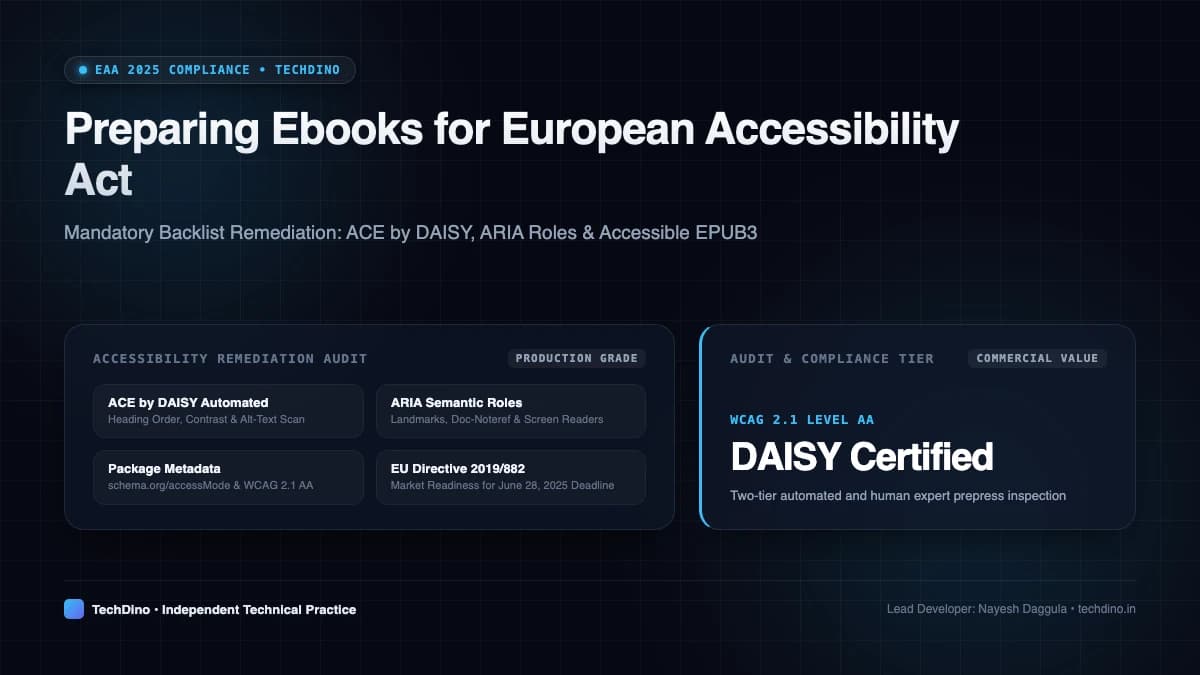
The European Accessibility Act requires all digital publications distributed in the EU to be accessible starting June 2025, mandating semantic HTML5 structure, navigation landmarks, language tagging, table accessibility, and discoverable accessibility metadata under W3C EPUB 3 standards. Working as an independent prepress specialist, Nayesh Daggula audits and remediates EPUB catalogs using EPUBCheck and ACE by DAISY for publishers worldwide.
The global publishing industry is undergoing a regulatory shift toward inclusive digital distribution. Under Directive 2019/882 of the European Parliament—widely known as the European Accessibility Act (EAA)—all digital publications, reading software, and e-commerce platforms selling ebooks within the European Union must satisfy technical accessibility standards beginning June 28, 2025.
What the European Accessibility Act Mandates for Ebooks
The EAA applies not only to European publishers, but to any international publisher, author, or digital distributor (including US, UK, Canadian, and Asian presses) selling ebooks to consumers within EU member states. Non-compliant titles risk removal from digital storefronts or distribution delays on major retail platforms.
The legislation aligns directly with W3C EPUB 3 Accessibility Guidelines (EPUB Accessibility 1.1) and Web Content Accessibility Guidelines (WCAG 2.1 Level AA). Simply producing an ebook that opens in a reader is no longer sufficient; digital files must be operable by readers using assistive technologies such as screen readers, refreshable braille displays, and customizable text-to-speech tools.
The Core Technical Pillars of EAA Compliance
To conform to the European Accessibility Act, publishers must ensure that their EPUB3 files incorporate five foundational technical structural layers:
- Logical Reading Order & Heading Hierarchy: Content must flow in a meaningful sequence with correct H1, H2, and H3 hierarchies, without using heading tags solely for visual decoration.
- Assistive Navigation Landmarks: The package must contain a comprehensive navigation document (<nav epub:type='landmarks'>) declaring start of content, table of contents, and glossaries.
- Language & Direction Tagging: Explicit xml:lang and lang attributes on the <html> tag and all foreign-language phrases to prevent screen reader pronunciation errors.
- Alternative Text Descriptions: Informative images, charts, and diagrams must carry descriptive alt attributes or extended descriptions, while purely decorative elements must be marked with role='presentation' or aria-hidden='true'.
- Discoverable ONIX & Schema Metadata: Every package must embed Dublin Core and schema.org accessibility metadata (accessMode, accessibilityFeature, accessibilityHazard, and accessibilitySummary) so consumers can evaluate accessibility before purchasing.
Automated Auditing with EPUBCheck and ACE by DAISY
Prepress quality assurance requires a two-tiered testing methodology to identify structural defects before distribution:
| Validation Tier | Software Tool | Compliance Scope Verified |
|---|---|---|
| Technical Syntax Validation | W3C EPUBCheck | Verifies XML well-formedness, manifest integrity, OPF package declarations, and CSS stylesheet syntax. |
| Automated Accessibility Audit | ACE by DAISY | Scans heading hierarchies, checks contrast ratios, detects missing alt tags, and validates accessibility metadata. |
| Assistive Device Emulation | Screen Reader Testing | Manual visual and auditory verification using VoiceOver (macOS/iOS) and NVDA to confirm speech cadence. |
| Publisher Remediation | Prepress Specialist Review | Injects missing metadata, structures tables with scope attributes, and rectifies invalid reading orders. |
Practical Remediation Steps for Publisher Catalogs
Digitizing and remediating existing backlists does not require rebuilding books from scratch. For trade fiction and standard narrative nonfiction, automated preprocessing can rapidly correct 80% of structural issues, leaving specialized human audit for complex tables and custom figures.
Review our dedicated EPUB accessibility testing and validation service or explore high-volume catalog options on our bulk EPUB conversion service.
European Accessibility Act Ebook Compliance FAQs
Frequently Asked Questions
Does the European Accessibility Act apply to legacy ebook backlists?
The EAA applies to digital publications placed on the market after June 28, 2025. However, major digital distribution platforms and libraries in Europe are increasingly requiring existing backlist titles to meet accessible standards to avoid catalog disruption.
Can EPUB2 files satisfy the European Accessibility Act?
Generally no. EPUB2 lacks modern HTML5 semantic elements, ARIA role mapping, and standardized accessibility metadata schemes. Publishers are actively modernizing EPUB2 and MOBI archives into EPUB3 to ensure compliance.
Can automated testing tools like ACE by DAISY establish full compliance alone?
Automated testing catches approximately 30% to 50% of accessibility issues (such as missing tags or invalid structures). The remaining compliance requirements, particularly image description accuracy and reading order logic, require human editorial inspection.
How can publishers get their EPUB titles audited for EAA compliance?
Publishers can submit sample EPUB files through our website for an automated diagnostic audit. We deliver an itemized report detailing syntax errors, missing metadata, and remediation recommendations.
Need Setup or Custom Coding?
Get in touch to rebrand or customize our ready-made products, or discuss custom development services. All quotes are customized and private.
Related Articles
Migrating Publisher InDesign Archives to Clean EPUB3: A Technical Prepress Runbook
A technical workflow for book publishers, prepress designers and freelance specialists converting Adobe InDesign IDML archives into validated reflowable EPUB3 files.
Buying a Self-Hosted Sales CRM with Source Code: Production Buyer's Guide
A complete guide for B2B sales teams evaluating self-hosted CRM software with source code, WhatsApp integration, quotation automation, and zero per-seat fees.