
AI Opportunity Scoring and Win-Loss Pattern Mining in Enterprise Sales CRM
Short answer
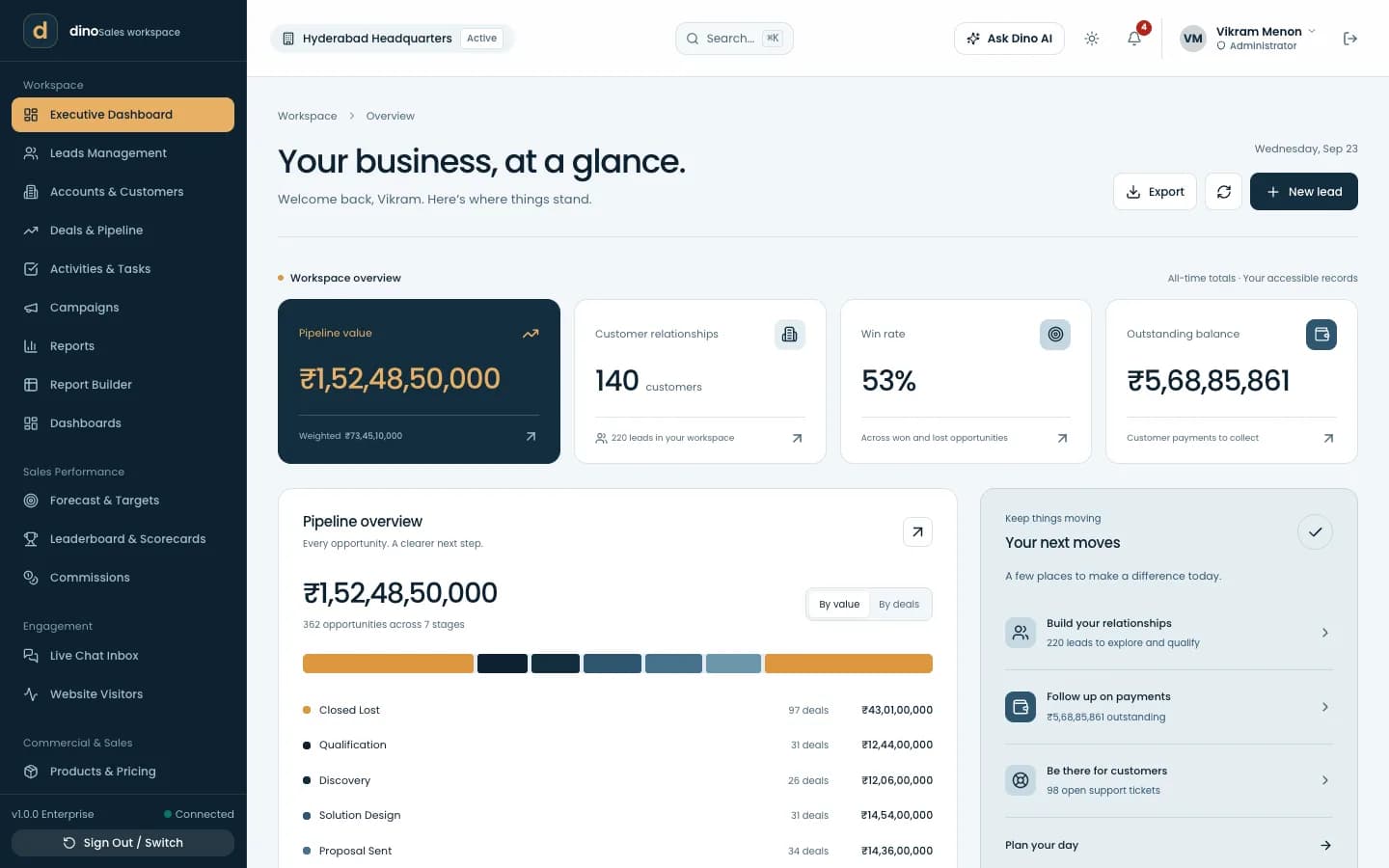
AI opportunity scoring evaluates deal momentum using measurable behavioral data, including proposal response latency, multi-threading among decision makers, quotation discount margins, and stage dwell time. By mining historical win-loss patterns, the CRM delivers objective probability ratings and next-step recommendations, helping sales managers spot stalled opportunities before quarter-end deadlines.
In complex B2B sales cycles, sales pipelines are frequently distorted by optimistic representative self-reporting. Reps often assign 80% win probabilities to opportunities where executive sponsors have gone quiet and contract revisions have languished for weeks.
AI opportunity scoring eliminates subjective bias by inspecting tangible engagement telemetry. By analyzing interaction recency, buyer involvement, and quotation terms against years of historical win-loss records, the CRM calculates an empirical deal probability that guides executive resource allocation.
Deconstructing Algorithmic Deal Scoring Telemetry
An effective deal scoring model replaces static stage percentages with dynamic behavioral signals collected across every touchpoint in the sales cycle.
| Pipeline Dimension | Measured Behavioral Signal | Score Impact | Predictive Rationale |
|---|---|---|---|
| Multi-Threading | Number of unique verified client stakeholders active in email/meetings | Positive (+20 pts) | Deals with 3+ involved stakeholders close at over 2.5x the rate of single-contact deals |
| Quotation Discounting | Discount percentage exceeding standard departmental policy | Negative (-15 pts) | Deep early discounting correlates strongly with margin erosion and lower customer lifetime value |
| Stage Dwell Time | Opportunity remaining in Current Stage > 2x average duration | Negative (-25 pts) | Deals that stall past departmental benchmark velocity rarely recover without executive intervention |
| Contract Markup Latency | Client legal redlines returned within 48 business hours | Positive (+15 pts) | Rapid turnaround on master services agreements signals committed buyer budget and urgency |
These factors combine into an objective health score, alerting sales leaders when high-value opportunities begin decelerating.
Mining Historical Win-Loss Patterns for Hidden Objections
Closed-lost notes in standard CRMs are often incomplete, with reps selecting generic reasons like 'Lost on Price'. Natural language processing (NLP) models mine meeting transcripts, email threads, and proposal revisions to identify root causes.
- Feature Gap Clustering: Groups customer pushback on specific compliance requirements or integration needs to inform product roadmap prioritization.
- Competitor Mention Tracking: Identifies which rival vendors appear most frequently at the negotiation stage and maps effective counter-positioning points.
- Pricing Boundary Discovery: Pinpoints the exact price-per-seat or licensing threshold where win rates degrade across different company size segments.
In-Line Guidance and Autonomous Deal Playbooks
Scoring deals is only half the battle; the CRM must also guide the account executive on how to move the deal forward. When the system detects declining engagement, it proactively suggests proven playbook actions.
For example, if a procurement stakeholder raises security questions, the CRM surfaces the approved compliance documentation and suggests introducing an enterprise architect into the conversation.
Sales Velocity and Pipeline Forecasting Integrity
Accurate forecasting requires factoring pipeline velocity into weighted revenues. Multiplying pipeline value by AI confidence scores generates forecast brackets that reflect realistic revenue outcomes, allowing operations teams to plan hiring and infrastructure budgets with greater certainty.
Frequently Asked Questions
Frequently Asked Questions
How does Dino Sales CRM calculate opportunity win probabilities?
Dino Sales CRM evaluates multi-stakeholder participation, communication recency, quotation discount levels, and stage dwell time against historical closed deals.
Can sales reps override AI opportunity scores?
Yes. Reps can adjust stage forecasts, but the CRM displays both the representative forecast and the objective AI telemetry score side-by-side for sales leadership review.
Does Dino Sales CRM store customer pipeline data on third-party AI servers?
No. When deployed self-hosted, all CRM records, customer notes, and scoring computations remain entirely within your private server environment.
Can quotation generation automatically trigger invoice creation?
Yes. Accepted quotations in Dino Sales CRM can instantly convert into proforma or commercial tax invoices with customized terms and payment gateway links.
Need Setup or Custom Coding?
Get in touch to rebrand or customize our ready-made products, or discuss custom development services. All quotes are customized and private.
Related Articles
Customer 360 Account Hierarchy and Recurring AMC Billing in Modern CRM
Master enterprise account management with Customer 360 parent-subsidiary hierarchies, unified interaction timelines, and recurring Annual Maintenance Contract (AMC) billing.
Inbound Lead Scoring, Data Enrichment, and SLA Routing in B2B CRM
Discover how inbound lead scoring, firmographic enrichment, automated round-robin routing, and response SLA clocks maximize B2B sales pipeline conversion rates.