
Buying Enterprise ERP Software with Source Code: A Production Buyer's Guide
Short answer
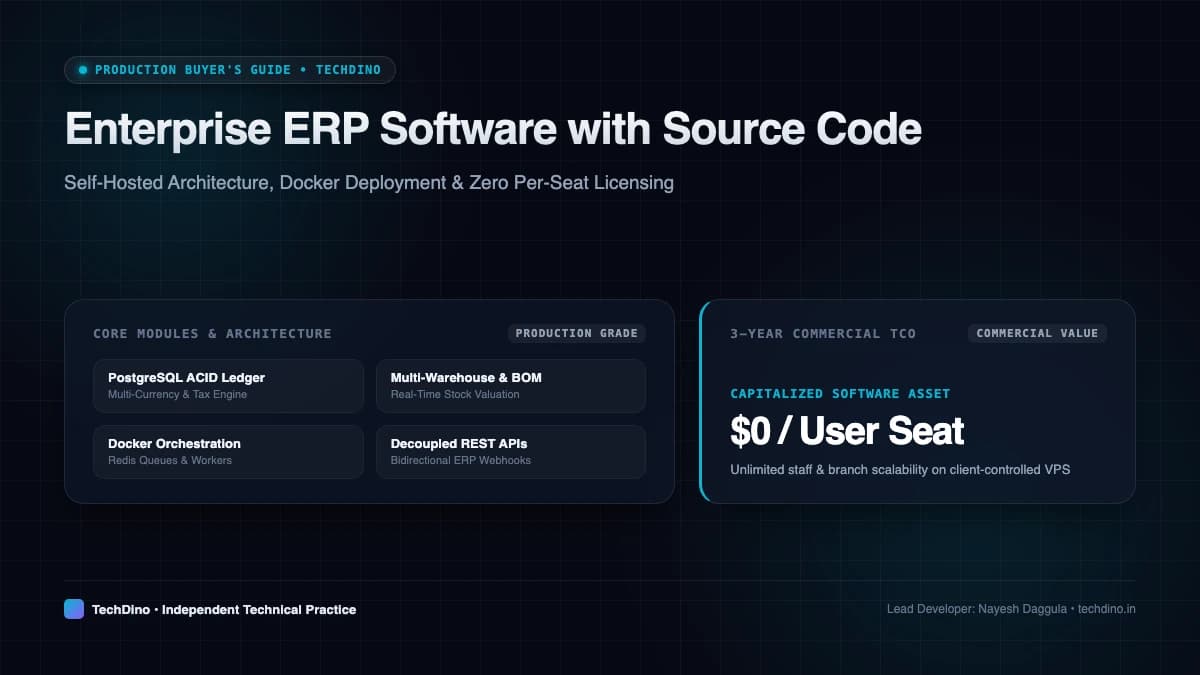
Buying enterprise ERP software with source code allows organizations to deploy a full-scale business management system on their own private servers for a one-time fee. This model eliminates recurring per-user SaaS license fees, provides permanent database sovereignty, and grants engineering teams complete freedom to adapt manufacturing, inventory, accounting, and multi-branch modules to bespoke operational workflows without vendor lock-in.
Software discussed: Dino ERP · Try the live demo
The Business Case: One-Time Source Code Purchase vs Recurring SaaS ERP
Enterprises evaluating resource planning systems frequently encounter a dilemma: subscribe to per-seat cloud software (such as SAP, NetSuite, or Odoo Enterprise) or acquire ready-made ERP software with source code. For growing organizations with 25 to 200 operational users, per-seat subscription models create an escalating financial liability. As headcount expands, monthly license fees compound, while custom workflow modifications remain constrained by proprietary cloud architectures.
Purchasing Dino ERP under a one-time source code license shifts ERP from an operational expense (OpEx) rent model to a capitalized software asset (CapEx). By hosting the software on your own private cloud or on-premise infrastructure, your organization maintains full operational independence.
| Evaluation Metric | Per-Seat Cloud SaaS ERP | Dino ERP Self-Hosted Source Code |
|---|---|---|
| 50-User 3-Year Software Cost | $90,000 to $180,000+ in ongoing subscription fees | Single one-time software purchase fee for the agreed scope |
| Server & Database Hosting | Proprietary vendor cloud with multi-tenant sharing | Client-owned VPS (AWS, Hetzner, DigitalOcean, or On-Premise) |
| Data Sovereignty & Legal Control | Subject to vendor terms, price increases, and cloud migrations | Client database control and regional compliance |
| Codebase Customization | Limited to vendor APIs, sandboxes, and proprietary scripting | Full access to modify frontend, backend APIs, and DB schemas |
| User Expansion Penalties | Costs scale linearly with every additional warehouse or sales clerk | Zero per-seat licensing penalties across any number of staff |
Architectural Criteria for Production ERP Source Code Evaluation
Before acquiring enterprise software for production deployment, your technical team must evaluate the underlying stack to confirm maintainability, horizontal scalability, and clean code boundaries. Dino ERP is architected around modern, open-standard technologies rather than obscure legacy frameworks:
- PostgreSQL Relational Core: ACID-compliant transaction processing with strict foreign key constraints, table partitioning for high-volume ledger entries, and automated point-in-time recovery.
- Docker Compose Deployment: Multi-container orchestration containing the application web services, Redis background queue workers, and database replicas for seamless environment parity between staging and production.
- Decoupled REST and Webhook APIs: Standardized JSON endpoints allowing direct bidirectional integration with external logistics providers, payment gateways, and third-party warehouse scanners.
- Granular Role-Based Access Control (RBAC): Fine-grained permission trees governing reading, creating, approving, and auditing actions across individual branch locations, departments, and financial ledgers.
- Comprehensive Audit Logging: Immutable database audit trails tracking every ledger modification, inventory adjustment, and user login with IP and timestamp metadata.
Evaluating Core Modules in Dino ERP
A production-grade ERP must bridge every department without requiring disparate third-party plugins. Dino ERP provides comprehensive operational coverage across 27 operational areas:
- Financial Accounting & Multi-Currency Ledger: General ledger, accounts payable, accounts receivable, bank reconciliation, automated tax calculation (including India GST e-invoicing, GCC/UAE VAT, and US sales tax), and multi-currency exchange tracking.
- Inventory & Multi-Warehouse Tracking: Real-time stock valuation using FIFO or weighted average costing, lot and batch tracking with expiration monitoring, reorder point alerts, and automated inter-warehouse transfer orders.
- Procurement & Vendor Management: Purchase requisitions, automated request for quotation (RFQ) dispatch, purchase order lifecycle management, goods receipt notes (GRN), and vendor bill matching.
- Manufacturing Work Orders & BOM: Multi-level Bill of Materials (BOM), production routing, workstation capacity scheduling, scrap tracking, and finished goods batch generation.
- Multi-Branch & Franchise Governance: Consolidated profit-and-loss dashboards with branch-level isolation, enabling headquarters to oversee distributed retail outlets or regional distribution hubs.
Data Sovereignty and Global Deployment Considerations
Data protection legislation is tightening across every major trading bloc. Under the Indian Digital Personal Data Protection (DPDP) Act 2023, the European Union General Data Protection Regulation (GDPR), and the UAE Federal Decree-Law No. 45/2021, transferring sensitive customer and employee financial data across proprietary foreign SaaS clouds introduces substantial compliance risks.
Deploying Dino ERP on client-controlled infrastructure ensures that all financial journals, payroll records, and vendor contracts reside in chosen geographic jurisdictions (such as AWS Mumbai for Indian data residency or Hetzner Frankfurt for European GDPR compliance). Organizations also eliminate the risk of sudden vendor policy shifts, account suspensions, or forced subscription price hikes.
Explore full technical specifications on the Dino ERP product page, review our custom software development services, or contact us to review the live demonstration.
Frequently Asked Questions About Buying ERP Software with Source Code
Frequently Asked Questions
What assets are delivered when buying Dino ERP with source code?
Buyers receive application source code for the agreed scope, including frontend interfaces, backend API services, PostgreSQL database schema migrations, Docker Compose configuration scripts, and comprehensive architectural documentation.
Can our internal engineering team modify the Dino ERP codebase after deployment?
Yes. Because the software is delivered with source code under an agreed commercial license, your in-house engineering team or contracted developers have full freedom to build custom integrations, add industry-specific modules, or modify UI workflows without vendor intervention.
What server infrastructure is required to host Dino ERP?
Dino ERP operates efficiently in standard containerized environments. A standard production deployment running on a modern virtual private server (VPS) with 4 vCPUs, 8GB RAM, and SSD storage (such as AWS EC2, DigitalOcean, or Hetzner) easily accommodates up to 100 concurrent operational users.
How does Dino ERP handle regional tax compliance and invoicing?
Dino ERP includes configurable tax engines supporting multi-jurisdictional rules, including India GST e-invoicing and e-way bills, Middle East VAT schemas, European standard tax rates, and North American state sales taxes.
What ongoing technical support is provided after software delivery?
Every Dino ERP deployment includes three months of post-delivery technical support covering deployment guidance, environment configuration, and defect resolution, with optional annual maintenance agreements available for extended requirements.
The software in this article
Dino ERP
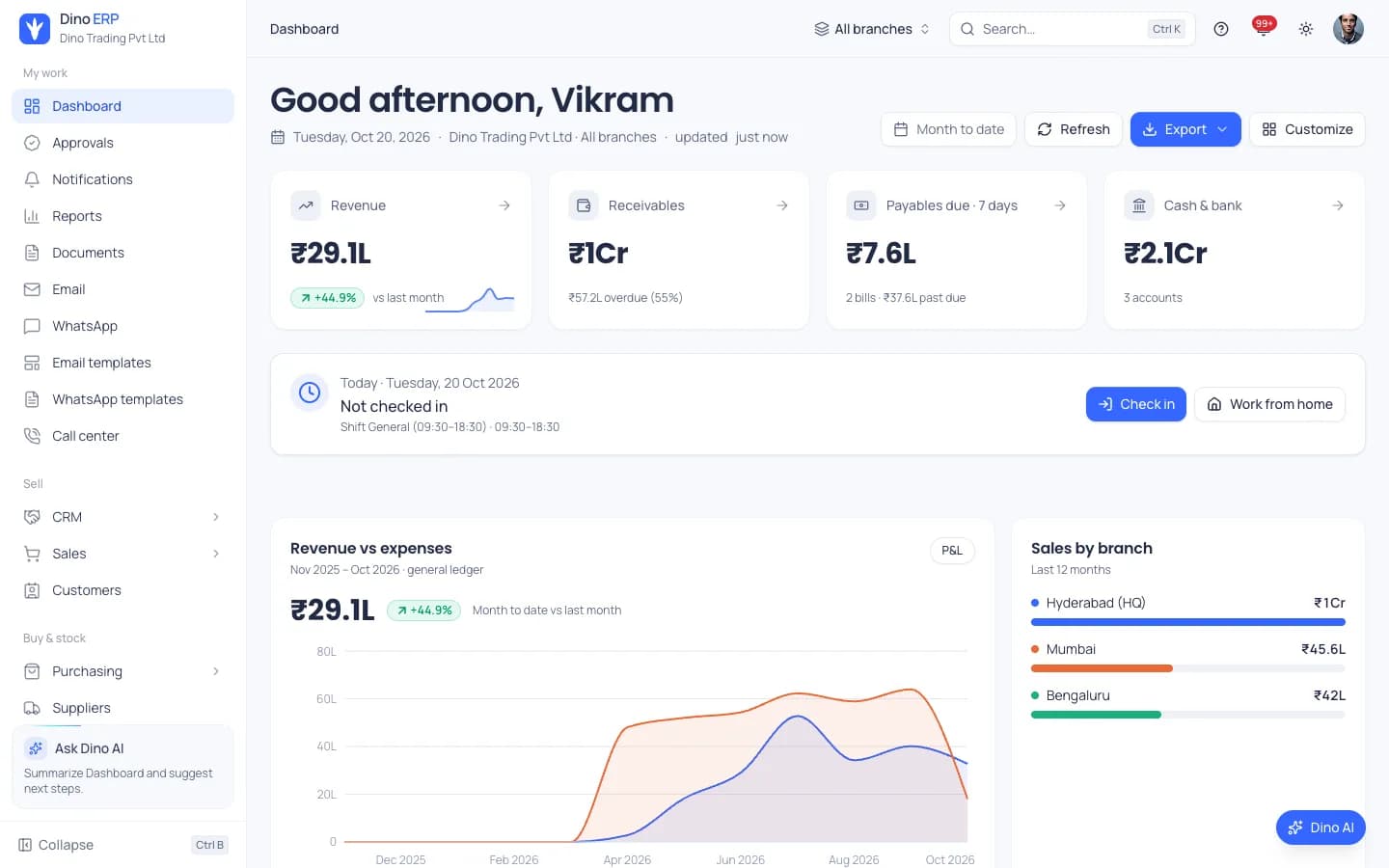
Dino ERP is an AI-powered, self-hosted, white-label ERP with 27 product areas across seven suites, including CRM, sales, purchasing, inventory and WMS, finance, country tax setup, HR and payroll, projects, manufacturing, quality, assets, helpdesk, POS, e-commerce, subscriptions, rental and portals, plus Dino AI for questions, document capture and forecasts.
Want Dino ERP Under Your Brand?
Rebrand Dino ERP with your logo and domain, or have it customized for your workflow. All quotes are customized and private.
Related Articles
Buying a White-Label OTT Streaming Platform: Production Architecture & Buyer's Guide
How media companies, film distributors, and content creators can buy a white-label OTT streaming platform with source code, multi-screen apps, and client-controlled cloud infrastructure.
Buying a Self-Hosted Sales CRM with Source Code: Production Buyer's Guide
A complete guide for B2B sales teams evaluating self-hosted CRM software with source code, WhatsApp integration, quotation automation, and zero per-seat fees.