
Buying a White-Label OTT Streaming Platform: Production Architecture & Buyer's Guide
Short answer
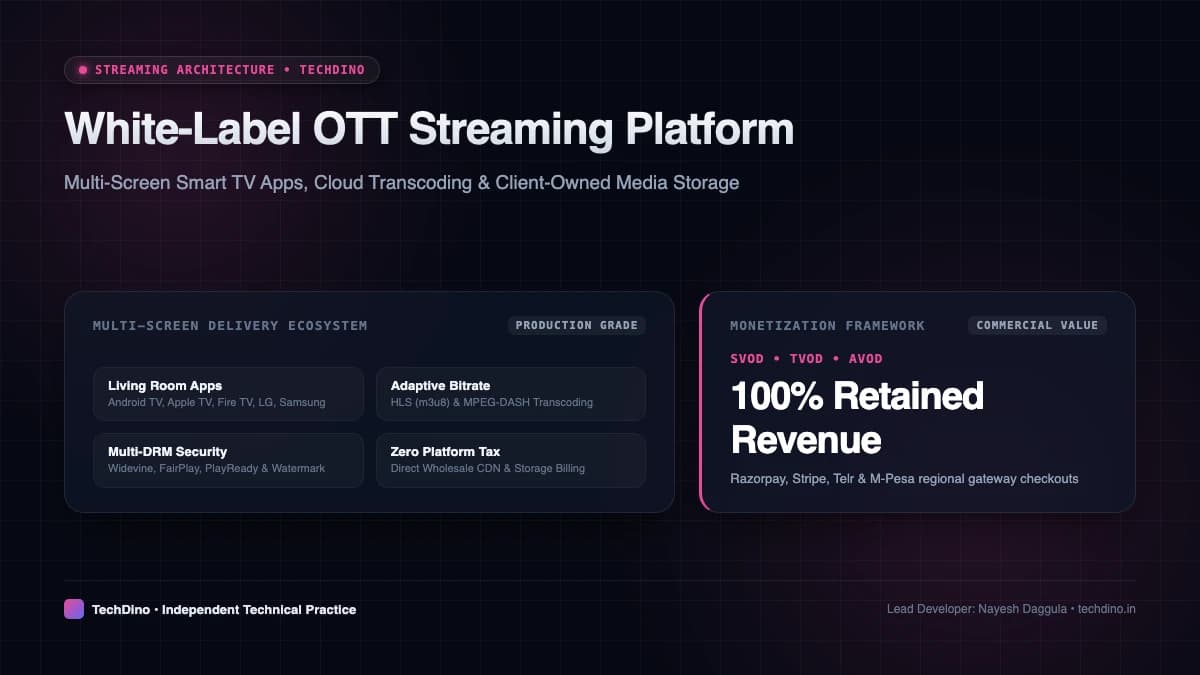
Buying a white-label OTT streaming platform with source code gives media producers, broadcasters, and niche content creators full control over their video distribution business. Rather than paying escalating subscriber revenue shares or bandwidth markups to SaaS streaming providers, purchasing Dino OTT provides production-ready Web, Mobile, and Smart TV applications with client-controlled cloud transcoding, private media storage, and multi-tier subscription billing.
Software discussed: Dino OTT
The Economics of Buying an OTT Platform vs Renting SaaS Video Infrastructure
Media organizations, educational publishers, independent film studios, and regional broadcasters often begin their streaming journey by exploring SaaS video platforms such as Vimeo OTT, Uscreen, or Muvi. While attractive initially, SaaS OTT pricing structures typically impose recurring platform subscriptions combined with per-subscriber fees, transaction percentages, and steep bandwidth overage markups.
When viewer numbers scale from 1,000 to 50,000 active subscribers, rental models capture a disproportionate share of operating margins. Buying Dino OTT under a source code license decouples business growth from software vendor rent. Media companies retain 100% of subscriber revenue and pay direct, wholesale bandwidth rates directly to commodity infrastructure providers such as Cloudflare, AWS, or Backblaze.
| Operational Cost Element | Turnkey SaaS Video Subscription | Dino OTT Client-Owned Infrastructure |
|---|---|---|
| Platform Licensing Fees | $500 to $3,000+ monthly recurring base charges | One-time software purchase with source code delivery for agreed scope |
| Per-Subscriber Surcharges | $0.50 to $1.50 per subscriber every month | $0.00 — zero subscriber or viewer penalties |
| Bandwidth and Delivery Pricing | $0.08 to $0.15 per GB with proprietary markup | Direct wholesale rates (e.g., $0.01/GB on Cloudflare / AWS) |
| Subscriber Data & Direct Relationships | Stored in vendor database; difficult export workflows | Database ownership in client PostgreSQL/MongoDB instance |
| Branding and App Store Placement | Shared or containerized vendor app templates | Custom branded applications published under client developer accounts |
Production Video Pipeline: Transcoding, Packaging, and Multi-CDN Delivery
A robust streaming platform requires an automated ingestion and delivery pipeline capable of transforming raw master files into responsive, buffer-free playback streams across divergent global network conditions. Dino OTT implements a decoupled, event-driven video ingestion workflow:
- Automated Transcoding Pipeline: Orchestrated FFmpeg or AWS MediaConvert workflows converting master videos into multi-bitrate HLS (HTTP Live Streaming) and MPEG-DASH adaptive ladders (from 360p mobile profiles up to 4K Ultra HD).
- Segment Packaging and Encryption: Video segments are chunked into 6-second fragments and protected with AES-128 envelope encryption or hardware DRM headers before writing to persistent object storage.
- Cost-Optimized Cloud Storage: Storage buckets configured on Cloudflare R2 or Amazon S3 with lifecycle transition policies, eliminating egress fees during high-volume streaming spikes.
- Multi-CDN Edge Distribution: Integration with global content delivery networks such as Cloudflare Stream and AWS CloudFront, caching video fragments at edge points of presence across North America, Europe, the Middle East, India, and Southeast Asia.
Multi-Screen Ecosystem: Web, Mobile, and Smart TV Applications
Audiences expect continuous viewing experiences across personal and living-room screens. Dino OTT delivers a unified multi-screen ecosystem managed from a single administrative video CMS:
- Responsive Web Portal: Built with modern Next.js architecture featuring server-side rendering, instant video previews, watchlist synchronization, and Picture-in-Picture playback.
- Native Mobile Apps (iOS & Android): Built with responsive media players, offline encrypted downloads, background audio playback, and push notification triggers for newly released episodes.
- Living Room TV Applications: Dedicated interfaces for Android TV / Google TV, Apple TV (tvOS), Amazon Fire TV, and Smart TV web engines, supporting remote-control d-pad navigation and 4K HDR playback.
Digital Rights Management, Content Protection, and Geo-Licensing
Commercial film distribution and sports broadcasting demand strict content protection. Dino OTT supports multi-DRM licensing integration including Google Widevine (Modular), Apple FairPlay Streaming, and Microsoft PlayReady. Furthermore, dynamic forensic watermarking overlays the viewer's IP address and session identifier directly onto the playback canvas to discourage illicit screen recording.
Territorial broadcast rights are enforced through IP-based geo-blocking middleware, allowing distributors to whitelist or blacklist specific countries, states, or regions to satisfy regional licensing obligations.
Monetization Models and Localized Payment Gateways
Dino OTT supports versatile monetization frameworks tailored to global and emerging regional markets:
- Subscription Video on Demand (SVOD): Multi-tiered recurring plans (monthly, quarterly, annual) with family profiles, device stream concurrency limits, and automated renewal dunning.
- Transactional Video on Demand (TVOD / PPV): Pay-per-view rentals and permanent electronic sell-through (EST) with configurable 48-hour viewing windows.
- Advertising-Supported Streaming (AVOD / FAST): Server-side ad insertion (SSAI) and client-side VAST/VMAP protocols for monetizing free or hybrid tiers with high-fill video ad networks.
- Global & Regional Payment Gateways: Direct integration with Stripe and PayPal for international audiences, Razorpay and PayU for Indian UPI and cards, Telr for UAE and GCC markets, and M-Pesa for East African mobile money.
Review architecture details on the Dino OTT product page, learn more about our mobile app development services, or contact us to evaluate streaming demos.
Frequently Asked Questions About Buying White-Label OTT Platforms
Frequently Asked Questions
What source code repositories are included when purchasing Dino OTT?
Buyers receive the complete frontend web application, administrative video CMS, backend API microservices, database schemas, and codebase repositories for iOS, Android, and Smart TV applications specified in the agreed project scope.
Who owns the subscriber database and video content?
You retain 100% ownership of your subscriber records, payment histories, and video content libraries. All data resides in your private database and cloud storage buckets, completely free from third-party platform lock-in.
What are the ongoing monthly costs after purchasing the platform?
Because there are no ongoing software license fees paid to TechDino, your only recurring expenses are your direct cloud infrastructure costs: virtual server hosting, storage (e.g., Cloudflare R2 or AWS S3), and CDN bandwidth used by your viewers.
Can live television channels and sports events be streamed on Dino OTT?
Yes. Dino OTT includes support for live HLS streams, electronic program guides (EPG), DVR catch-up windows, and concurrent viewer scaling for real-time sports and broadcast channels.
How are mobile and Smart TV apps published to the app stores?
Apps are compiled with your brand identities, digital signing certificates, and deployed directly to your Apple Developer, Google Play Console, and Amazon Developer accounts with our deployment assistance.
The software in this article
Dino OTT
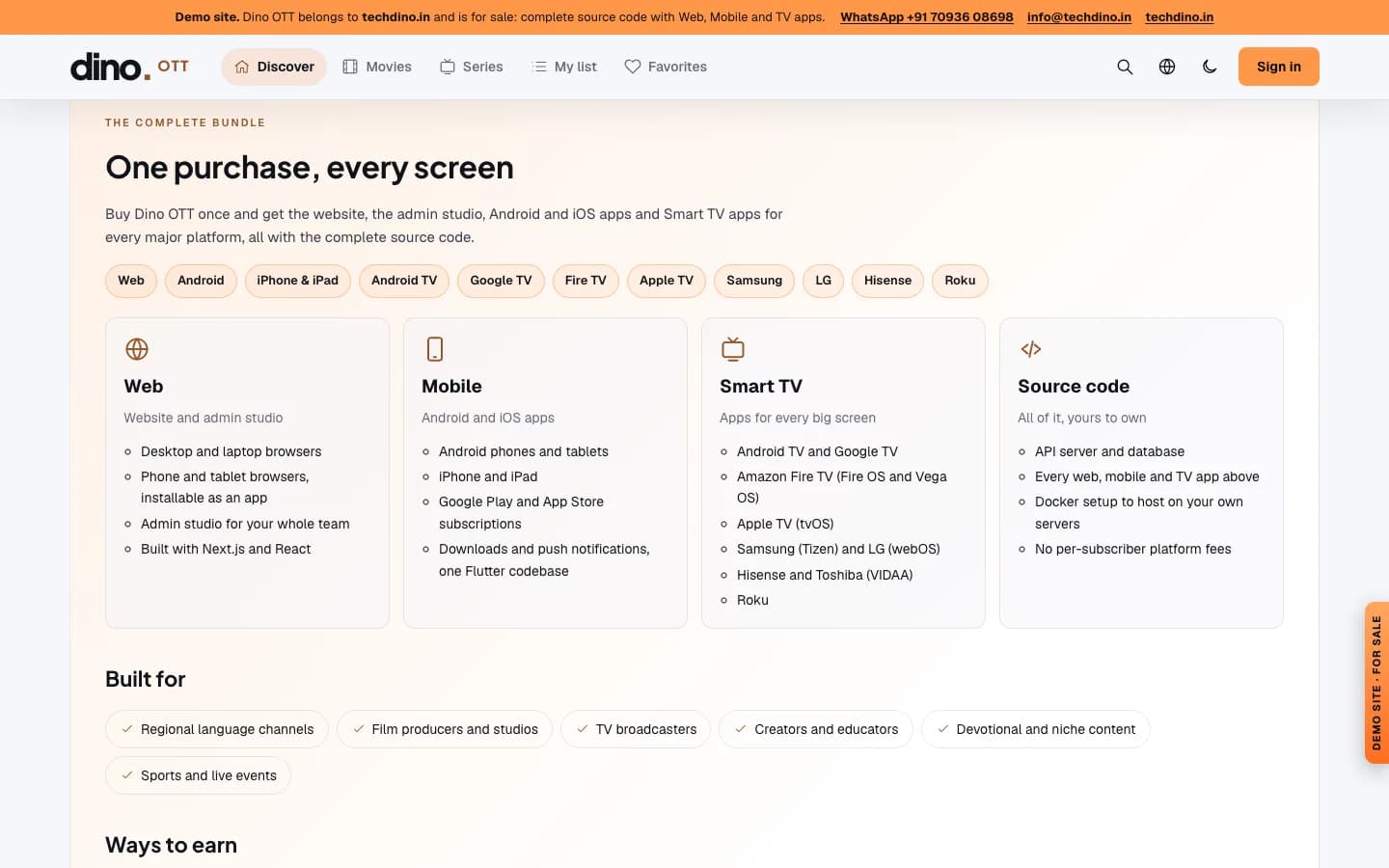
Dino OTT is a white-label OTT streaming platform with a customer website, an admin studio with 14 staff roles, Android and iOS apps from one Flutter codebase, and Smart TV apps for Android TV, Google TV, Fire TV, Apple TV, Samsung, LG, VIDAA and Roku, sold with the source code.
Want Dino OTT Under Your Brand?
Rebrand Dino OTT with your logo and domain, or have it customized for your workflow. All quotes are customized and private.
Related Articles
White-Label OTT Platform: How to Launch Your Own Streaming Service on Web, Mobile and Smart TV
What a white-label OTT platform includes, how it compares with building from scratch or renting a hosted service, which devices matter, and the costs you still carry after launch.
How to Start an OTT Platform in India: Regional Language Streaming, Payments and the IT Rules
A step-by-step plan for launching a regional language OTT service in India: content rights, the IT Rules 2021 and DPDP Act, UPI and app-store payments, devices and running costs.