
Docker Compose Deployment for Multi-Service Business Applications
Short answer
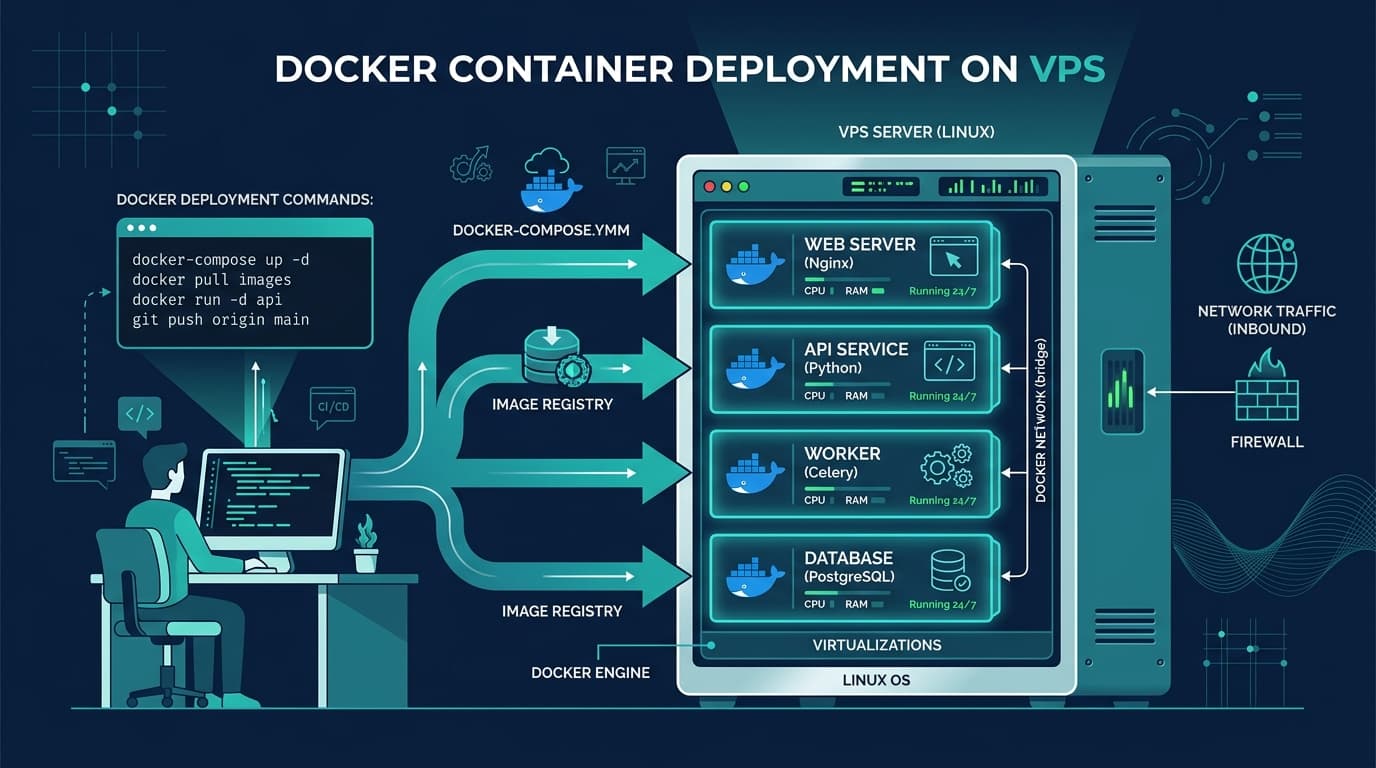
Docker Compose deployment for business applications defines all services — web frontend, API backend, database, background worker and vector database — in a single YAML file. Running one command starts the entire stack with health checks, restart policies and a shared network, making self-hosted business software reproducible across development, staging and production environments.
Why Docker Compose Has Become Standard for Business Software
Modern business applications no longer run as monolithic single-process scripts. An enterprise platform like Dino Business OS requires a responsive Next.js frontend, an Express API backend, a transactional MySQL 8.4 database, an asynchronous worker process for background PDF and email tasks, and a specialized vector database like Qdrant for semantic AI search. Attempting to install each dependency directly onto a bare Linux virtual machine creates dependency conflicts, port collisions, and complicated upgrade paths.
Docker Compose abstracts this entire service topology into a declarative `docker-compose.yml` file. With a single command, system administrators can initialize, link, network, and supervise the complete application stack consistently across any standard Ubuntu VPS.
Anatomy of an Enterprise Container Stack
| Container Service | Technology Engine | Internal Port | Core Functional Responsibility |
|---|---|---|---|
| Frontend Web App | Next.js 15 & React 19 | 3000 | Serves server-rendered web pages, responsive dashboards, and interactive portals |
| Backend REST API | Node.js & Express | 4000 | Executes business logic, role-based authorization, and transactional database queries |
| Relational Database | MySQL 8.4 LTS | 3306 | Stores transactional ledgers, customer profiles, product catalogs, and user credentials |
| Background Worker | Node.js Process | Internal | Processes queued asynchronous tasks including PDF invoice generation and batch notifications |
| Vector Database | Qdrant Engine | 6333 | Manages high-dimensional semantic embeddings for corporate policy and knowledge search |
| Reverse Proxy Gateway | Nginx & Certbot | 80 / 443 | Terminates public SSL certificates, applies rate limiting, and routes traffic cleanly |
Key Operational Best Practices for VPS Production Deployments
- Enforce explicit health checks on database and API containers to ensure dependent services wait until prerequisite sockets are fully open
- Pin specific container image tags and database versions rather than using latest to prevent unexpected breaking changes during maintenance rebuilds
- Keep database storage files and user media uploads in named persistent Docker volumes that survive container re-creations and updates
- Store sensitive credentials, database passwords, and AI API keys in an uncommitted `.env` file with strict filesystem access permissions
- Configure resource constraints including memory and CPU quotas per container to prevent runaway background tasks from starving the host OS
- Implement automated offsite database backups using cron jobs that dump compressed SQL snapshots to secure object storage buckets
Frequently Asked Questions
Frequently Asked Questions
What VPS specifications are recommended for a full business stack?
A standard Linux VPS with 4 virtual CPUs, 8 GB of RAM, and 80 GB of SSD or NVMe storage easily runs the web, API, MySQL, worker, and Qdrant services under normal business traffic.
How do updates work with Docker Compose?
Administrators pull the latest application code, run `docker compose build`, and execute `docker compose up -d` to replace running containers with minimal user disruption.
Is Docker Compose suitable for production environments?
Yes. For single-server installations handling small to medium business operations, Docker Compose is resilient, easy to monitor, and straightforward to maintain without Kubernetes overhead.
How is SSL certificate renewal managed?
Certbot integrates with Nginx directly on the host or inside a dedicated proxy container to renew Let's Encrypt certificates automatically via system timers.
Need Setup or Custom Coding?
Get in touch to rebrand or customize our ready-made products, or discuss custom development services. All quotes are customized and private.
Related Articles
Autonomous AI Agents vs Deterministic Workflows: An Engineering Decision Matrix
A practical engineering guide to deciding when to implement autonomous LLM agents versus deterministic state machines for business automation.
Urban Micro-Warehouse & Dark Store Inventory Sync: Real-Time Quick-Commerce Architecture
Engineering high-speed micro-fulfillment architectures: atomic inventory reservations, barcode scanning workflows, and sub-15-minute quick-commerce dispatch.