
CRM and Sales Pipeline Software for Distribution and Trading Companies
Short answer
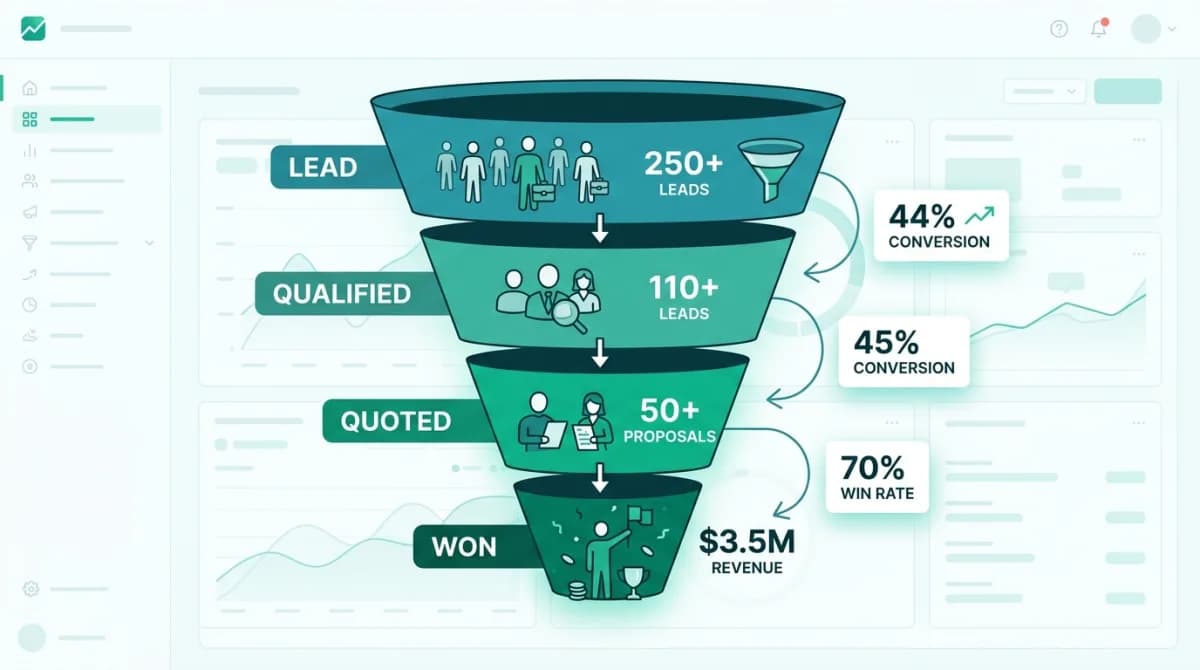
CRM and sales pipeline software for distribution companies tracks leads from first contact through qualification, quotation, sales order, delivery and tax invoice in one connected system. It replaces scattered spreadsheets with a structured pipeline that shows every deal's stage, value and next action while linking sales commitments directly to inventory and finance records.
Software discussed: Dino Business OS · Try the live demo
Why Wholesale Distribution Demands Integrated Sales Workflows
Wholesale trading and product distribution businesses operate under fundamentally different commercial dynamics than digital software agencies. Distributors handle thousands of stock-keeping units (SKUs), variable customer price lists, credit limits, multi-warehouse dispatch logistics, and strict delivery timelines. Standalone customer relationship tools that merely record email logs without visibility into available inventory or pending receivables create massive friction between sales representatives and fulfillment teams.
Distribution margins are thin enough that process cost matters directly. When a single order passes through quotation, confirmation, dispatch and invoicing with manual re-entry at each step, the handling cost consumes a meaningful share of a few percent margin. Integration is not an efficiency nicety in this sector; it is the difference between a profitable line and a busy one.
The Connected Lead-to-Ledger Commercial Journey
In high-velocity distribution environments, every commercial transaction moves through a disciplined five-stage document progression:
- Inquiry acquisition and qualification: New inquiries from phone, website, or wholesale directories enter the pipeline with designated sales rep assignment
- Customer profile conversion: Qualified prospects convert into comprehensive customer records with billing details, tax registration numbers, and assigned payment terms
- Quotation generation with tier pricing: Sales officers issue formal itemized quotations with SKU quantities, approved discount structures, and delivery lead times
- Approval gating and order confirmation: Approved quotations convert seamlessly into confirmed sales orders, automatically reserving inventory at designated branch warehouses
- Delivery dispatch and invoice creation: Warehouse teams generate delivery notes upon dispatch, triggering automated tax invoice creation and journal posting
Essential Capabilities for Trading and Distribution CRMs
| Capability | Operational Value for Distributors | Market Applicability |
|---|---|---|
| Customer 360-degree timeline | Instant visibility over historical purchases, returns, payment punctuality, and open quotes | India, UAE, Global |
| Real-time multi-branch stock check | Prevents sales reps from committing out-of-stock items across regional fulfillment centers | India, Saudi Arabia, GCC |
| Tax compliance engine | Computes applicable GST (CGST, SGST, IGST) in India or VAT in UAE directly on invoices | India, UAE |
| Maker-checker quote approvals | Ensures high-discount quotations require supervisory approval before client delivery | Enterprise distribution |
| Receivables age analysis | Flags overdue accounts before new sales orders are approved for dispatch | Wholesale trade credit |
Distribution has a requirement that generic sales CRMs rarely model: the same customer buys the same SKUs repeatedly at negotiated rates. A pipeline built for one-off deals forces reps to rebuild each order by hand, while a distribution CRM carries customer-specific price lists, last-ordered quantities and credit limits into the quotation screen. That single difference decides whether the CRM speeds up order entry or slows it down.
Eliminating Cross-Departmental Reconciliation Drag
When sales officers write quotations in one tool, dispatchers manage shipments via messaging apps, and accountants issue invoices in standalone desktop ledgers, discrepancies inevitably arise. Customers receive incorrect products, discount promises are forgotten, and invoices fail to match delivery counts. Unifying the entire commercial lifecycle within one database eliminates manual re-keying and establishes verifiable operational accountability.
Reconciliation drag is usually visible in a single symptom: the sales team's monthly number and the finance team's monthly number never match. The gap comes from orders counted at confirmation on one side and at invoice on the other. Connecting the documents so an invoice can only originate from a confirmed order removes the discrepancy at source rather than negotiating it in a month-end meeting.
Frequently Asked Questions
Frequently Asked Questions
Can CRM software handle multi-branch distribution?
Yes. Software like Dino Business OS enforces branch-level stock, permissions, and reporting so each branch manages its own inventory while headquarters sees consolidated data.
Is CRM software for distribution available in India and UAE?
Yes. Platforms designed for these markets support INR and AED currencies, GST and VAT tax rules, and regional business workflows.
Does the CRM connect directly to accounting?
In an integrated ERP, every sales invoice posts a balanced journal entry to the general ledger automatically, eliminating manual double-entry between sales and finance systems.
How are customer credit limits enforced?
The system checks total outstanding receivables plus the value of unfulfilled sales orders against the customer's approved credit limit before confirming new bookings.
The software in this article
Dino Business OS
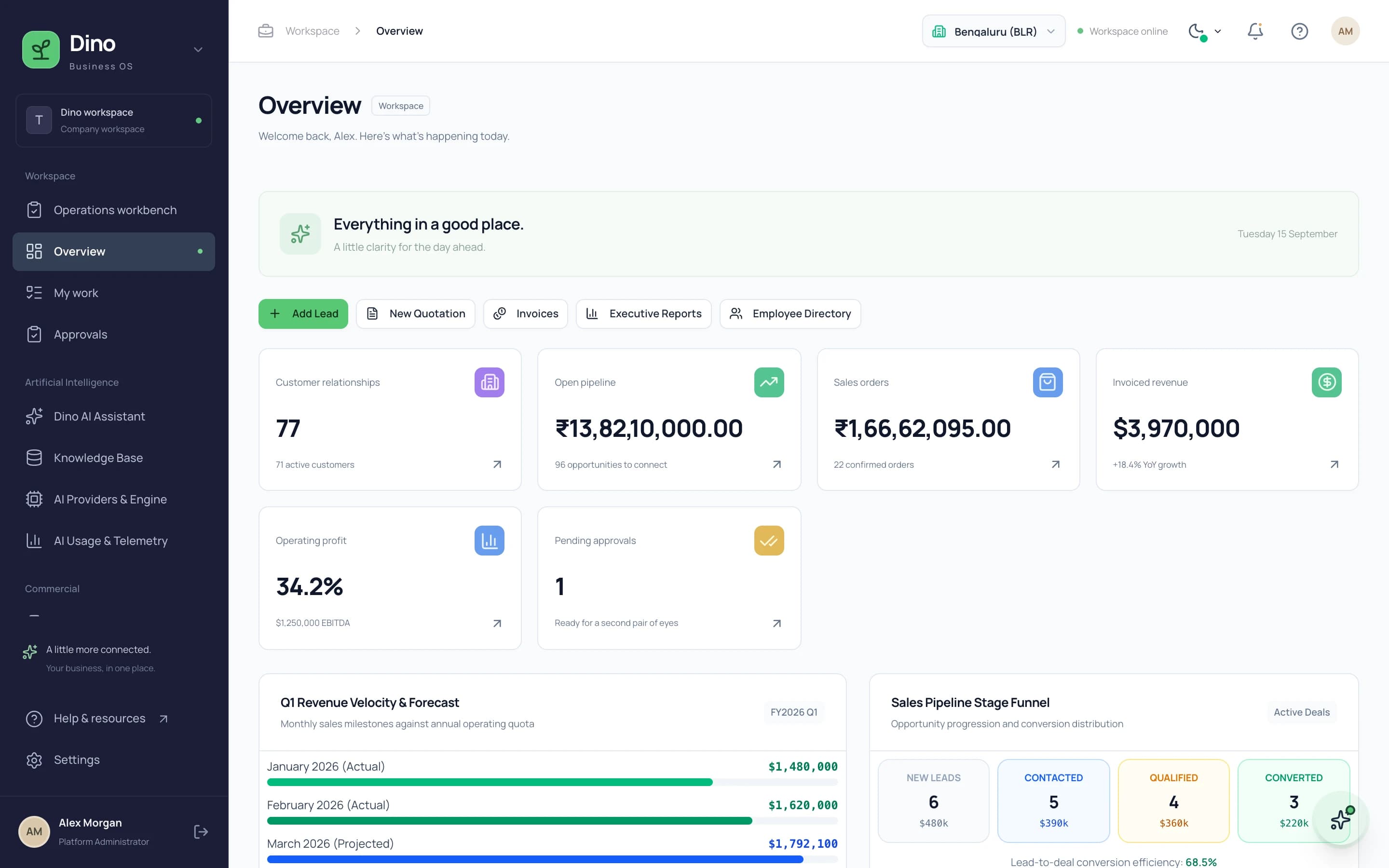
Dino Business OS is AI-powered business operations software that connects CRM, sales, procurement, inventory, projects, HR, payroll, service, assets, documents and finance in one permission-controlled workspace with a built-in LangGraph multi-agent AI assistant.
Want Dino Business OS Under Your Brand?
Rebrand Dino Business OS with your logo and domain, or have it customized for your workflow. All quotes are customized and private.
Related Articles
Real Estate CRM for Builders, Brokerages and Leasing Teams: From Lead to Collection
Why a real estate CRM must carry a deal from lead intake through unit inventory, offers and approvals, booking, milestone collections and leasing — and how Realest CRM does it on one database.
White-Label Real Estate CRM for Dubai and UAE Property Brokerages
How Dubai and UAE real estate brokerages deploy a white-label CRM with PropertyFinder and Bayut XML synchronization, RERA compliance fields, and AED currency management.