
How AI Assistants Answer Business Questions from Live Company Data
Short answer
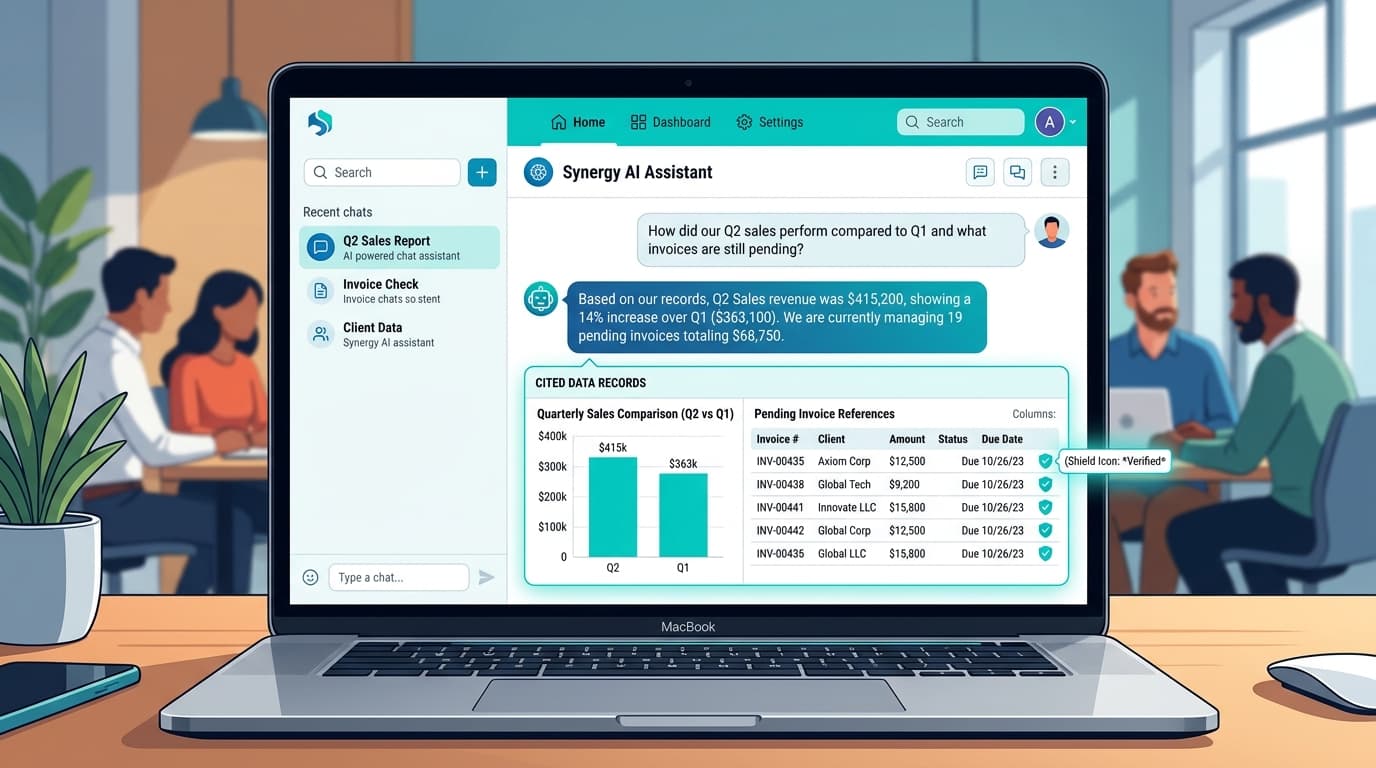
AI assistants answer business questions by routing each query to specialist agents that run permission-scoped database queries against live company records. The agents retrieve matching invoices, leads, employees or policy documents, and the supervisor model compiles a cited answer listing the exact source records. The assistant never creates or modifies data.
The Problem with General-Purpose AI in Enterprise
General public chatbots like ChatGPT or Claude possess broad conversational dexterity, but they possess zero visibility into your company's actual ledger balances, customer accounts, or stock availability. When prompted with questions like 'What is our outstanding receivables balance for Apex Trading?', a generic model either refuses to answer or invents plausible-sounding numbers. Business leaders cannot run operations on probabilistic guesses.
The Deterministic Query and Retrieval Pipeline
An enterprise business assistant pairs generative conversational synthesis with deterministic database queries. Rather than asking an LLM to remember corporate data, the system treats the language model as a natural language query planner and summarizer:
- Inbound natural language query ingestion: The user types or speaks an inquiry such as 'Which quotations above 50,000 are awaiting manager approval?'
- Semantic intent classification: The supervisor model determines whether the inquiry relates to sales, procurement, accounting, or company policy
- Deterministic query compilation: The corresponding specialist agent dynamically constructs a structured database query filtered strictly by the user's role and branch
- Read-only data retrieval: The query executes against the live relational database replica, extracting genuine record identifiers, customer names, and transaction totals
- Grounding and answer compilation: The language model receives the extracted records as factual context and writes a concise natural language briefing
- Transparent citation rendering: The user interface highlights every primary entity referenced, allowing one-click navigation directly to the underlying document
Why Permission Scoping Must Happen in Application Code
A frequent architectural vulnerability in naive AI integrations is relying on system prompts to guard confidential information. Instructing a model 'do not reveal executive compensation' fails under adversarial phrasing or prompt injection. Production business assistants enforce authorization at the database level: the authenticated user's session token injects user role IDs and branch scopes into the query engine before execution occurs. If a sales executive queries payroll, the database returns zero records.
Separation of Analysis from Mutation
Operational integrity demands that analytical assistants never possess direct write access to financial ledgers or client databases. In Dino Business OS, the AI assistant is strictly read-only. Invoices, delivery confirmations, purchase orders, and salary disbursement schedules must be created through dedicated user interfaces equipped with validation rules, maker-checker authorization steps, and immutable audit logs.
Frequently Asked Questions
Frequently Asked Questions
Can the AI assistant make mistakes or hallucinate numbers?
Because the assistant summarizes real records returned by SQL queries and cites each document, users can instantly verify claims against primary records.
Does the AI assistant send confidential data to third parties?
Only the query text and the specific matching record context required for synthesis are sent over encrypted HTTPS to the configured model provider. Data is never used for model training.
How are API keys for AI models secured?
Provider API keys are encrypted with AES-256-GCM before storage in the database and are never displayed in the administrative interface after initial configuration.
Can the assistant answer policy questions from employee handbooks?
Yes. Unstructured documents like HR policies and standard operating procedures are chunked and embedded in Qdrant, allowing the assistant to quote exact handbook clauses.
Need Setup or Custom Coding?
Get in touch to rebrand or customize our ready-made products, or discuss custom development services. All quotes are customized and private.
Related Articles
How Vector Databases Power Enterprise AI Knowledge Bases
A technical overview of how vector databases like Qdrant enable enterprise AI assistants to search company policies, SOPs and manuals using semantic similarity rather than keyword matching.
How LangGraph Multi-Agent AI Assistants Work in Business Software
A technical overview of how LangGraph orchestrates specialist AI agents for CRM, finance, HR and operations to answer business questions from live records with permission-scoped retrieval.