
Self-Hosted ERP vs SaaS ERP: Which Model Suits Your Business?
Short answer
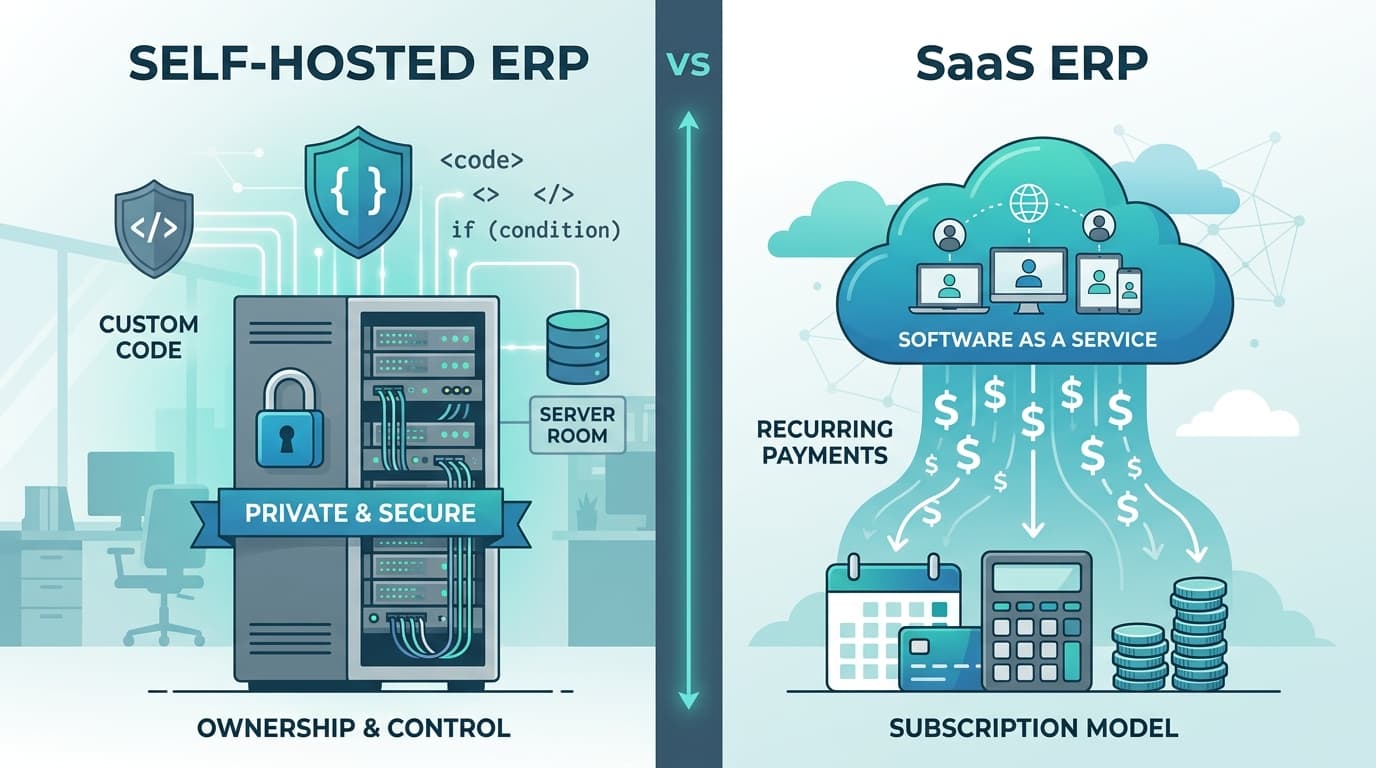
Self-hosted ERP is business operations software deployed on the buyer's own server with full source-code access and no mandatory recurring platform fees. SaaS ERP is hosted by the vendor on their cloud with monthly or annual subscriptions. Self-hosted suits businesses that need data control and long-term cost predictability; SaaS suits teams prioritising zero-maintenance hosting.
The Two ERP Delivery Models
Every enterprise technology leader faces a fundamental architectural choice when modernizing operational infrastructure: deploy self-hosted business software onto a private virtual server you control, or subscribe to a vendor-managed multi-tenant cloud application. While both approaches can provide core customer management, inventory tracking, and accounting capabilities, they diverge dramatically in long-term cost trajectory, data privacy compliance, and code customizability.
Side-by-Side Comparison Matrix
| Factor | Self-Hosted ERP on Private VPS | Multi-Tenant SaaS ERP Subscription |
|---|---|---|
| Upfront investment | One-time commercial license or codebase acquisition | Low initial cost, billed on recurring monthly cycle |
| Ongoing software fees | Zero mandatory recurring software fees; only standard VPS hosting (approx \$20 to \$60 per month) | Escalating per-user seat fees (\$40 to \$180 per employee per month) |
| 3-Year Total Cost of Ownership | Predictable, flat cost structure that decreases per user as company scales | Substantially higher total expenditure due to recurring user tier jumps |
| Source code access | Delivered complete for backend API, frontend web app, and database migrations | Proprietary black-box; client cannot inspect or modify underlying logic |
| Data residency and privacy | Stored locally on your chosen data center in India, UAE, or EU jurisdiction | Stored on shared multi-tenant cloud servers under vendor control |
| Custom workflow modification | Unlimited flexibility to customize schemas, reports, and internal workflows | Constrained strictly to vendor feature roadmaps and generic UI toggles |
| Vendor lock-in exposure | Minimal; database and codebase belong to your engineering custody | Severe; export formats are proprietary and price hikes must be absorbed |
| AI provider integration | Connect your own private API keys and select models freely | Restricted to vendor-selected artificial intelligence features with markups |
When Self-Hosted ERP Makes Commercial Sense
- Your organization employs twenty or more team members across branches, making per-seat SaaS licensing economically disadvantageous
- Regional privacy laws or industry mandates require company data to reside on domestic private servers in Hyderabad, Mumbai, Dubai, or Frankfurt
- Your business operates proprietary pricing formulas, custom discount matrix rules, or unique supply-chain workflows
- You possess internal technical capability or work with a trusted systems partner to oversee a containerized Docker stack
- You require direct database access for custom business intelligence dashboards, automated backups, and external reporting integrations
When Multi-Tenant SaaS Remains Viable
For micro-enterprises with fewer than five employees who lack any technical expertise, multi-tenant cloud subscriptions offer immediate utility without server maintenance. However, once business transaction volume expands and custom departmental workflows emerge, the constraints of closed platforms become a major operational bottleneck.
Frequently Asked Questions
Frequently Asked Questions
Is self-hosted ERP more expensive upfront?
Yes, the initial purchase involves a one-time software license and deployment setup. However, over a two to three-year horizon, self-hosted software is substantially more cost-effective because per-seat subscription fees are completely eliminated.
Can I migrate from SaaS ERP to self-hosted later?
Yes, provided your current SaaS tool allows CSV or JSON database exports. Starting directly with self-hosted software avoids complex subsequent data extraction and migration hurdles.
Do self-hosted ERPs receive updates?
Yes. Software grants include foundational code releases, and TechDino includes three months of complimentary technical support to assist with deployment, configuration, and maintenance.
What hosting platforms can run self-hosted ERP?
Self-hosted platforms with Docker Compose can be installed on Hostinger VPS, DigitalOcean, AWS EC2, Google Cloud, Hetzner, or private on-premise hardware.
Need Setup or Custom Coding?
Get in touch to rebrand or customize our ready-made products, or discuss custom development services. All quotes are customized and private.
Related Articles
Quotation-to-Invoice Workflow Automation: Eliminate Manual Re-Entry
How automated quotation-to-invoice workflows connect quotations, sales orders, delivery notes, tax invoices and payment receipts into one document chain that eliminates manual data re-entry.
Role-Based Access Control in Business Software: How RBAC Works
A practical guide to how role-based access control works in business ERP software, covering roles, permissions, module access, branch scoping and why AI assistants need permission-scoped queries.