
ERP Software with Source Code: What You Receive, What the Licence Allows and What It Costs to Run
Short answer
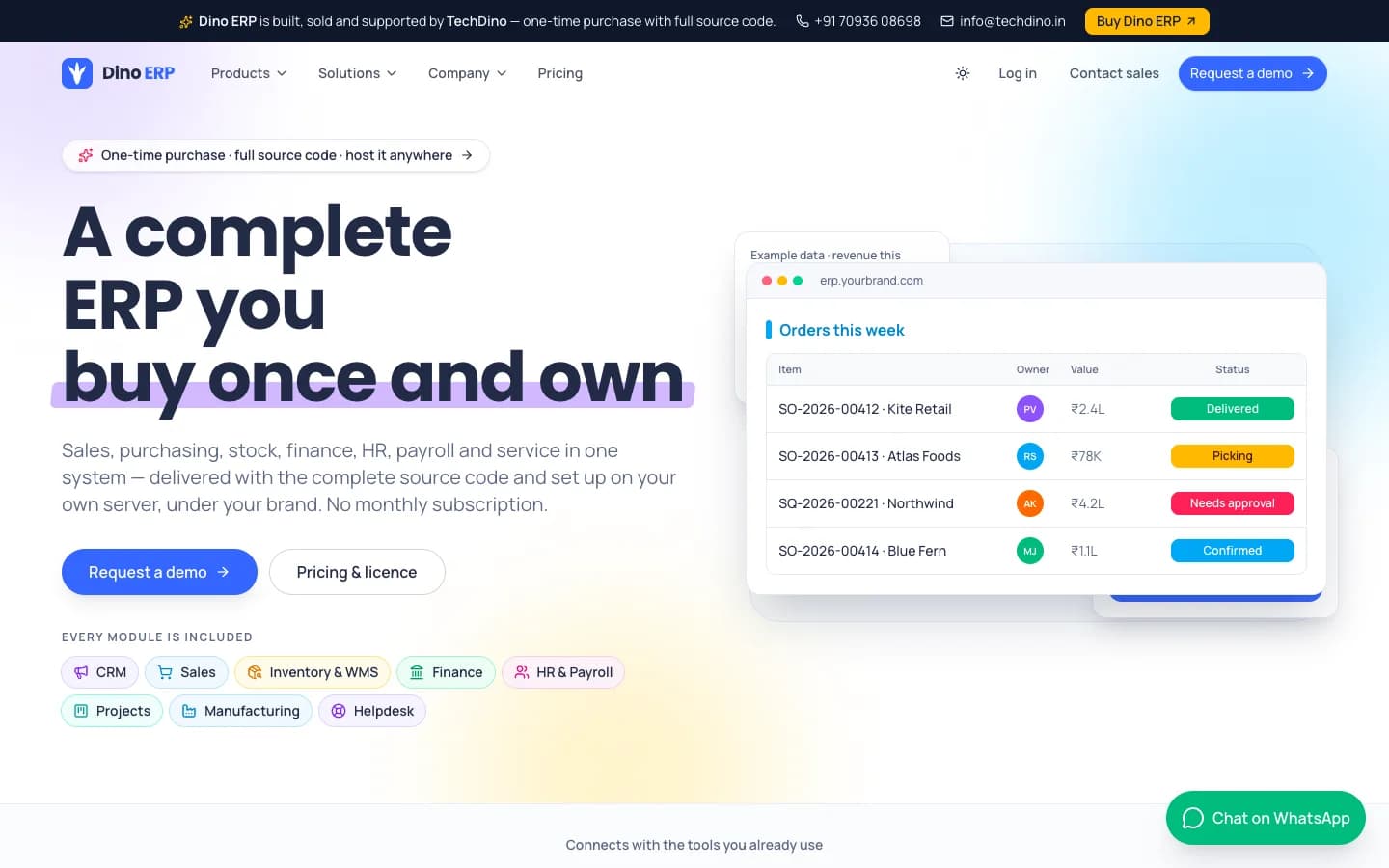
ERP software with source code is bought once for an agreed scope instead of rented per user each month. The buyer receives the application code, database schema, deployment setup and documentation, hosts it on its own server and may modify it under the licence. The trade-off is that hosting, backups, updates and long-term development become the buyer's responsibility after the support period.
Software discussed: Dino ERP · Try the live demo
Per-user ERP subscriptions look cheap at ten users and expensive at a hundred. Businesses that have settled their processes start asking whether they could own the system instead. Buying ERP software with source code is that option, and it is only a good deal when you know exactly what you receive and what you take on.
What a Source-Code Handover Should Contain
| Deliverable | What it is | Why you need it |
|---|---|---|
| Application source | The web app, API and background worker code | Lets your developers fix, extend and audit the system |
| Database schema and migrations | Table definitions and versioned migration files | Needed to upgrade safely and move between servers |
| Seed and reference data | Starter roles, tax profiles and sample records | Gets a fresh installation running |
| Deployment configuration | Docker Compose files, nginx and environment templates | Reproducible installs on any Linux server |
| Documentation | Setup, administration and architecture notes | Reduces dependence on the original developer |
| Support period | A fixed window of technical support | Covers installation questions and verified bugs |
For Dino ERP, that means the Next.js 15 web app, the Express 5 API in TypeScript with Prisma, the BullMQ background worker, the MySQL schema, migrations and seed data, the Docker Compose stack with Redis, nginx, vector search and daily backups, documentation and admin training, and three months of technical support.
What the Licence Allows
- Use, modify and deploy the ERP for your own business under a commercial licence.
- Extend it with your own modules and integrations, by your developers or under a separate development agreement.
- Reselling or deploying it for other businesses needs a separate reseller arrangement stating the number of installations.
- Source-code access does not by itself transfer copyright or grant resale rights. Check both in writing, as explained in how source-code licensing works.
Five-Year Cost: Subscription vs One-Time Purchase
Compare the total over the period you expect to run the system, not the first-year price. Use your own quotes in this framework:
| Cost line | Per-user subscription | One-time purchase with source code |
|---|---|---|
| Software | Price per user per month × users × 60 months | One-time quotation for the agreed scope |
| Hosting | Included | Server or cloud costs, typically a small monthly amount for one company |
| Implementation | Partner fees for setup and migration | Setup and migration assistance included; extra modules quoted |
| Add-ons | Extra modules, storage and API limits often priced per user | Built into the scope or developed once |
| Support after year one | Included in the subscription | Your team, or a support agreement |
| AI usage | Often bundled or sold as an add-on | Paid to the AI provider you configure, or zero with a self-hosted model |
As an illustration, a subscription priced at 50 US dollars per user per month costs 24,000 dollars a year for 40 users and 120,000 dollars over five years, before add-ons, and rises with every hire. A one-time purchase plus hosting and an annual support budget is flat as headcount grows. The break-even point depends on your user count and how much development you expect to need.
What You Take On
- Hosting and uptime: someone must run the server, watch disk space and renew SSL.
- Backups: daily backups are configured in Dino ERP, but restores should be tested on a schedule.
- Security updates: operating system, database and dependency patches are applied by your team or a support provider.
- Upgrades: new features from the original developer are merged deliberately, especially if you changed the code.
- Developer access: plan for at least occasional TypeScript and database skills for changes and reports.
When Source-Code ERP Is the Wrong Choice
- Your processes change every quarter and you are still discovering what you need.
- Nobody, inside or outside the business, can run a Linux server.
- You need a vendor-certified compliance attestation that a self-hosted system does not provide.
- Your user count will stay small enough that a subscription remains cheaper over five years.
Questions to Ask Before You Buy
- Is the source code for every module included, or only some?
- Can I see the demo with my own process before buying? Dino ERP has a role-based demo with 16 quick sign-ins.
- Which country tax and payroll rules ship, and which need configuration?
- How are permissions enforced: in the interface only, or on every API route?
- What happens after the support period, and what does an ongoing agreement cost?
- Where do AI requests go, and can AI be switched off or run on a self-hosted model?
To rebrand or resell an ERP, read the white-label ERP software guide. For the hosting decision itself, see self-hosted ERP vs SaaS ERP, and for the technical design, the self-hosted enterprise ERP architecture guide. Licensing terms are summarised on the source code and licensing page.
Frequently Asked Questions
Can I buy ERP software with source code instead of a subscription?
Yes. Some ERP products, including Dino ERP, are sold once for an agreed scope with the source code, deployed on your own server, with no per-user monthly fee from the developer.
What is included when you buy ERP source code?
The application code, database schema and migrations, seed data, deployment configuration, documentation and a support period. For Dino ERP that covers all 27 product areas, a Docker Compose stack and three months of technical support.
Can I modify ERP software I bought with source code?
Yes, under the commercial licence, for your own business. Reselling it or deploying it for other businesses needs a separate reseller arrangement.
Is one-time ERP cheaper than a subscription?
Over several years it usually is once user numbers grow, because the software cost stays flat while per-user fees rise with headcount. Add hosting, support and development to the comparison before deciding.
What happens after the support period ends?
The software keeps running; nothing expires. Further help, updates or new development are available under a separate support or development agreement, or from your own developers.
The software in this article
Dino ERP
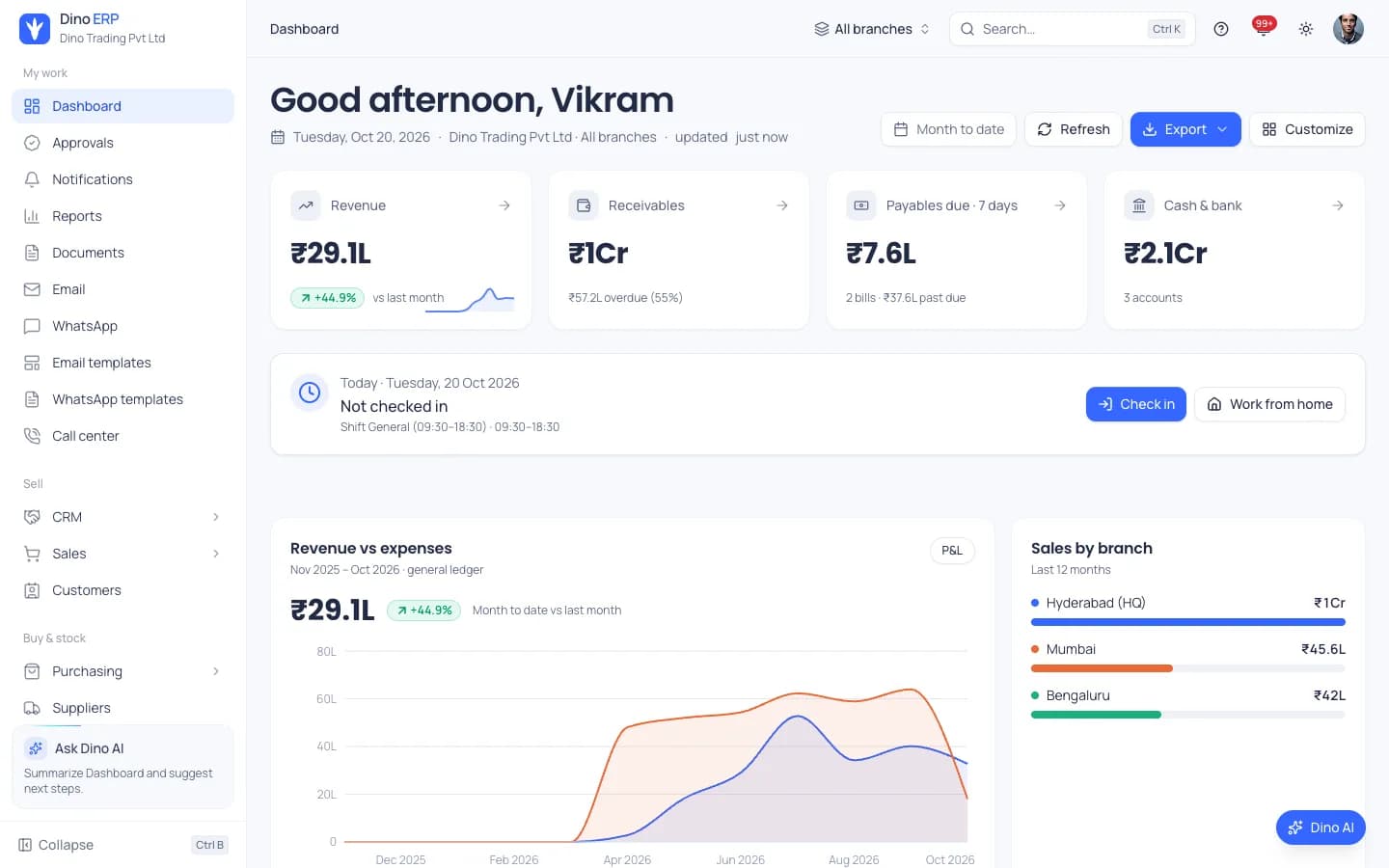
Dino ERP is an AI-powered, self-hosted, white-label ERP with 27 product areas across seven suites, including CRM, sales, purchasing, inventory and WMS, finance, country tax setup, HR and payroll, projects, manufacturing, quality, assets, helpdesk, POS, e-commerce, subscriptions, rental and portals, plus Dino AI for questions, document capture and forecasts.
Want Dino ERP Under Your Brand?
Rebrand Dino ERP with your logo and domain, or have it customized for your workflow. All quotes are customized and private.
Related Articles
White-Label ERP Software: How to Rebrand, Resell or Run Your Own ERP
What white-label ERP software is, who buys it, what can be rebranded, how it compares with open-source and SaaS ERP, and the licence terms resellers need in writing.
AI-Powered General Ledger Reconciliation, Regional Tax Schedules, and Cash Flow Projections
How intelligent ERP accounting modules automate bank statement reconciliation, compute regional GST and VAT profiles, and build reliable 90-day cash flow forecasts.