
White-Label ERP Software: How to Rebrand, Resell or Run Your Own ERP
Short answer
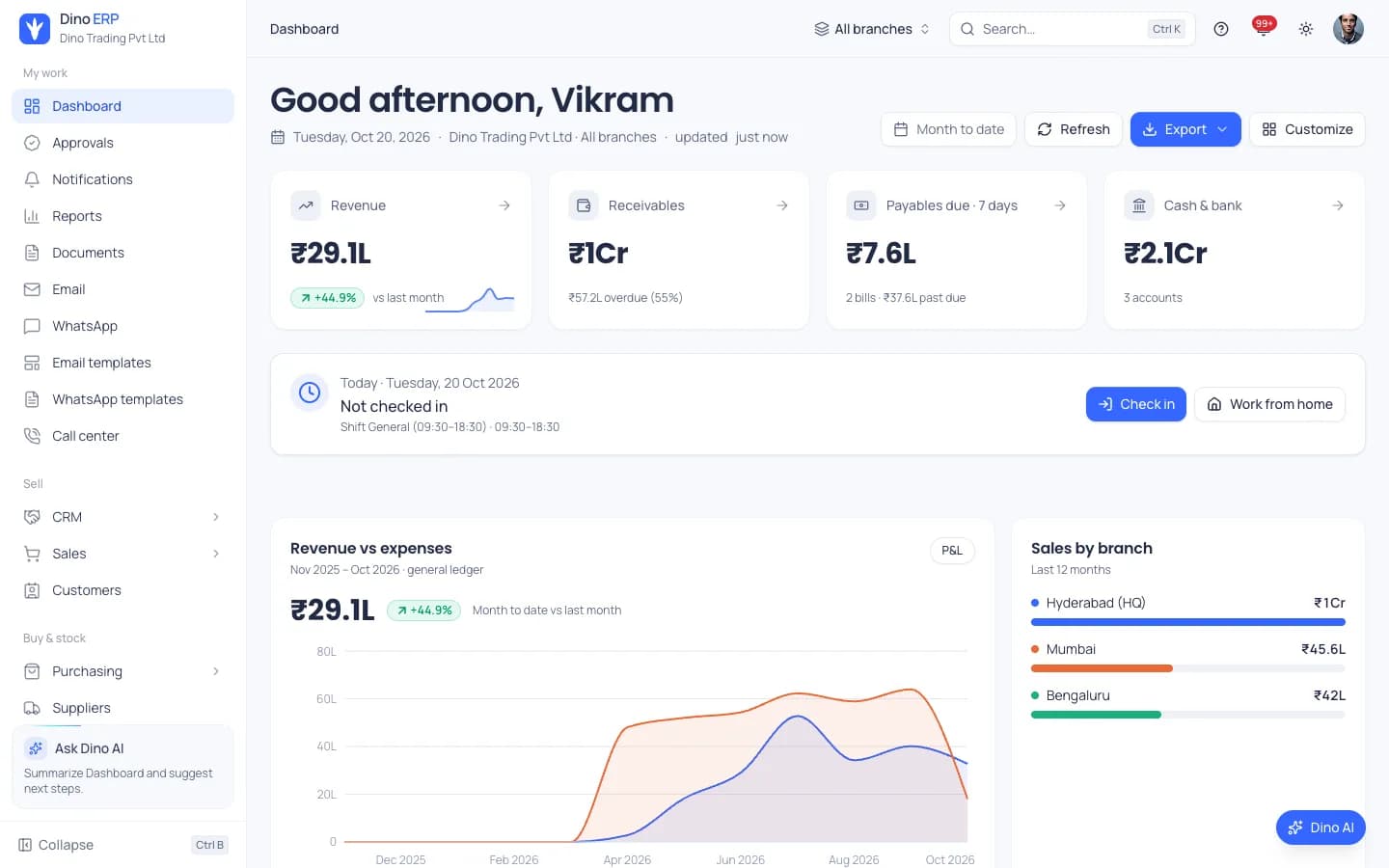
White-label ERP software is a complete ERP system that a reseller, consultant or business deploys under its own brand. It carries your name, logo, colours, domain and document layouts while the vendor stays invisible. With source code and a reseller licence, an IT partner can install it for clients, extend it and charge for implementation and support without building an ERP from scratch.
Software discussed: Dino ERP · Try the live demo
ERP is one of the hardest products to build well. A real ERP needs a double-entry ledger that never drifts from stock and sales, approval rules, permissions down to the branch and field, tax setup per country, payroll, manufacturing and reporting. That is years of work before the first customer. White-label ERP lets an IT consultant, an accounting firm or a growing business start from a finished system and put its own name on it.
What Is White-Label ERP Software?
A white-label ERP is built by one developer and licensed to others who present it as their own. The buyer replaces the branding on every screen, document and portal, deploys it on hosting it controls, and either runs it for its own business or installs it for clients. It is the same model as white-label software in general, applied to the system that runs a company's books and operations.
Who Buys White-Label ERP
- IT consultants and software resellers who want an ERP to sell and implement under their own brand.
- Accounting and tax firms that want to offer clients a branded system tied to their bookkeeping services.
- Industry specialists, for example in distribution, manufacturing or construction, who want to add vertical modules on top of a proven core.
- Multi-branch businesses that want an ERP under their own group brand, hosted on their own servers, without per-user fees.
What Can Be Rebranded
| Element | What changes | Why it matters |
|---|---|---|
| Product name and logo | Login page, navigation, browser tab and emails | Clients see one brand from first login |
| Colours and domain | Theme colours and a custom domain with SSL | The ERP looks like part of your service |
| Print layouts | Invoices, quotations, purchase orders and payslips with logo, bank details and signatures | Documents leave the system under your name |
| Portals | Customer and supplier portals and the careers page | External users never see the original vendor |
| Notifications | Email and WhatsApp templates | Messages match your tone and language |
| Language and layout | English, Hindi and Arabic with right-to-left documents in Dino ERP | Fits Gulf and South Asian clients |
White-Label vs Open-Source vs SaaS ERP
| Factor | White-label ERP with source code | Open-source ERP | SaaS ERP |
|---|---|---|---|
| Branding | Your brand throughout | Possible, subject to the project's licence and trademarks | The vendor's brand |
| Licence | Commercial licence; reselling needs a written reseller arrangement | GPL or LGPL terms set redistribution duties; enterprise editions are often per-user | Subscription terms |
| Recurring fees | No per-user fee for the agreed scope | None for the community edition; paid editions vary | Per user, per month |
| Hosting | Your server or cloud | Your server, or the project's paid cloud | The vendor's cloud |
| Support | Vendor support period, then your team or an agreement | Community or paid partners | Included in the subscription |
| Customization | Full access to the code | Full access, within licence terms | Configuration and vendor APIs only |
Open-source ERPs such as ERPNext (GPLv3) and Odoo Community (LGPLv3) are strong options, but their licences decide what you must share when you redistribute and their names are trademarks. A commercial white-label licence states your rights in one agreement. SaaS ERP is the least work to run, at the cost of brand, data location and fees that rise with headcount. The trade-offs for running your own server are covered in self-hosted ERP vs SaaS ERP.
Reselling: What the Licence Must Say
- Own use or resale: a standard commercial licence covers use, modification and deployment for your own business. Installing for other businesses needs a reseller arrangement.
- Number of installations: the reseller agreement should state how many client installations are covered.
- Branding rights: confirm you may remove the vendor's name from the product and documents.
- Modifications: confirm who owns code you add, and whether you can reuse it across clients.
- Support boundaries: which questions go to the original developer, for how long, and which you answer yourself.
- Copyright: source-code access alone does not transfer copyright or grant resale rights, so put both in writing. See how source-code licensing works.
Architecture Questions Resellers Should Ask
- Tenancy: Dino ERP runs one company per installation with any number of branches, so a reseller deploys one installation per client, each with its own database and backups.
- Deployment: one Docker Compose stack per installation, with web, API, worker, MySQL, Redis, nginx, vector search and daily backups, runs on any Linux server.
- Permissions: check that every API route enforces permissions. Dino ERP's build fails if a route ships without a permission gate.
- Ledger integrity: posted documents should be immutable, numbering gap-free and closed periods locked.
- Country setup: Dino ERP ships tax starters for India GST, VAT in the UAE, Saudi Arabia, Bahrain, Oman, the UK and EU, GST in Australia, New Zealand and Singapore, SST in Malaysia and US sales tax, each needing accountant review.
- AI privacy: Dino AI uses the provider key you configure or a self-hosted model, with Strict and Air-gapped modes for clients who need them.
How a White-Label ERP Engagement Runs
- Scope: agree the modules, countries, branding and number of installations.
- Brand: apply your name, logo, colours, domain and print layouts.
- Deploy: install the stack on your server or your client's, with SSL and backups.
- Configure: branches, roles, approval rules, the tax profile and payroll starter, reviewed with an accountant.
- Migrate: import customers, suppliers, products, employees and opening balances.
- Hand over: source code, documentation, admin training and three months of technical support.
A standard branded deployment is estimated at approximately two weeks after scope, assets and access are confirmed.
For what the source-code handover contains and how to budget five years of running costs, read ERP software with source code. For what AI adds inside an ERP, see AI-powered ERP software for growing businesses. Regional tax and payroll notes are on the Dino ERP page and country pages such as Dino ERP in the UAE.
Frequently Asked Questions
What is white-label ERP software?
It is a complete ERP system licensed to a reseller or business that deploys it under its own brand, with its own name, logo, colours, domain and document layouts, while the original developer stays invisible.
Can I resell a white-label ERP to my clients?
Yes, with a reseller arrangement. A standard licence covers your own business; installing for clients needs a written agreement that states the number of installations, branding rights and support boundaries.
Is white-label ERP better than open-source ERP?
Neither is better in general. Open-source ERP is free to start but its licence sets redistribution duties and its name is a trademark. A commercial white-label licence gives clear rebranding and resale terms in one agreement, with vendor support at handover.
Can one Dino ERP installation serve several client companies?
No. Each installation runs one company in one operating country with any number of branches, so resellers deploy a separate installation per client.
Which countries' tax rules does Dino ERP support?
Tax starters cover India GST, VAT in the UAE, Saudi Arabia, Bahrain, Oman, the UK and EU, GST in Australia, New Zealand and Singapore, SST in Malaysia, South Korea VAT and US sales tax, plus a generic profile. Each needs review by an accountant before go-live.
How long does a white-label ERP setup take?
A standard branded deployment is estimated at approximately two weeks after scope, brand assets and server access are confirmed. Data migration volume and custom modules can extend it.
The software in this article
Dino ERP
Dino ERP is an AI-powered, self-hosted, white-label ERP with 27 product areas across seven suites, including CRM, sales, purchasing, inventory and WMS, finance, country tax setup, HR and payroll, projects, manufacturing, quality, assets, helpdesk, POS, e-commerce, subscriptions, rental and portals, plus Dino AI for questions, document capture and forecasts.
Want Dino ERP Under Your Brand?
Rebrand Dino ERP with your logo and domain, or have it customized for your workflow. All quotes are customized and private.
Related Articles
ERP Software with Source Code: What You Receive, What the Licence Allows and What It Costs to Run
Buying ERP once with the source code instead of renting it per user: what the handover contains, what the licence permits, a five-year cost framework and when it is the wrong choice.
AI-Powered General Ledger Reconciliation, Regional Tax Schedules, and Cash Flow Projections
How intelligent ERP accounting modules automate bank statement reconciliation, compute regional GST and VAT profiles, and build reliable 90-day cash flow forecasts.