
What Is AI-Powered ERP Software and Why Growing Businesses Need It
Short answer
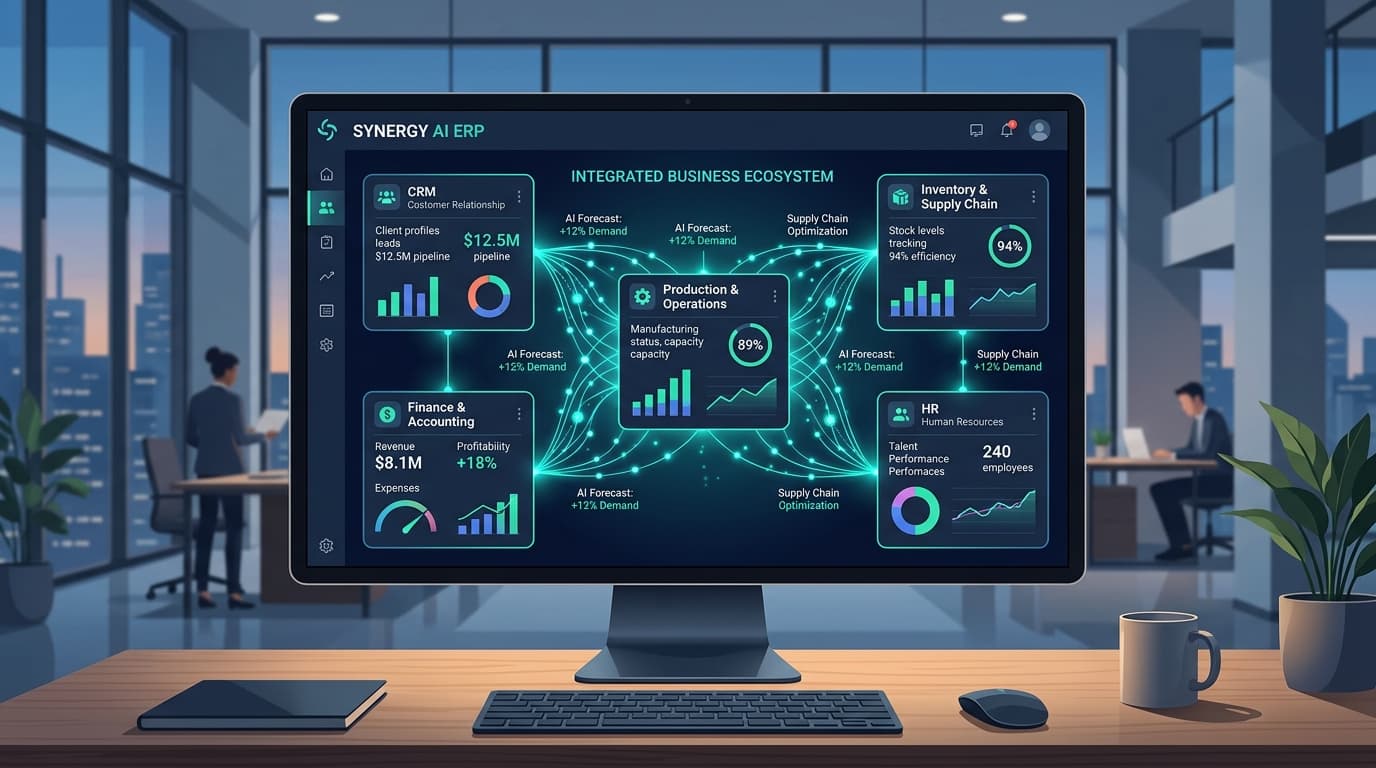
AI-powered ERP software is a business operations platform that connects CRM, sales, procurement, inventory, projects, HR, payroll and finance in one workspace with a built-in AI assistant. The assistant retrieves live company records within each user's permissions and replies with cited sources, replacing manual report assembly and cross-system lookups.
What Does AI-Powered ERP Actually Mean?
Traditional ERP systems connect business modules — accounting, inventory, supply chain, and human resources — into one transactional relational database. AI-powered ERP adds an intelligent language-model layer on top that can inspect, interpret, and answer operational inquiries from those live records. Instead of exporting multiple spreadsheet reports and manually calculating reconciliation summaries, an operations director or branch manager asks the AI assistant a natural language question and receives an instant, verified response with direct source record links.
Crucially, the artificial intelligence layer does not bypass approval gates or modify transactional records without human oversight. It functions as a read-only business analyst that retrieves only the data the signed-in user is explicitly authorized to view, summarizes findings cleanly, and cites the corresponding primary ledger entries, invoices, and purchase orders.
Core Modules in an AI-Powered ERP
Modern enterprise operations require deep cohesion between disparate departments. An integrated AI-powered business operations system coordinates eleven fundamental business workflows under one governance framework:
- CRM and lead pipeline with customer 360-degree profiles and contact timelines
- Quotation-to-cash sales document chain: quotation, sales order, delivery note, tax invoice, and payment receipt
- Procurement workflow: purchase requisition, multi-level approval, supplier purchase order, and warehouse goods receipt
- Multi-branch inventory ledger with real-time stock movements, transfers, and valuation tracking
- Employee directory, attendance logging, leave approval workflows, and reviewed monthly payroll
- General ledger, journal postings, chart of accounts, profit and loss statements, and balance sheet reporting
- Fixed asset registers with automatic depreciation schedules and custodial assignment tracking
- Field service ticketing, annual maintenance contracts (AMC), and customer equipment maintenance history
- Document revision control with internal team screening and version history retention
- AI assistant that answers operational questions from permitted records with cited sources
Who Needs AI-Powered ERP Software?
Companies transitioning past the spreadsheet stage often struggle with information fragmentation. When sales data sits in one CRM, inventory in another warehouse tool, and invoices in desktop accounting packages, leadership loses visibility over true operating margins. AI-powered platforms eliminate cross-tool data friction by unifying transactions across the organization.
| Business Type | Key Pain Solved | Region Focus |
|---|---|---|
| Distribution and trading companies | Disconnected sales orders, warehouse stock, and finance across multi-city branches | India, UAE, Saudi Arabia, global |
| Professional service firms | Manual project timesheets, billing claims, and uncoordinated staff capacity planning | India, United States, United Kingdom |
| Field service operators | Fragmented annual maintenance agreements, lost service tickets, and field technician dispatch delays | India, UAE, GCC region |
| Wholesale and supply chain groups | Stockouts caused by lack of purchase request visibility against real-time customer commitments | India, Southeast Asia, Middle East |
| Multi-branch enterprises | Staff accessing confidential payroll or margin figures outside their branch or role permissions | Global markets |
Self-Hosted Deployment Versus Closed SaaS Models
Many commercial ERP suites operate strictly as multi-tenant SaaS clouds that impose steep per-seat monthly license fees and restrict direct database access. When your business grows from twenty to two hundred employees, software costs multiply unpredictably. In contrast, self-hosted deployment on client-controlled VPS infrastructure with complete source code handover ensures predictable operational expenditures, sovereign data residency, and the flexibility to adapt code to specific regulatory environments like GST in India or VAT in the UAE.
Frequently Asked Questions
Frequently Asked Questions
Can an AI ERP assistant create or change business records?
No. The AI assistant functions strictly in read-only mode for business data. It retrieves and summarizes live records while quotations, orders, invoices, and payroll runs require explicit human confirmation through approval workflows.
What data does the AI assistant access?
The assistant only queries records the signed-in user is permitted to see, based on their role, module permissions, and branch assignments. Restricted records never reach the language model context window.
Is AI-powered ERP suitable for businesses in India and UAE?
Yes. Platforms like Dino Business OS support INR payroll, tax invoices, multi-currency transactions, and regional finance workflows used in India, UAE, and international trade corridors.
What server infrastructure is required to host an AI-powered ERP?
A standard Linux VPS with 4 vCPUs, 8 GB RAM, and Docker Compose handles the web application, backend API, relational database, background worker, and vector search service smoothly.
Need Setup or Custom Coding?
Get in touch to rebrand or customize our ready-made products, or discuss custom development services. All quotes are customized and private.
Related Articles
How Vector Databases Power Enterprise AI Knowledge Bases
A technical overview of how vector databases like Qdrant enable enterprise AI assistants to search company policies, SOPs and manuals using semantic similarity rather than keyword matching.
How AI Assistants Answer Business Questions from Live Company Data
A practical explanation of how AI assistants retrieve invoices, leads, employees and policy documents from live business records, enforce permissions, and cite their sources.