
Autonomous AI Agents vs Deterministic Workflows: An Engineering Decision Matrix
Short answer
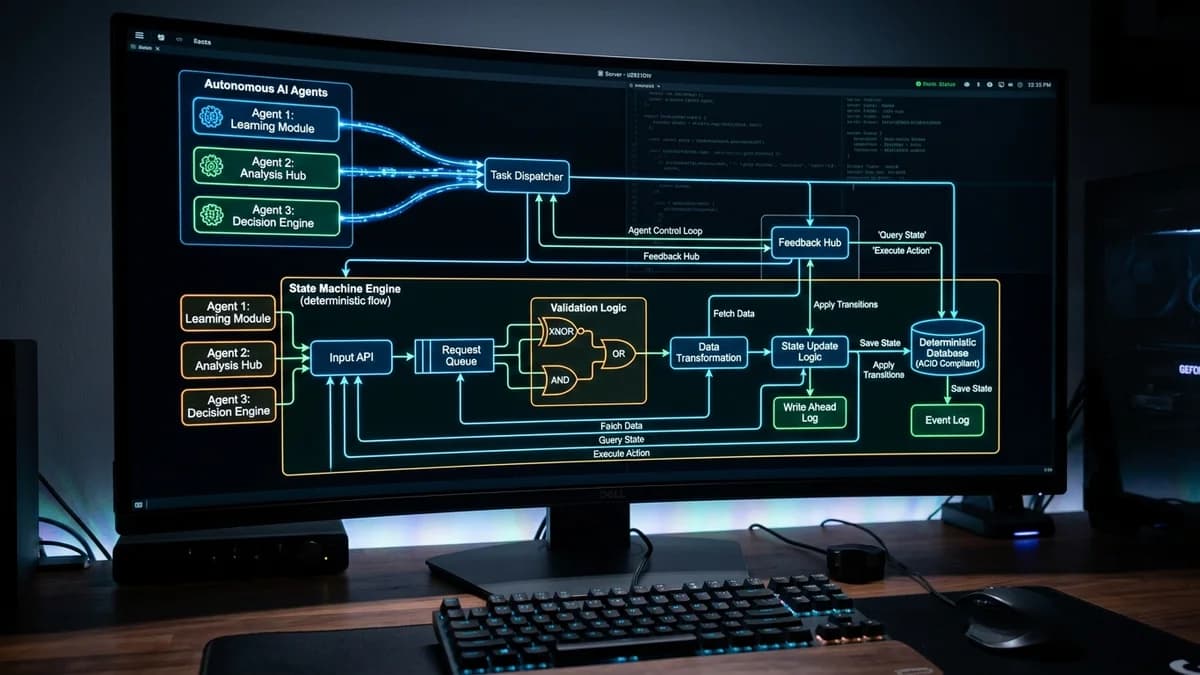
Software architects choose between autonomous AI agents and deterministic workflows based on predictability requirements. Deterministic state machines excel at transactional business operations like billing and order fulfillment where 100% rule adherence is required. Autonomous AI agents suit unstructured tasks like qualitative customer sentiment extraction and complex document synthesis, operating under structured guardrails to prevent unpredictable outcomes.
The rapid emergence of agentic reasoning frameworks has created a tendency to apply large language models to every business automation challenge. However, deploying probabilistic AI agents in domains requiring strict compliance or deterministic accuracy frequently leads to non-deterministic errors, latency inflation, and uncontrolled token expenses.
Decision Framework: Selecting the Right Automation Pattern
Evaluate your business process against four critical architectural criteria to determine whether an AI agent or a state machine is appropriate:
- Input Unpredictability: If input data arrives as unstructured natural language, messy email threads, or freeform documents, an AI agent's semantic interpretation is essential.
- Failure Cost: If a flawed decision carries financial or compliance liability (e.g., executing payment transfers or issuing refunds), deterministic state machines must enforce rules.
- Execution Speed & Latency: Deterministic rules execute in microseconds, whereas multi-step agentic reflection loops often take several seconds to complete.
- Cost & Token Budget: Deterministic code costs fractions of a cent per million operations, whereas multi-agent planning loops consume significant token volumes per invocation.
System Comparison: Autonomous AI Agents vs Deterministic State Machines
| System Dimension | Autonomous AI Agent Pattern | Deterministic State Machine Pattern |
|---|---|---|
| Execution Paradigm | Probabilistic reasoning and dynamic tool selection | Strict rules-based finite state transitions |
| Ideal Problem Domain | Document synthesis, sentiment triage, creative text generation | Billing calculations, inventory decrements, account status updates |
| Repeatability | Output may vary slightly across runs given identical inputs | Deterministic bit-for-bit identical outputs for identical inputs |
| Auditability & Debugging | Requires inspection of prompt history and reasoning logs | Direct inspection of database state transitions and stack traces |
| Operational Cost | Variable per-token pricing based on reasoning depth | Virtually zero marginal computational execution expense |
Explore our AI Agent Development Services and Custom Software Engineering to engineer balanced automation systems.
The Hybrid Pattern: Sandboxing AI with Guardrail State Machines
The most dependable enterprise systems marry both paradigms. The autonomous AI agent interprets customer intent, extracts structured parameters from natural language, and suggests proposed actions. A deterministic state machine then validates the parameters against strict business rules before allowing database commits, preventing hallucinations from affecting production data.
Frequently Asked Questions
Engineering Dependable Business Automation
Harness the power of artificial intelligence without compromising operational predictability. Contact TechDino to architect a production-ready automation system tailored to your enterprise.
Frequently Asked Questions
How can businesses stop autonomous AI agents from hallucinating during database actions?
By enforcing strict Pydantic or JSON schema validation and requiring deterministic verification gates before any mutating database operations are executed.
When is an LLM agent strictly necessary over regular code?
When dealing with semantic ambiguity, unstructured document ingestion, conversational natural language, or multi-modal image and voice analysis.
Can autonomous AI agents integrate with legacy SQL databases and internal APIs?
Yes. By providing the model with typed tool schemas, agents can securely query read-only database replicas and dispatch API requests.
What monitoring tools are used to track agent decision paths?
We implement structured tracing frameworks that record every prompt, tool execution, and token cost for administrative review and quality assurance.
Explore Next
- See our ready-made software products
- Learn about our AI agent development services
Need Setup or Custom Coding?
Get in touch to rebrand or customize our ready-made products, or discuss custom development services. All quotes are customized and private.
Related Articles
Low-Latency AI Voice Agents: WebRTC, Speech-to-Text, and Pipeline Architecture
Engineering sub-500ms conversational AI voice agents: streaming speech recognition, language model inference, text-to-speech synthesis, and interruption handling.
Deploying Enterprise RAG on Private Business Documents: Architecture, Vector Databases, and Guardrails
A technical blueprint for deploying enterprise Retrieval-Augmented Generation on private internal documents with pgvector, hybrid search, and hallucination guardrails.