
OTT Monetization Models Explained: SVOD vs TVOD vs AVOD vs Pay-Per-View
Short answer
OTT services earn money in four main ways. SVOD charges a recurring subscription for the catalogue, TVOD charges per title as a rental or purchase, AVOD streams free and earns from video ads, and pay-per-view sells tickets for live events. Most growing services combine them, for example a free ad-supported tier, a paid ad-free plan and rentals for new releases.
Software discussed: Dino OTT
Choosing how to charge is the decision that shapes everything else on a streaming service: the catalogue you license, the apps you need, the payment providers you sign with and the numbers you watch every week. The models below are not exclusive, and the strongest services mix them deliberately.
The Four Models at a Glance
| Model | How the viewer pays | Suits | Number to watch |
|---|---|---|---|
| SVOD (subscription) | A monthly or yearly plan for the whole catalogue | Deep catalogues, regional language services, kids and education | Monthly churn |
| TVOD (rent or buy) | Per title, with a viewing window or to keep | New films, premium releases, niche documentaries | Conversion rate per title |
| AVOD (ad-supported) | Free, paid for by advertisers | Large audiences, library content, news and short shows | Ad revenue per thousand views |
| PPV (pay-per-view) | A ticket for a scheduled live event or premiere | Concerts, local sports, film premieres, spiritual events | Tickets sold per event |
SVOD: Subscriptions
Subscriptions give predictable revenue and reward a catalogue viewers come back to. Plans usually differ by video quality, the number of profiles, how many devices can sign in and how many can stream at the same time. Free trials, coupons and gift codes help acquisition, and annual plans reduce churn.
The risk is churn: viewers join for one show and cancel after it ends. A steady release calendar and a back catalogue worth exploring keep them. In Dino OTT, each plan sets its profiles, connected devices and simultaneous streams, and coupons, gift codes and free trials are managed in the admin studio.
TVOD: Rentals and Purchases
Transactional video on demand charges for one title at a time. A rental opens a viewing window, often 48 hours from first play; a purchase, sometimes called EST or buy-to-own, keeps the title in the viewer's library. TVOD suits new releases that would undervalue a film if bundled into a subscription, and audiences who watch occasionally and will not subscribe.
AVOD: Free, Ad-Supported Streaming
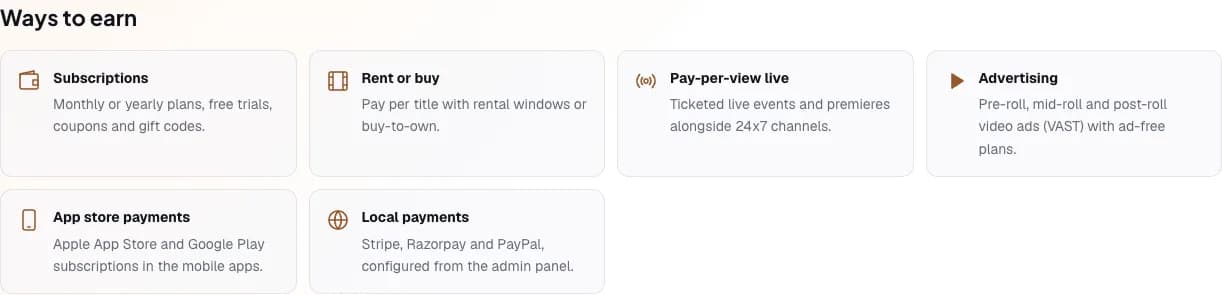
AVOD removes the payment barrier and earns from advertisers instead. Video ads are served through VAST tags from an ad server, as pre-roll before the title, mid-roll during it and post-roll after it. Revenue depends on CPM, the price per thousand impressions, and fill rate, the share of ad slots actually sold. Dino OTT supports pre-roll, mid-roll and post-roll VAST ads and ad-free plans, so a free ad-supported tier can sit next to a paid plan.
Client-side ad insertion, where the app requests ads itself, is simplest to start with. Server-side ad insertion stitches ads into the stream and is harder for ad blockers to skip, but needs a specialised provider and is scoped as a separate integration.
Pay-Per-View: Live Events and Premieres
Pay-per-view sells access to a specific event: a concert, a local cricket or football league final, a film premiere or a religious festival broadcast. Revenue arrives in a burst around the event, so marketing before the date matters more than the catalogue. Tickets can sit alongside 24x7 live channels with a programme guide, so viewers who buy once discover the rest of the service.
Hybrid Models Are the Norm
- Free with ads plus a paid ad-free plan: the free tier builds reach and the paid plan converts the most engaged viewers.
- Subscription plus premium rentals: new releases are rented first and move into the subscription catalogue later.
- Subscription plus pay-per-view: members get the catalogue and buy tickets for special live events.
- Free trial into an annual plan: a trial lowers the barrier and an annual price cuts churn.
App-Store Billing and Payment Fees
Digital subscriptions sold inside Android and iOS apps generally go through Google Play and App Store billing, which charge a commission that commonly ranges from 15% to 30% depending on the programme and how long the subscription has run. Web checkout through a gateway such as Stripe, Razorpay or PayPal carries a lower processing fee. Dino OTT supports both, so a service can sell on the web and inside the apps and price each channel with its fees in mind.
Choosing a Model by Content Type
| Content | Lead model | Add later |
|---|---|---|
| Regional language films and series | SVOD with low-priced plans | Rentals for new releases |
| Large free library, news or short shows | AVOD | Ad-free subscription |
| New theatrical releases | TVOD rentals | Move into SVOD after the window |
| Local sports and concerts | Pay-per-view | Subscription for archives and highlights |
| Courses and coaching | SVOD or per-course purchase | Live sessions as tickets |
| Devotional content | AVOD or low-priced SVOD | Pay-per-view for festival broadcasts |
Metrics That Tell You It Is Working
- Churn: the share of subscribers who cancel each month.
- ARPU: average revenue per user across plans, rentals, tickets and ads.
- LTV against CAC: the revenue a viewer brings over their lifetime compared with what it cost to acquire them.
- Completion rate per title: whether viewers finish what they start, which guides licensing.
- Ad fill rate and CPM for AVOD tiers.
- Conversion from trial or free tier to paid plans.
To plan the platform itself, read the white-label OTT platform guide. For India-specific pricing and regulations, see how to start an OTT platform in India.
Frequently Asked Questions
What is the difference between SVOD, TVOD and AVOD?
SVOD charges a recurring subscription for the catalogue, TVOD charges per title as a rental or purchase, and AVOD is free to watch and earns from video ads.
Which OTT monetization model is best for a new service?
It depends on the catalogue. A deep library suits subscriptions, a few premium films suit rentals, a large free library suits ads, and live events suit pay-per-view. Many services start with a free ad-supported tier and a paid ad-free plan.
What is VAST in video advertising?
VAST is the IAB standard format that lets a video player request an ad from an ad server and play it as pre-roll, mid-roll or post-roll.
How much do app stores take from OTT subscriptions?
Google Play and App Store commissions on digital subscriptions commonly range from 15% to 30%, depending on the programme and subscription age. Web checkout through a payment gateway usually costs less.
Can one OTT platform run subscriptions, rentals and ads together?
Yes. Dino OTT runs subscriptions, rentals and buy-to-own, pay-per-view tickets and VAST video ads with ad-free plans in the same service.
The software in this article
Dino OTT
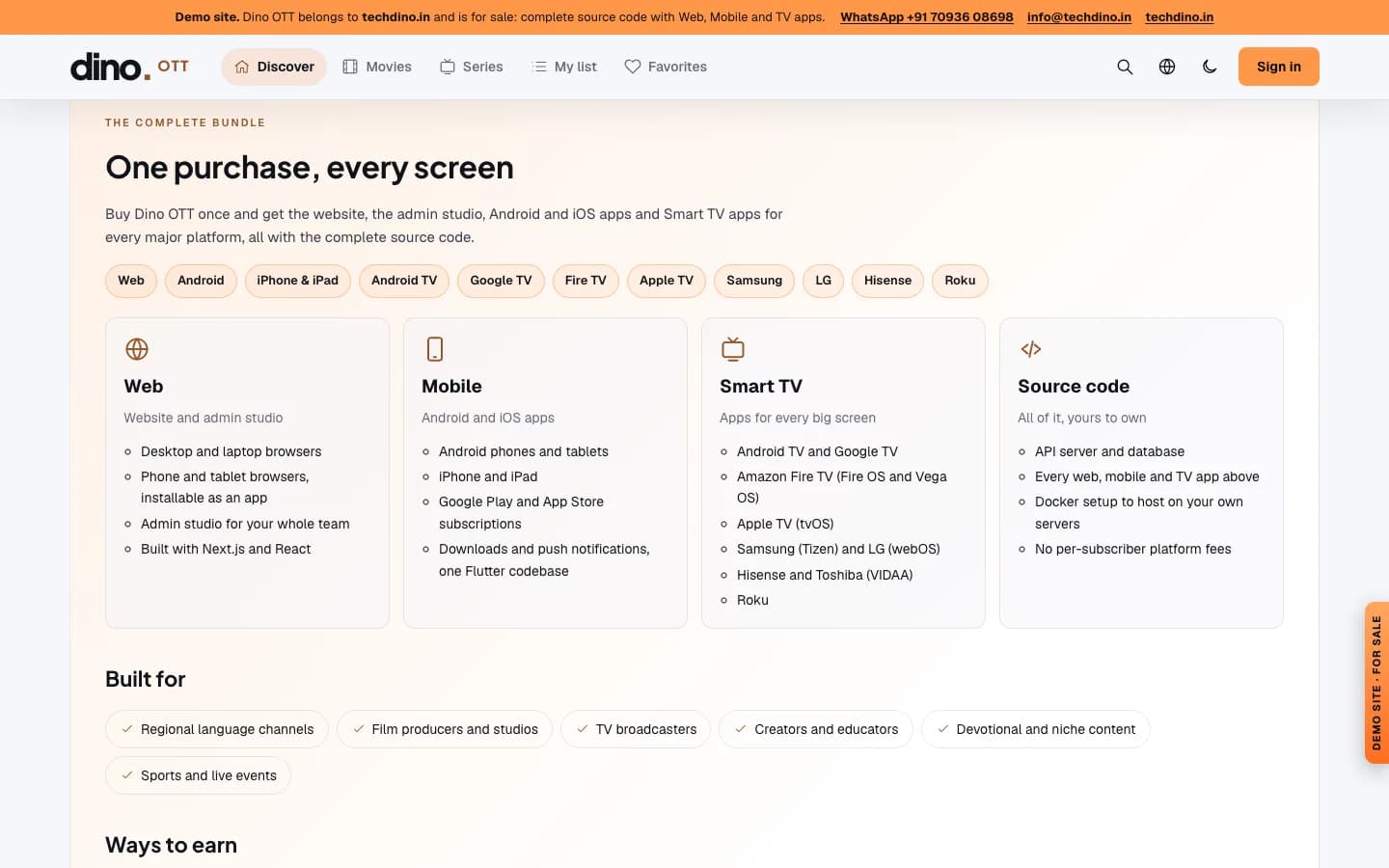
Dino OTT is a white-label OTT streaming platform with a customer website, an admin studio with 14 staff roles, Android and iOS apps from one Flutter codebase, and Smart TV apps for Android TV, Google TV, Fire TV, Apple TV, Samsung, LG, VIDAA and Roku, sold with the source code.
Want Dino OTT Under Your Brand?
Rebrand Dino OTT with your logo and domain, or have it customized for your workflow. All quotes are customized and private.
Related Articles
How to Start an OTT Platform in India: Regional Language Streaming, Payments and the IT Rules
A step-by-step plan for launching a regional language OTT service in India: content rights, the IT Rules 2021 and DPDP Act, UPI and app-store payments, devices and running costs.
White-Label OTT Platform: How to Launch Your Own Streaming Service on Web, Mobile and Smart TV
What a white-label OTT platform includes, how it compares with building from scratch or renting a hosted service, which devices matter, and the costs you still carry after launch.