
Two-Way ERP Stock Synchronization: Connecting Purchase Orders, Ledgers, and WMS
Short answer
Synchronizing ERP purchase orders with stock ledgers requires perpetual valuation, landed cost allocation, and two-way bin confirmations. When warehouse teams record goods receipts, the ERP credits inventory clearing, debits received stock, and signals warehouse management systems to allocate storage bins. Automated variance buffers prevent stockouts while maintaining audited accounting ledgers across multiple branches.
In distributed retail, manufacturing, and wholesale distribution, inventory misalignment between procurement records and warehouse physical counts represents a recurring source of balance-sheet distortion. When a purchase order is fulfilled, simply flagging a line item as received inside an administrative panel fails to reflect physical storage bins, transit losses, or landed freight overhead.
Modern enterprise architectures overcome this through two-way stock synchronization: an event-driven loop that binds procurement purchase orders, double-entry financial journals, and warehouse management system (WMS) bin allocations.
The Accounting Mechanics of Goods Receipt Note (GRN) Processing
A purchase order represents an operational commitment, not a financial liability. The balance-sheet liability only crystallizes when the supplier's goods physically pass inspection at the receiving bay. At that juncture, the system generates a Goods Receipt Note (GRN), triggering perpetual inventory journal entries.
| Operational Event | Financial Ledger Debit | Financial Ledger Credit | Inventory Subledger Effect |
|---|---|---|---|
| Purchase Order Issued | None (Commitment Only) | None (Commitment Only) | Tracked in Allocated Inbound Pipeline |
| Goods Received at Dock | Stock In-Transit / Clearing | Accounts Payable Accrued (Unbilled GRN) | Physical Staging Bin Count +N |
| Quality Inspection Passed | Raw Materials / Finished Goods | Stock In-Transit / Clearing | Transferred from Staging to Storage Bins |
| Vendor Invoice Matched | Accounts Payable Accrued | Trade Creditors (Payable) | Zero Subledger Change (Price Variance Checked) |
By maintaining an Unbilled GRN clearing account, financial controllers prevent un-invoiced stock from inflating profit margins during monthly reporting closes.
Two-Way Synchronization Between Central ERP and Warehouse Floors
Enterprise ERPs record inventory at a macro facility level (for example, Warehouse South), whereas WMS engines manage granular storage topologies (aisle, rack, shelf, bin coordinate). Synchronization must operate bi-directionally without race conditions.
- Inbound ASN Broadcast: When an advance shipping notice (ASN) arrives from a vendor, the ERP pushes anticipated line items, batch identifiers, and temperature thresholds to the WMS dock scheduler.
- Directed Put-Away Confirmation: Once pallets are scanned and stored, the WMS emits a putaway-confirmed webhook containing bin coordinates and lot numbers, committing the units to available-to-promise (ATP) stock.
- Pick-Face Cycle Counting: Discrepancies noted during routine picking automatically register a quarantine status on the central ERP ledger, preventing e-commerce and retail POS terminals from overselling unverified stock.
Landed Cost Allocation and Perpetual Valuation Models
Procurement costs rarely equal the supplier's unit price on the invoice. Port customs tariffs, ocean freight surcharges, marine insurance, and inland haulage all factor into true landed cost valuation. If inventory is valued solely on ex-factory purchase prices, the cost of goods sold (COGS) is artificially suppressed.
Through landed cost vouchers, modern ERP platforms allocate secondary freight invoices proportionally across line items by volume, weight, or base value. The system recalculates moving-average cost (MAC) dynamically as lots are received into stock.
Handling Partial Shipments and Purchase Order Amendments
Real-world supply chains frequently experience short-shipments, damaged packaging, and supplier split deliveries. A resilient ERP keeps purchase order lines open until either the total quantity passes inspection or an authorized procurement officer explicitly closes the line with a backorder cancellation note.
This prevents orphaned clearing accounts and ensures that remaining quantities continue to register accurately in material requirement planning (MRP) calculations.
Frequently Asked Questions
Frequently Asked Questions
What is the difference between periodic and perpetual inventory in an ERP?
Periodic inventory calculates inventory value only at the end of an accounting period via physical audits, whereas perpetual inventory updates stock ledgers and cost of goods sold instantly upon every receipt, adjustment, or sale.
How does an ERP handle purchase order price variances?
When a vendor invoice differs from the purchase order rate, the ERP routes the difference to a Purchase Price Variance (PPV) expense account rather than adjusting previously issued historical stock.
Can Dino ERP integrate with existing third-party barcode scanners and WMS hardware?
Yes. Dino ERP provides REST API endpoints and webhooks designed for standard handheld RF barcode terminals and automated warehouse sorting systems.
Is Dino ERP deployed on our private infrastructure?
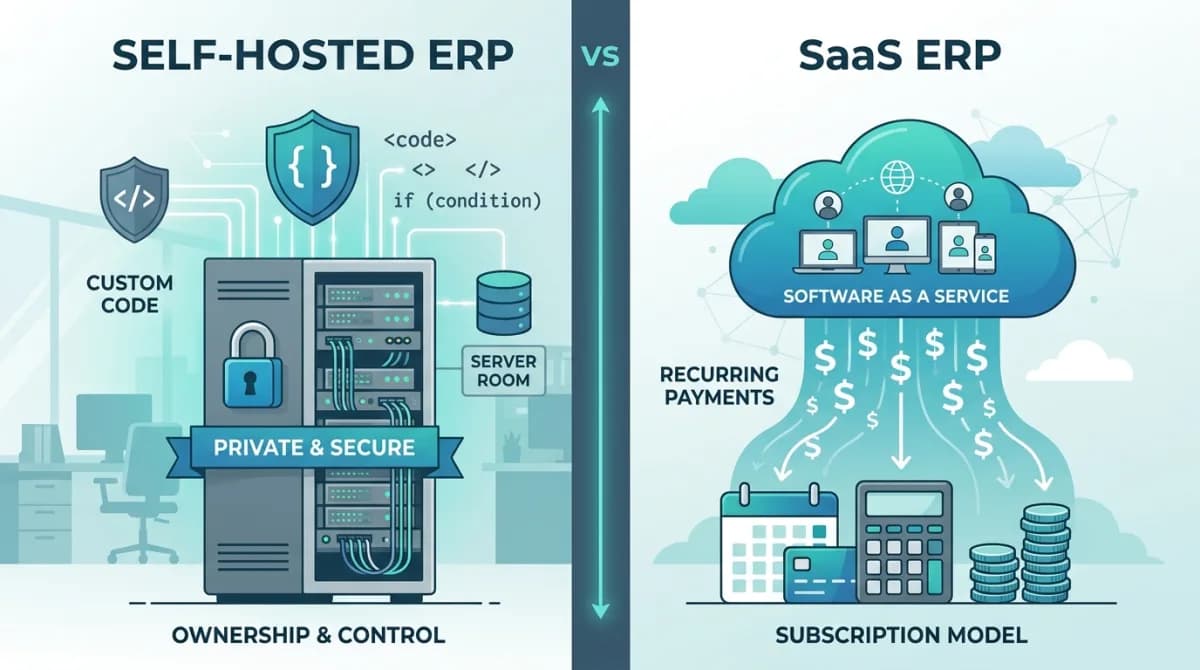
Yes. Dino ERP is packaged as self-hosted Docker containers, allowing businesses to deploy on private VPS instances or cloud environments without cloud-provider lock-in.
Need Setup or Custom Coding?
Get in touch to rebrand or customize our ready-made products, or discuss custom development services. All quotes are customized and private.
Related Articles
AI-Powered General Ledger Reconciliation, Regional Tax Schedules, and Cash Flow Projections
How intelligent ERP accounting modules automate bank statement reconciliation, compute regional GST and VAT profiles, and build reliable 90-day cash flow forecasts.
Deterministic Workflow Automations vs AI Agents in Enterprise Task Management
Compare deterministic trigger-condition-action automations with autonomous AI agents in enterprise task management, exploring architectural strengths, safety guardrails, and hybrid patterns.