
West African Retail Operations: Eliminating Monthly Dollar Fees with Self-Hosted POS
Short answer
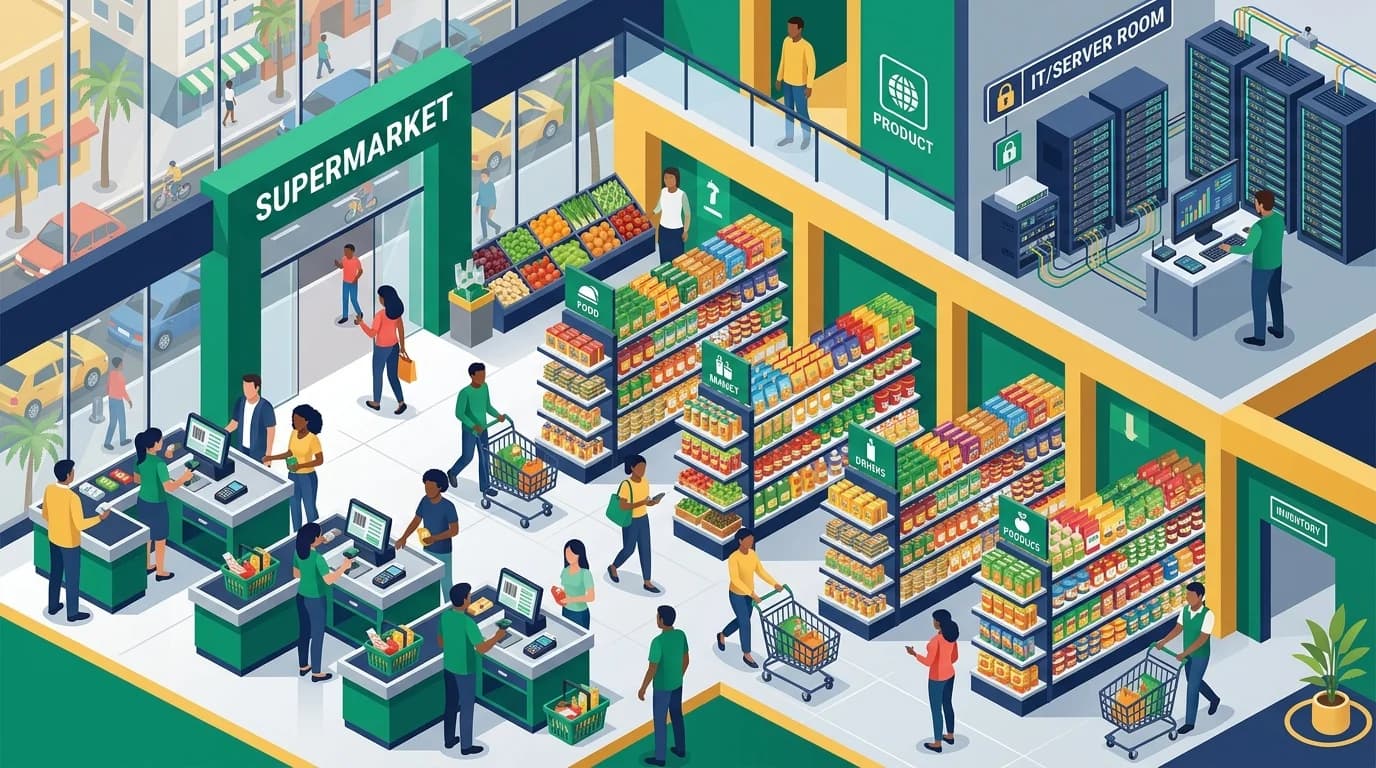
Supermarket chains, pharmacies, and wholesale distributors in Nigeria and Ghana face significant recurring overhead when paying foreign currency software subscriptions for cloud point-of-sale registers. Deploying a self-hosted retail POS on private server infrastructure delivers synchronized multi-store inventory, offline barcode billing, and local bank payment processing under a predictable cost structure.
Foreign Exchange Pressure on West African Retailers
Retail operators managing grocery stores, boutiques, and electronics outlets across Lagos, Abuja, and Accra face steep operational friction with dollar-billed SaaS systems. Paying $80 to $120 monthly per checkout counter rapidly escalates across multi-store footprints. A retail chain with 10 checkout registers across 3 branches incurs over $12,000 (roughly 18 million Naira) annually in basic software billing.
Local network outages further compound the issue. When internet connections fluctuate, pure cloud POS systems fail to process checkout queues, leading to lost sales. Self-hosted POS with offline caching provides retail resilience without recurring foreign exchange liabilities.
Engineering Capabilities for West African Retail Markets
TechDino RetailDino SaaS unifies physical checkout terminals, regional warehouse logistics, and local payment channels:
- Offline-Resilient Checkout: Cashiers continue barcode scanning and receipt generation during broadband interruptions, auto-syncing sales when internet reconnects.
- Local Payment Gateways: Wire checkout terminals directly to local payment rails (such as Paystack, Flutterwave, and direct bank transfer prompts) with zero platform surcharge.
- Inter-Store Inventory Transfers: Dispatch and track stock transfers between central warehouses in Ikeja and retail branches in Lekki or Victoria Island.
- Theft Prevention & Cash Drawer Audits: Monitor cash reconciliations, end-of-shift register closures, and discrepancy alerts across all active checkout points.
Financial Comparison: Monthly Dollar SaaS vs. Self-Hosted Model
| Expense Parameter | Per-Register Cloud POS (10 Counters) | TechDino RetailDino SaaS (Self-Hosted) |
|---|---|---|
| Monthly Register Fee | $80 - $120 / counter ($1,000/mo) | Single one-time code acquisition license |
| Cloud Infrastructure | Included in foreign currency subscription | $15 - $25 / month (Private VPS) |
| Cashier & Manager Logins | Restricted by purchased tiers | Unlimited register and cashier profiles |
| Payment Channel Markup | Vendor commission cut on card rails | Direct merchant settlement (Zero markup) |
| 3-Year Total Expenditure | $36,000+ (54+ Million NGN) | Predictable baseline following Year 1 |
Frequently Asked Questions
Local Server Hardening & Database Synchronization Across West Africa
RetailDino SaaS uses an offline-first indexed client database coupled with a centralized PostgreSQL server. Even if metropolitan cellular or fiber networks experience temporary drops in Lagos or Accra, cashiers continue processing customer checkouts. The local SQLite or browser cache automatically synchronizes transactions once connectivity is re-established.
Administrators receive complete deployment documentation, database migration scripts, and server configuration templates. Because the software is owned under a perpetual license, your internal IT team or designated developers can customize database schemas, implement proprietary corporate integrations, and manage system updates without third-party vendor permission.
Frequently Asked Questions
Can the software print thermal receipts on standard USB/ESC-POS printers?
Yes. Cashier registers support standard thermal receipt printers, electronic cash drawers, and USB handheld barcode scanners.
How does multi-store stock tracking operate?
A centralized PostgreSQL database manages real-time inventory balances across all physical store branches and warehouse hubs.
Does the system support VAT and withholding tax reporting?
Yes. Configurable tax rules calculate 7.5% Nigerian VAT and generate itemized accounting summaries for statutory tax filings.
Need Setup or Custom Coding?
Get in touch to rebrand or customize our ready-made products, or discuss custom development services. All quotes are customized and private.
Related Articles
South African Flexible Workspaces: Comparing Subscription SaaS with Self-Hosted Systems
Analyze coworking software expenses in South Africa. Eliminate per-desk platform fees while maintaining POPIA compliance and ZAR debit order billing.
East African Academy Operations: Reducing School ERP Fees with M-Pesa Integration
Avoid per-student foreign currency software subscriptions in Kenya and East Africa. Deploy self-hosted school ERP with automated M-Pesa fee collection.