
AI-Powered Sales CRM: Architecture, Record Grounding, and Self-Hosted Deployment
Short answer
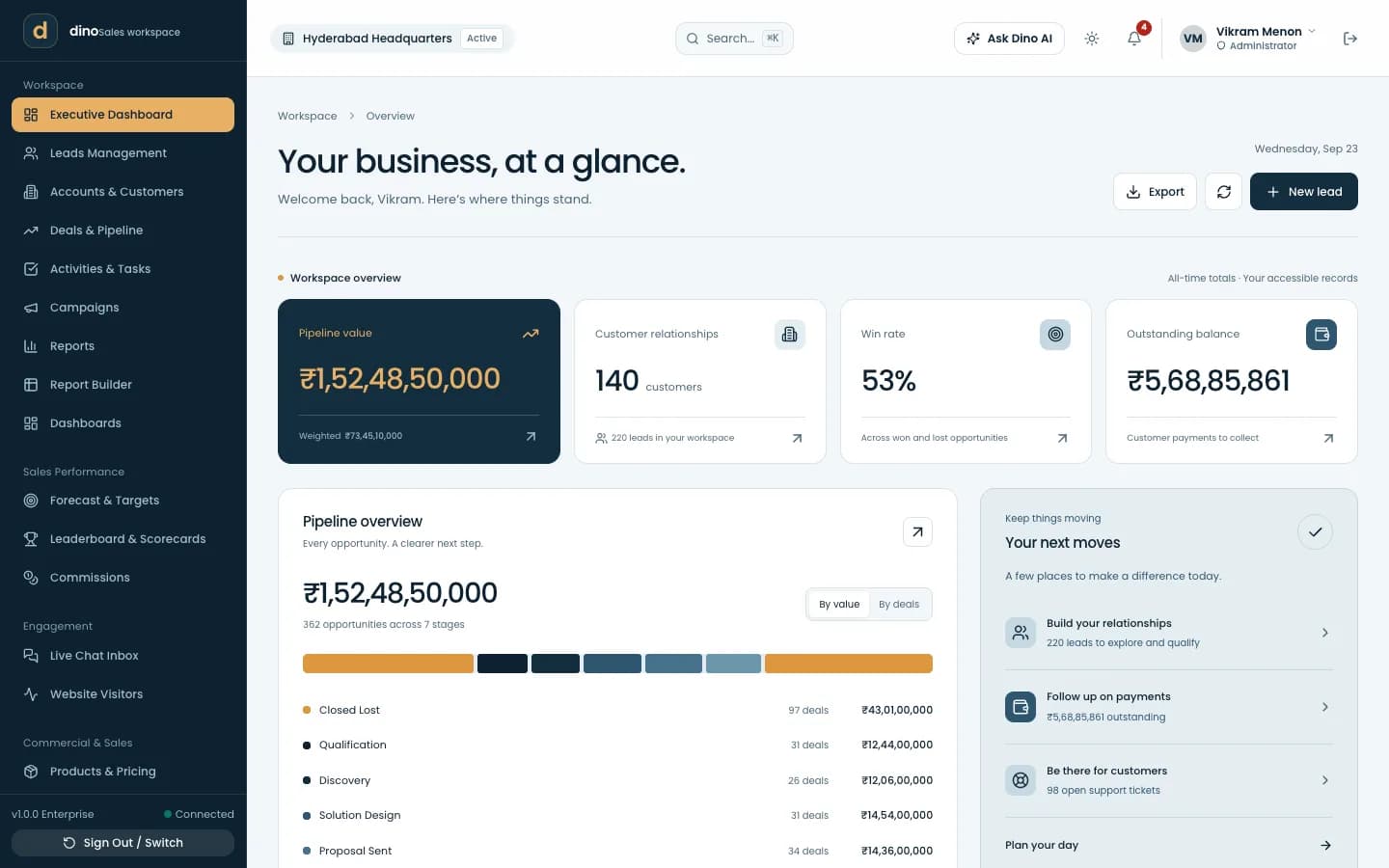
An AI-powered sales CRM connects lead tracking, deal pipelines, quotations, invoicing and support within a unified database, using large language models grounded strictly in company records. Rather than sending raw data to shared clouds, a self-hosted architecture encrypts provider API keys, enforces role-based permissions, and enables contextual querying across accounts, communications, and historical pipeline metrics.
Database Architecture and Unified Data Models
In standard enterprise environments, sales teams often suffer from tool fragmentation. Customer records reside in one tool, quotations in another, and invoicing in accounting software. An AI-powered sales CRM eliminates this fragmentation by anchoring the entire commercial customer journey to a single relational schema.
From the initial inbound lead capture through deal progression, quotation issuance, sales order confirmation, and invoice aging, every interaction updates a single customer timeline. This relational structure ensures that when automated services or human operators review an account, they access complete historical context including communications, contract revisions, and payment statuses.
How Grounded AI Retrieval Operates on CRM Records
Generic language models frequently struggle with enterprise data because they lack domain context and risk hallucinating false pricing or commitments. A grounded AI sales assistant resolves this issue through constrained retrieval mechanisms.
When a sales representative or manager prompts the assistant, the system queries the internal PostgreSQL database using structured filters and permission scopes. The relevant records—such as account history, open deal values, quotation line items, or unpaid balances—are extracted and formatted into the model's prompt as explicit factual context. This ensures that the assistant's answers are strictly derived from real transactions.
API Key Management and Tenant Data Privacy
For B2B organizations handling sensitive customer lists and financial agreements, public multi-tenant cloud AI systems introduce data privacy concerns. In our architecture, businesses use their own API keys from providers such as OpenAI, Anthropic, Google, or OpenRouter.
These API credentials are encrypted at rest using AES-256 in the host database and decrypted only in-memory during active requests. Furthermore, administrators can set per-user token expenditure ceilings, preventing unexpected cost overruns while keeping confidential prospect data under private governance.
Single-Tenant vs Multi-Tenant Deployment Profiles
| Architecture Factor | Single-Tenant Self-Hosted | Multi-Tenant Public Cloud |
|---|---|---|
| Data Isolation | Complete physical and logical isolation on private server | Shared database with logical tenant partitioning |
| Customization | Full source code modifications and custom database fields | Limited to vendor-defined extension points |
| AI Model Keys | Bring-your-own API key with zero vendor markup | Bundled subscription with fixed markup pricing |
| Deployment Timeline | Standard setup approximately two weeks after scope, assets and access are confirmed | Immediate signup with recurring per-seat fees |
| Regulatory Compliance | Full control over physical data residency and regional audits | Dependent on vendor data centers and terms |
Deploying an independent single-tenant instance provides complete autonomy over infrastructure maintenance, backup cycles, and internal security auditing. Enterprises retain full ownership of their customer datasets without exposure to external vendor platform migrations.
Frequently Asked Questions
Frequently Asked Questions
How does the Dino AI assistant access sales data without violating permissions?
The assistant evaluates each query against the active user's role-based access rights. A sales executive only receives context from accounts and opportunities assigned to them, while executive roles can query aggregate pipeline metrics.
Can Dino Sales CRM be deployed on our existing company infrastructure?
Yes. The platform is distributed with source code for the agreed scope and can be deployed on any standard Linux virtual private server or Docker host under your direct control.
Which AI providers are supported by the embedded sales assistant?
The system natively supports OpenAI, Anthropic Claude, Google Gemini, and OpenRouter through encrypted API key configuration in the administration panel.
Need Setup or Custom Coding?
Get in touch to rebrand or customize our ready-made products, or discuss custom development services. All quotes are customized and private.
Related Articles
Why B2B Sales Teams Are Replacing Per-Seat SaaS with White-Label Sales CRM Software
Discover why expanding B2B sales organizations are moving away from restrictive per-seat SaaS models in favor of white-label, self-hosted CRM software with source code delivery for the agreed scope.
B2B Sales Pipeline Stages: Managing Deals from Lead Capture to Invoicing and Renewal
Learn how to structure an end-to-end B2B sales pipeline that bridges lead scoring, opportunity management, multi-level quotation approvals, and automated invoice aging.