
How to Start a Food Delivery Business in India: Licences, GST, Payments and Riders
Short answer
To start a food delivery business in India, pick a city or cluster of neighbourhoods, sign restaurants with FSSAI licences on a written commission agreement, recruit and verify riders, and launch a customer app, restaurant portal, rider app and admin console. Register for GST as an e-commerce operator, collect payments by UPI and cash on delivery, and settle restaurants weekly.
Software discussed: Dino Food Delivery · Try the live demo
India's national food delivery apps are concentrated in the largest cities, and restaurants in those cities pay commission that the National Restaurant Association of India's India Food Services Report 2024 put at 24.6% on average in 2023. Outside the metros, and in neighbourhoods where restaurants want a cheaper channel, there is room for a local marketplace that knows its city. This guide covers the steps, the rules that apply to an operator in India and the numbers to plan around.
Step 1: Choose the City and the Niche
A delivery marketplace works when restaurants, riders and customers are close together. Start with one city, or a cluster of neighbourhoods within a short ride of each other, and decide what makes you different from the national apps.
| Model | Who it suits | Why it works |
|---|---|---|
| Tier-2 and Tier-3 city marketplace | Founders in cities such as Warangal, Guntur, Nellore, Karimnagar or Vijayawada | Fewer national-app restaurants, shorter distances and loyal local brands |
| Neighbourhood or campus marketplace | Gated communities, IT parks, universities | Dense demand in a small radius keeps delivery times short |
| Cloud kitchen network | Operators running several food brands from shared kitchens | Direct orders across brands without paying commission to a third party |
| Restaurant group delivery | Chains with five or more outlets | Own fleet and customer data across branches |
| Cuisine or diet focus | Pure-veg, Jain, homestyle meals, healthy or regional cuisine | A clear reason to install one more app |
Step 2: Sign Restaurants on Clear Terms
Restaurants join when the terms are simpler and cheaper than the aggregators. Put the commission rate, platform fee, who funds each offer, the settlement cycle and the cancellation rules in a written agreement. A weekly settlement from Monday to Sunday, paid after finance approval, is easy to explain and to reconcile.
Each restaurant should hold a valid FSSAI licence or registration. FSSAI's guidelines for e-commerce food business operators, issued in 2018, expect platforms to list only licensed or registered food businesses, display their licence numbers and sign written agreements with them; in July 2018 FSSAI directed platforms to delist unlicensed restaurants. Collect the FSSAI licence, PAN card and a cancelled cheque at onboarding and verify each document before a restaurant goes live. Check the current FSSAI rules, and whether your own operations need a licence, with a food-safety consultant.
Step 3: Understand GST for a Food Delivery Platform
GST is where food delivery in India differs most from an ordinary online shop, because the platform itself becomes liable for tax on supplies made through it.
| Charge | How it is taxed (as reported at the time of writing) | Who pays |
|---|---|---|
| Food sold by restaurants through the app | 5% GST on restaurant services supplied through an e-commerce operator, under Section 9(5) of the CGST Act, since 1 January 2022 | The platform collects and pays it, not the restaurant |
| Delivery by riders who are not GST-registered | Local delivery through an e-commerce operator was brought under Section 9(5) at 18% from 22 September 2025, after the 56th GST Council meeting | The platform |
| Commission and platform fee charged to restaurants | 18% GST on the platform's own service | The platform, charged to the restaurant |
| Platform fee charged to customers | 18% GST on the platform's own service | The platform |
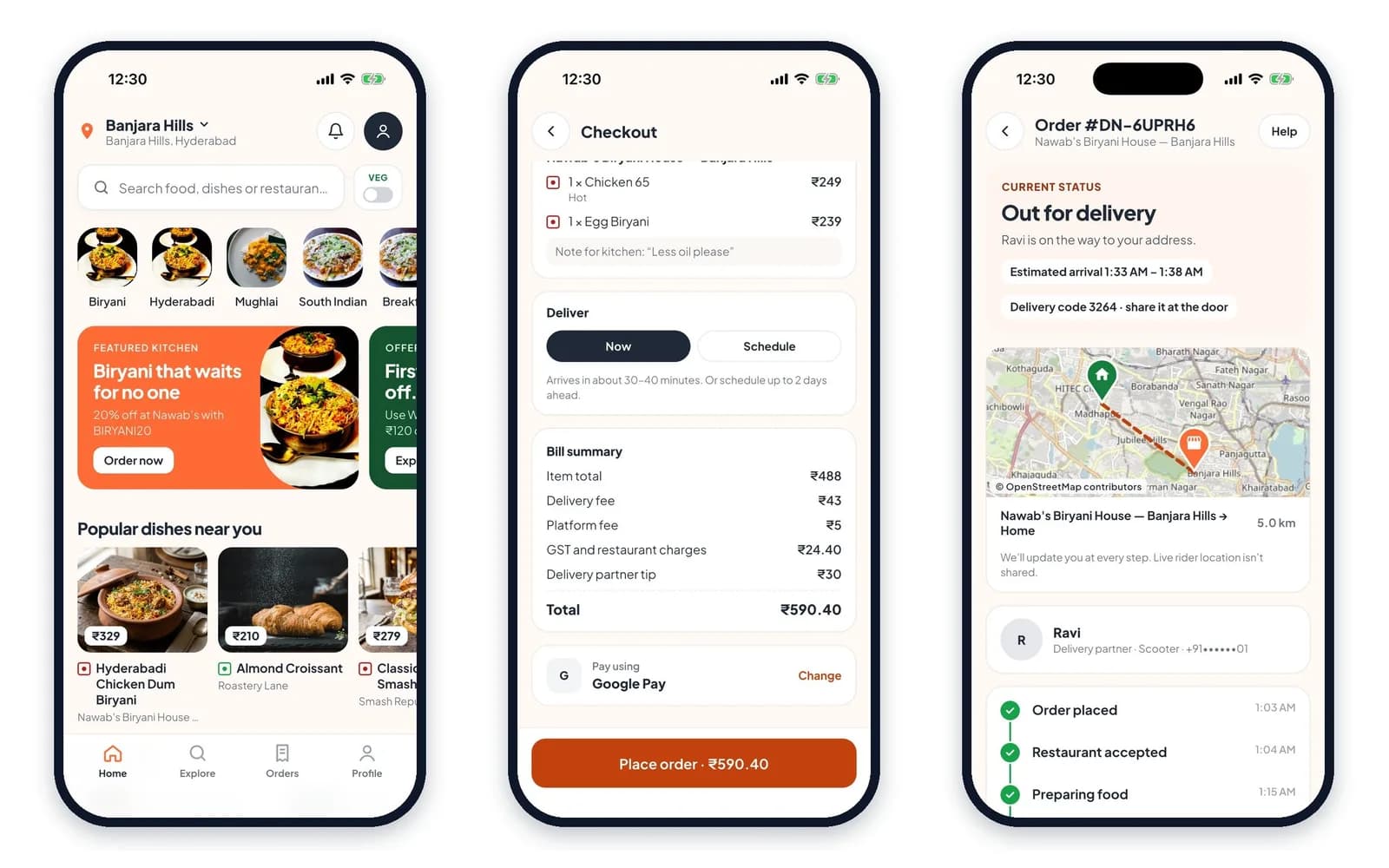
These rates change: the GST Council revisits delivery and e-commerce rules, and proposals to change the delivery rate have been reported. Confirm the current position, invoicing and TCS obligations with a GST practitioner before you price your fees. The checkout in Dino Food Delivery shows item total, delivery fee, platform fee, GST and charges as separate lines, so the customer bill matches what you report.
Step 4: Payments, UPI and Cash on Delivery
- UPI first: Google Pay, PhonePe and any UPI ID cover most online payments in India, with cards and netbanking for the rest.
- Hosted checkout: payment on the gateway's hosted page means the app never stores full card numbers.
- Cash on delivery: still expected in many towns. Track rider cash in a wallet, ask riders to deposit it, and deduct what is outstanding from their next payout.
- Failed payments: a failed payment must not create an order; the customer simply retries.
- Risk controls: withdraw cash on delivery for new accounts with large orders or repeated refusals, while prepaid orders always go through.
- Payouts: weekly transfers to restaurants and riders by bank or UPI through a payouts product such as RazorpayX.
Step 5: Recruit Riders and Set Fair Pay
Riders choose the platform that pays clearly and on time. Verify each rider's driving licence, Aadhaar or another ID, bank or UPI proof and a profile photo before the first offer. Set pay as a base amount per trip plus pay per km, add tips and incentives, and show the estimated earnings on every offer so a rider can decide in seconds. Keep the rider's phone number hidden from customers and allow contact only while a delivery is active.
Step 6: Launch the Apps
You need four applications: a customer app, a restaurant portal, a delivery partner app and an admin console. Building them from scratch takes months; a white-label food delivery app with source code lets you launch in your own brand in approximately two weeks of setup after scope and accounts are confirmed, plus app-store review time.
Dino Food Delivery customer app: location-first home, a transparent checkout bill and status-based tracking.
Indian customers expect a few things on day one: location first, a veg-only toggle, cuisines such as biryani, South Indian and North Indian on the home screen, UPI at checkout, an Indian mobile number with a one-time code for sign-in, and support attached to each order. Telugu, Hindi and Urdu in addition to English help in Hyderabad and across Telangana and Andhra Pradesh.
Step 7: Privacy and the DPDP Act
The Digital Personal Data Protection Act, 2023, and its rules, which are being phased in, apply to the phone numbers, addresses and order histories you hold. Ask for consent at sign-in, mask customer details for staff by default, record every reveal, and give customers a way to download their data or request deletion. Legal holds should pause erasure when an order is under dispute. Review your privacy policy and consent text with a lawyer.
Launch Costs to Budget For
- Software: a one-time white-label purchase, or the cost of building four apps.
- Hosting: a VPS or cloud server for the API, worker, database and web portals.
- Accounts: Google Play and Apple developer programmes, payment gateway, SMS and email providers.
- Supply: restaurant onboarding, menu photos and launch offers that restaurants and the platform fund together.
- Fleet: rider recruitment, verification and minimum earnings in the first weeks.
- Operations: support staff and a refund budget for missing items and late deliveries.
Frequently Asked Questions
How much does it cost to start a food delivery business in India?
It depends on the city, the software route and launch offers. Budget for the platform (a one-time white-label purchase or a custom build), hosting, developer and gateway accounts, rider recruitment and minimum earnings, restaurant onboarding and support. Discounts are usually the largest early cost.
Do I need an FSSAI licence for a food delivery app?
Restaurants listed on your app must hold an FSSAI licence or registration, and FSSAI's e-commerce guidelines expect platforms to display those numbers and sign written agreements with restaurants. Whether the platform itself needs a licence depends on whether it stores or handles food, so confirm with a food-safety consultant.
What GST applies to a food delivery platform in India?
Since 1 January 2022, the platform pays 5% GST on restaurant food supplied through it under Section 9(5). From 22 September 2025, local delivery by unregistered riders through a platform was reported at 18% under the same section, and the platform's own fees carry 18%. Confirm current rates with a GST practitioner.
Should a new food delivery app offer cash on delivery?
Usually yes outside the metros, with controls: track rider cash in a wallet, deduct outstanding cash from payouts, and switch off cash on delivery for new accounts with large orders or repeated refusals.
How long does it take to launch a food delivery app in India?
With a white-label platform, setup is estimated at approximately two weeks after scope, brand assets and accounts are confirmed, plus Google Play and App Store review. Signing enough restaurants and riders for a city usually takes longer than the software.
Which Indian cities suit a local food delivery marketplace?
Cities where national apps have fewer restaurants or longer delivery times, and dense neighbourhoods, campuses and IT parks within larger cities. Tier-2 cities in Telangana, Andhra Pradesh, Karnataka and Tamil Nadu are common starting points.
The software in this article
Dino Food Delivery
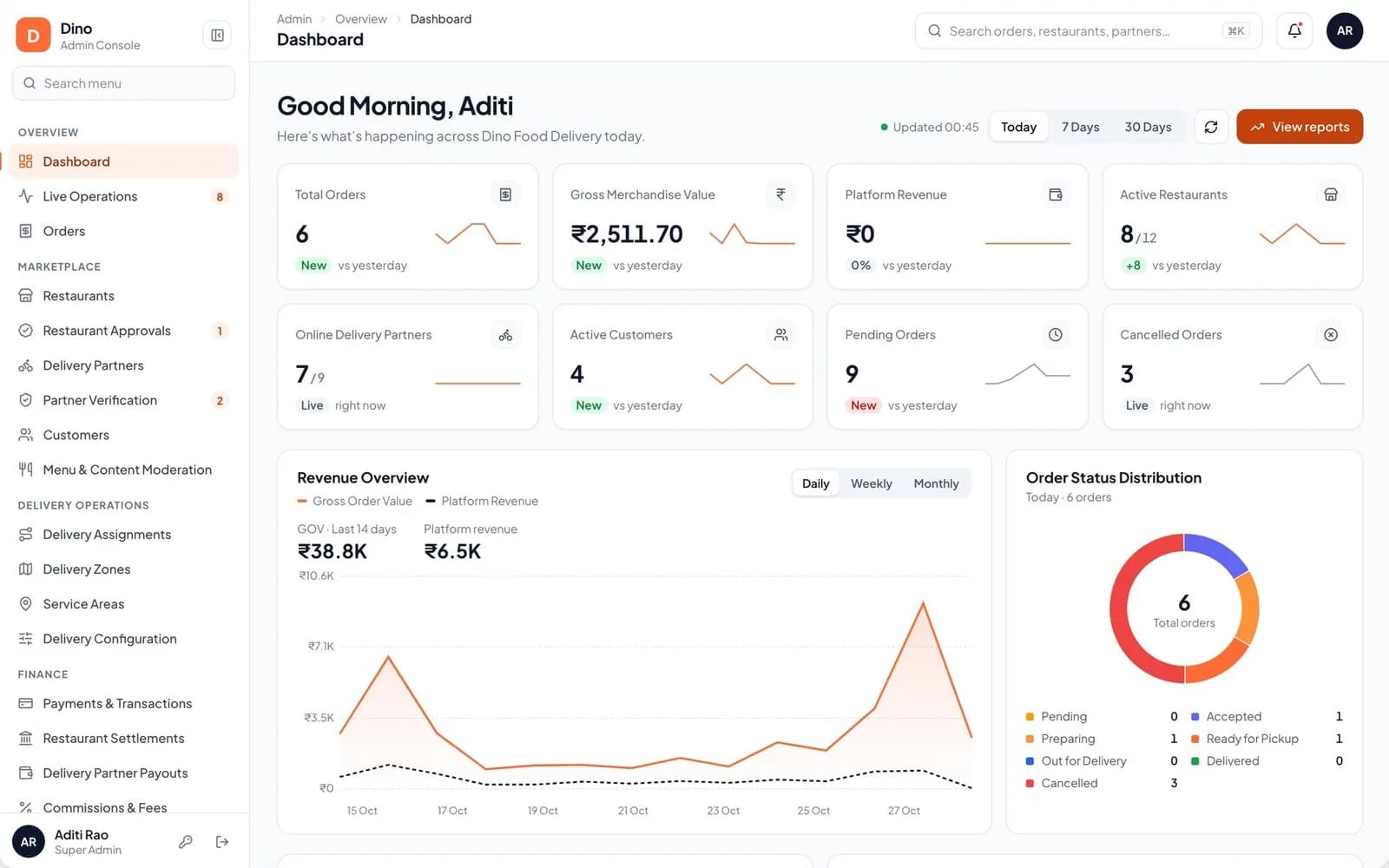
Dino Food Delivery is a white-label, multi-restaurant food delivery platform with an admin console, a restaurant portal, a Flutter customer app and a Flutter delivery partner app on one backend, with auto-dispatch, OTP handover, maker-checker finance controls and weekly settlements, sold with the source code.
Want Dino Food Delivery Under Your Brand?
Rebrand Dino Food Delivery with your logo and domain, or have it customized for your workflow. All quotes are customized and private.
Related Articles
White-Label Food Delivery App: How to Launch Your Own Delivery Marketplace
What a complete food delivery platform includes, how white-label compares with a custom build or a monthly SaaS, what it costs to run, and the launch checklist for your own branded marketplace.
Food Delivery App Features: The Complete Checklist for Customer, Restaurant, Rider and Admin Apps
Every feature a multi-restaurant food delivery platform needs, app by app: customer ordering, restaurant operations, rider dispatch and the admin controls for money, support and audit.