
Food Delivery App Features: The Complete Checklist for Customer, Restaurant, Rider and Admin Apps
Short answer
A food delivery app needs features in four connected apps. The customer app covers location, discovery, cart, checkout, payment and tracking; the restaurant portal covers live orders, kitchen timers, menu and settlements; the rider app covers KYC, offers, pickup and OTP delivery; and the admin console covers dispatch, approvals, refunds, payouts, campaigns, support and audit logs.
Software discussed: Dino Food Delivery · Try the live demo
Feature lists for food delivery apps usually stop at the customer screens: search, cart, payment, tracking. A marketplace that has to run every evening needs far more behind those screens. This checklist covers all four apps, separates the must-haves from the nice-to-haves, and uses Dino Food Delivery as a reference for how each feature works in a shipped product.
Customer App Features
The customer app decides whether people order a second time. Its job is to show what can actually be delivered to the customer's door, take a correct order and keep the customer informed without surprises.
| Feature | Why it matters | Priority |
|---|---|---|
| Location first (GPS, map pin or typed address) | Only restaurants that deliver to that address are shown | Must-have |
| Search with veg-only toggle, filters and sort | Find a dish or restaurant fast; rating, time, cost, offers, open now | Must-have |
| Restaurant page with rating, time, fee and cost for two | Everything needed to decide before opening the menu | Must-have |
| Menu with variants, add-ons and required choices | Spice level, size and extras priced correctly | Must-have |
| One-restaurant cart with a persistent cart bar | Keeps orders simple and kitchens accurate | Must-have |
| Phone sign-in with a one-time code at checkout | Browse freely, sign in only when ready to order | Must-have |
| Transparent bill: items, delivery fee, platform fee, GST, tip | No surprise charges at the last step | Must-have |
| UPI, cards, netbanking and cash on delivery | Matches how people pay in India | Must-have |
| Status-based tracking with a delivery code | Clear updates and a confirmed handover | Must-have |
| Separate ratings for restaurant, food and rider | Feedback reaches the right party | Should-have |
| Scheduled orders up to two days ahead | Office lunches and planned meals | Should-have |
| Help attached to each order, with ticket replies | Missing items and refunds without a phone call | Must-have |
| Data download and account deletion | Privacy law and trust | Must-have |
Restaurant Portal Features
A restaurant uses the portal during its busiest hours, so speed and sound matter more than design. Dino Food Delivery's portal has 22 pages for owners, branch managers and kitchen staff.
- Live orders feed that refreshes every 10 seconds, with a kitchen bell that repeats until someone accepts.
- Accept with a preparation time, which sets the arrival window the customer sees.
- Kitchen board with timers coloured by on time, last 25% of the target, or over target, plus printed tickets.
- Add a delay to one order, or tell every affected customer about a 10-minute delay.
- Menu items with veg or non-veg, price, prep time, bestseller tag and stock toggles per branch, with CSV import and export.
- Categories with lunch-only or dinner-only visibility, and option groups for variants, add-ons and single choices.
- Busy mode that adds 10, 20 or 30 minutes to prep times, a pause switch, weekly hours with up to three sessions a day and holidays.
- Branches with their own orders, hours, staff, menu availability and settlements.
- Earnings and weekly settlements, payments by method, analytics, offers, reviews with replies and a staff list with roles.
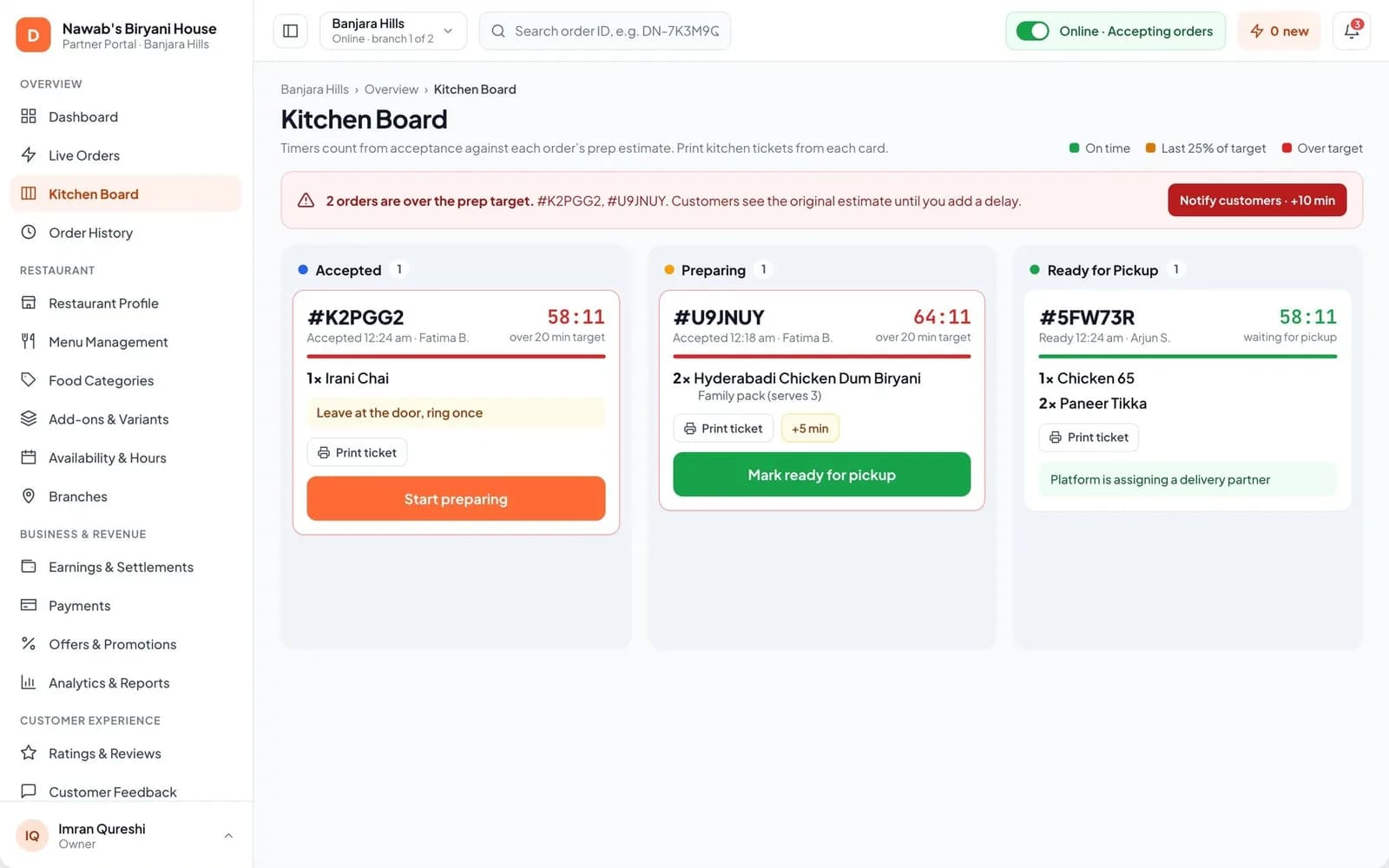
The restaurant kitchen board: timers count from acceptance against each order's preparation estimate.
Delivery Partner App Features
The rider app should handle one delivery at a time and make every step obvious, because riders use it on the move.
| Stage | Features | Priority |
|---|---|---|
| Join | Phone sign-in, personal details, licence, Aadhaar or PAN, bank or UPI proof, resubmit only a rejected document | Must-have |
| Go online | Online session with time, vehicle, today's earnings and deliveries | Must-have |
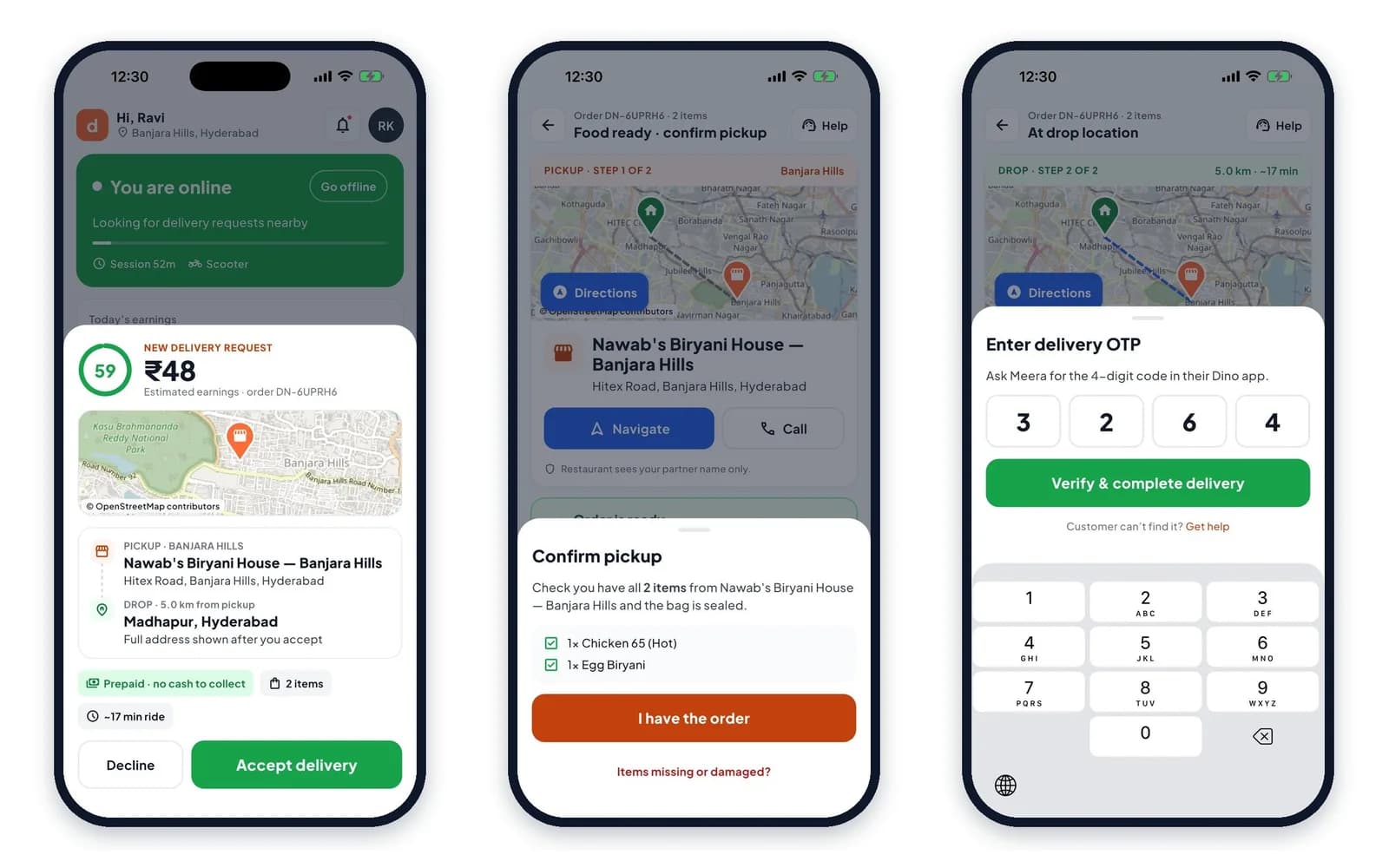
| Offer | Countdown with estimated earnings, pickup, drop area, distance, items and cash due; expires to the next rider | Must-have |
| Pickup | Directions, call the restaurant, items to collect, pickup code and a food-ready alert | Must-have |
| Confirm pickup | Tick every item or report missing or damaged items before leaving | Should-have |
| Deliver | Customer name, address, landmark and instructions; contact only while active; 4-digit OTP | Must-have |
| Money | Earnings breakdown, cash in hand owed to the platform, pending and paid payouts, next payout date | Must-have |
| Safety | Help topics, tickets, a call to support and an emergency button | Must-have |
Admin Console Features
The admin console is where the marketplace is run. Dino Food Delivery's has 40 pages grouped into ten areas.
| Area | Key features |
|---|---|
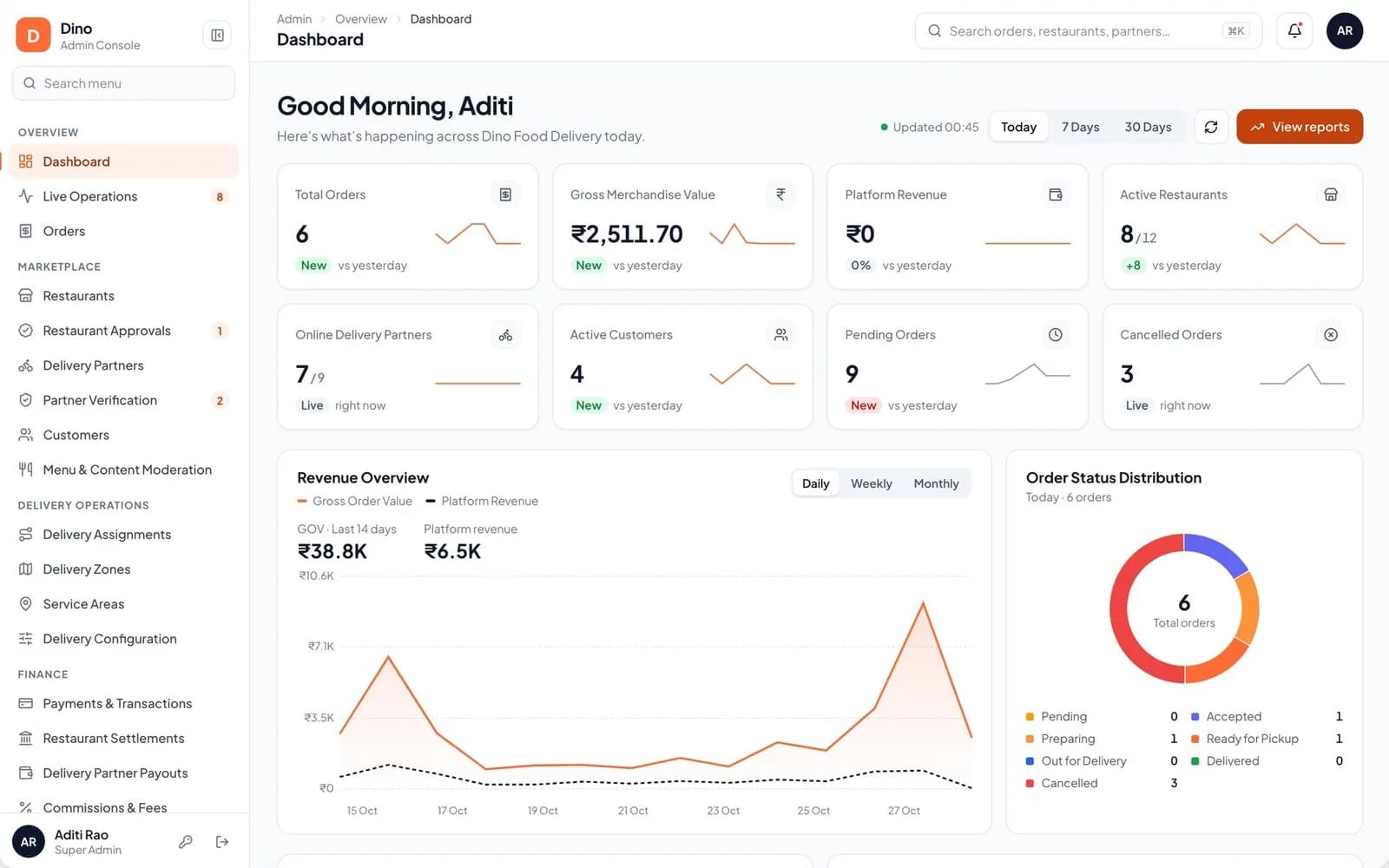
| Operations | KPI dashboard, live operations board with SLA flags, searchable orders with CSV export, order detail with refund, escalate or ticket |
| Dispatch | Auto-assignment on acceptance, dispatch queue, fleet capacity, audited manual overrides |
| Marketplace | Restaurant and rider directories with 360° views, document-by-document approvals, menu and review moderation |
| Customers and privacy | Masked personal data, customer 360°, cash-on-delivery switch, privacy requests and legal holds |
| Delivery network | Radius or polygon zones with fees, service areas with blackout windows, assignment rules, partner pay, delivery OTP, location master data |
| Finance | Payments ledger, refunds with limits, weekly settlements, partner payouts, commissions and fees with four-eyes approval, six reconciliation reports |
| Growth | Coupons, banners by zone and audience, push, SMS, email and in-app campaigns with A/B tests and quiet hours, ratings |
| Support and trust | One ticket queue for all three audiences, canned replies, internal notes, fraud rules |
| Insights | Ten report views, scheduled exports, anomaly alerts with cooldowns |
| Administration | Admin roles with city scope, permission matrix, 2FA and sessions, immutable audit log, system health, versioned settings |
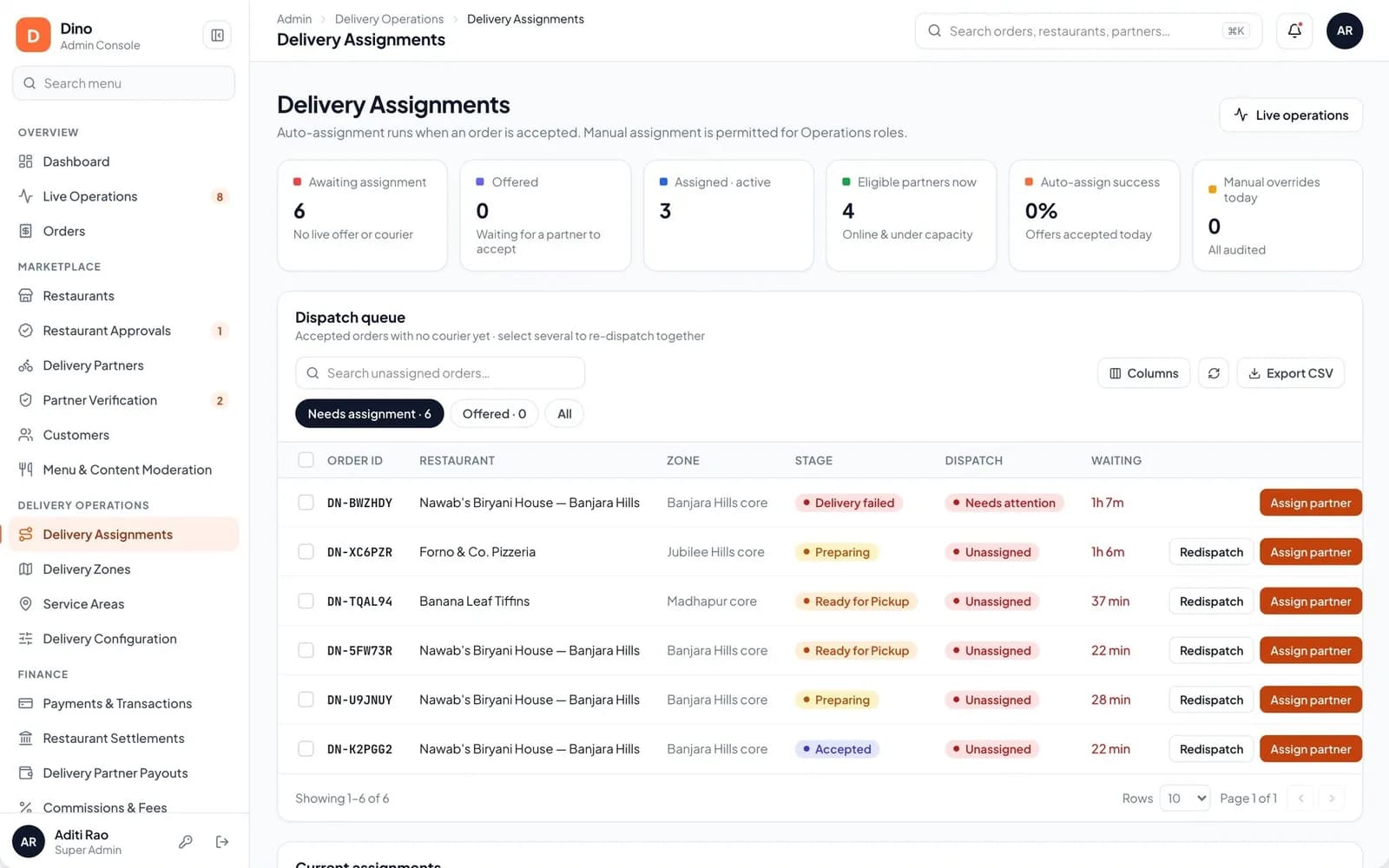
Dispatch queue: accepted orders with no courier, waiting time and one-click reassignment.
Money and Trust Features Most Checklists Miss
- Whole-paise amounts and a balanced ledger, so every payment, refund, settlement and payout nets to zero.
- Idempotent payments, so nothing is charged or paid twice when a network call is retried.
- Refund limits: small refunds auto-approve (below ₹200 in Dino Food Delivery) and large ones need two different approvers (above ₹1,000).
- Maker-checker approval on fee changes, payout adjustments and notification campaigns.
- A transactional outbox and worker heartbeats, so notifications and transfers are not lost when a process restarts.
- An immutable audit log that records denied actions as well as successful ones.
Nice-to-Haves You Can Add Later
Group ordering, subscriptions and loyalty points, table reservations, live GPS rider tracking, a customer web ordering site and POS integrations are useful but rarely decide whether a new marketplace survives its first year. Launch with the four apps above, then add features that your own order data shows customers or restaurants ask for. A single restaurant's own ordering, QR menu and table booking are covered by TechRestro.
Frequently Asked Questions
What are the must-have features of a food delivery app?
Location-first discovery, search and filters, menus with variants and add-ons, a transparent bill, UPI, card and cash payments, status-based tracking with a delivery code and order help for customers; plus a restaurant portal, a rider app with offers and OTP delivery, and an admin console for dispatch, refunds, settlements and support.
Which apps does a food delivery platform need?
Four: a customer app, a restaurant portal or app, a delivery partner app, and an admin console for the operator. They share one backend so every order status is the same in all four.
Does a food delivery app need live GPS rider tracking?
No. Status-based tracking with clear stages, an arrival window and a delivery code covers what customers need, and protects rider privacy. Dino Food Delivery uses status-based tracking and never shares the rider's live location with customers.
What admin panel features does a food delivery business need?
A live operations board, dispatch with overrides, restaurant and rider approvals, delivery zones and fees, refunds with limits, commissions, settlements and payouts, coupons and campaigns, support tickets, fraud rules, reports and an audit log.
How does a food delivery app handle cash on delivery?
The rider collects cash, the app records it as owed to the platform in the rider's wallet, and outstanding cash is deducted from the next payout. Cash on delivery can be switched off for risky accounts.
Software in this article
Dino Food Delivery
Dino Food Delivery is a white-label, multi-restaurant food delivery platform with an admin console, a restaurant portal, a Flutter customer app and a Flutter delivery partner app on one backend, with auto-dispatch, OTP handover, maker-checker finance controls and weekly settlements, sold with the source code.
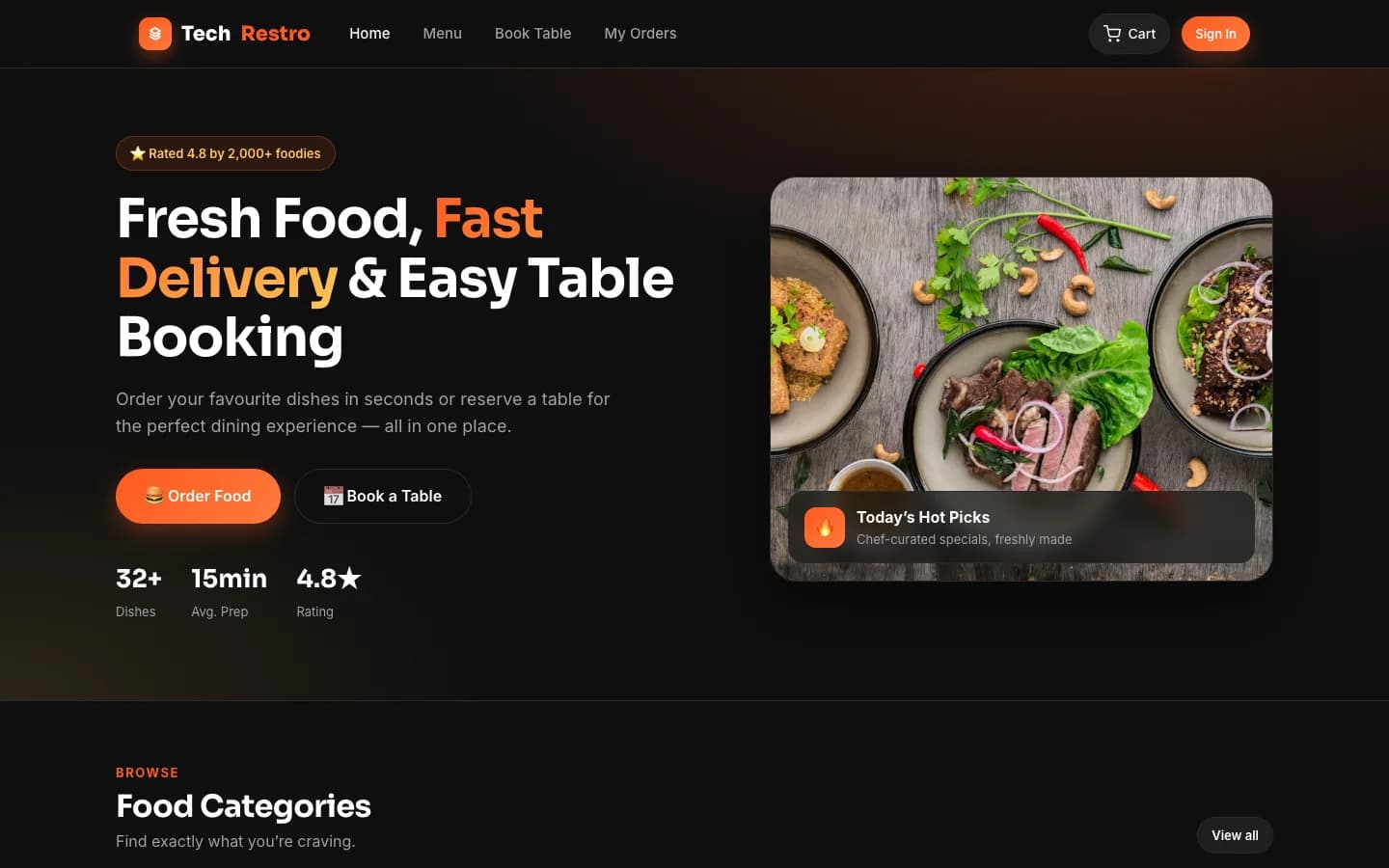
TechRestro
Restaurant online ordering and table booking platform with digital menu, delivery and pickup orders, reservation slots, and admin console with analytics.
Want Dino Food Delivery Under Your Brand?
Rebrand Dino Food Delivery with your logo and domain, or have it customized for your workflow. All quotes are customized and private.
Related Articles
How to Start a Food Delivery Business in India: Licences, GST, Payments and Riders
A step-by-step plan for launching a food delivery app in an Indian city: picking the market, FSSAI and GST obligations, UPI and cash on delivery, rider pay, restaurant commission and launch costs.
Food Delivery App Business Model: Commission, Fees and Unit Economics per Order
How a food delivery marketplace makes money: restaurant commission, delivery and platform fees, ads and subscriptions, rider pay and discounts, with a worked contribution-per-order example.