
Food Delivery App Business Model: Commission, Fees and Unit Economics per Order
Short answer
A food delivery app earns from restaurant commission, the customer's delivery fee and platform fee, and later from ads, subscriptions and restaurant-funded offers. Each order must cover rider pay, payment fees, discounts, refunds and support. A marketplace is viable when contribution per order stays positive after these costs, which depends on order value, delivery distance and order density.
Software discussed: Dino Food Delivery · Try the live demo
Food delivery is a thin-margin business run at volume. The platform sits between restaurants, riders and customers and takes a small share of every order, so the numbers per order decide whether growth helps or hurts. This guide breaks down the revenue lines, the costs and a worked example you can change for your own city.
How a Food Delivery Marketplace Makes Money
| Revenue line | Paid by | Typical form | Notes |
|---|---|---|---|
| Commission | Restaurant | Percentage of food value | The largest line. Aggregator commission in India averaged 24.6% in 2023 per the NRAI India Food Services Report 2024; a local marketplace usually competes below that |
| Delivery fee | Customer | Flat or distance-based, often by zone | Offsets rider pay; free delivery above a minimum order is a common offer |
| Platform fee | Customer | Small fixed amount per order | Shown as its own line on the bill |
| Restaurant-funded offers | Restaurant | Discounts the restaurant pays for | Drive volume without costing the platform |
| Ads and featured placement | Restaurant | Banner, featured kitchen or search slot | Becomes meaningful once there is steady traffic |
| Subscriptions | Customer | Monthly plan for free delivery or offers | Raises order frequency; needs volume first |
Where the Money Goes
- Rider pay: base pay per trip plus pay per km, tips passed through, incentives at peak hours and minimum earnings while the fleet grows.
- Payment costs: gateway fees on online orders and transfer fees on payouts.
- Discounts: platform-funded coupons and free delivery, usually the biggest cost in the first months.
- Refunds: missing items, wrong orders and late deliveries.
- Support: agents handling tickets from customers, restaurants and riders.
- Technology: servers, SMS, push and email, and any per-order software fee if the platform is rented.
- Taxes: GST the platform pays on supplies made through it; in India, food supplied through an e-commerce operator carries 5% under Section 9(5).
Worked Example: Contribution per Order
The figures below are illustrative for a Tier-2 Indian city. They exclude GST collected and paid through, and they assume an online-paid order of 4 km. Replace them with your own numbers.
| Line | Amount (₹) | Assumption |
|---|---|---|
| Food value (average order value) | 350 | Two dishes and a drink |
| Commission from restaurant | +63 | 18% of food value |
| Delivery fee from customer | +30 | Zone base fee |
| Platform fee from customer | +5 | Fixed per order |
| Platform revenue | 98 | Sum of the three lines above |
| Rider pay | −45 | ₹25 base trip pay + ₹5 per km × 4 km |
| Payment gateway fee | −8 | About 2% of the amount paid online |
| Platform-funded discount | −20 | Average across all orders, not only coupon orders |
| Refunds and support reserve | −6 | Missing items, late orders, agent time |
| Contribution per order | 19 | Before servers, marketing and salaries |
At 500 orders a day, ₹19 per order is about ₹2.85 lakh a month toward fixed costs. The same marketplace at 6 km average distance pays ₹10 more to the rider and drops to ₹9 per order, which is why order density, not just order count, decides profitability.
Levers That Move Unit Economics
- Density: more restaurants and customers inside each delivery zone shortens trips and raises orders per rider hour.
- Zone fees: price delivery by zone and distance instead of one flat fee for the whole city.
- Offer funding: shift offers from platform-funded to restaurant-funded once restaurants see the volume.
- Batching rules: allow more than one order per rider only where it does not delay food.
- Cash controls: cash on delivery costs more to reconcile and carries refusal risk, so limit it for new accounts and large orders.
- Refund limits: auto-approve small refunds to save agent time, and require two approvers for large ones.
- No per-order software fee: a platform you own keeps that share in the contribution line.
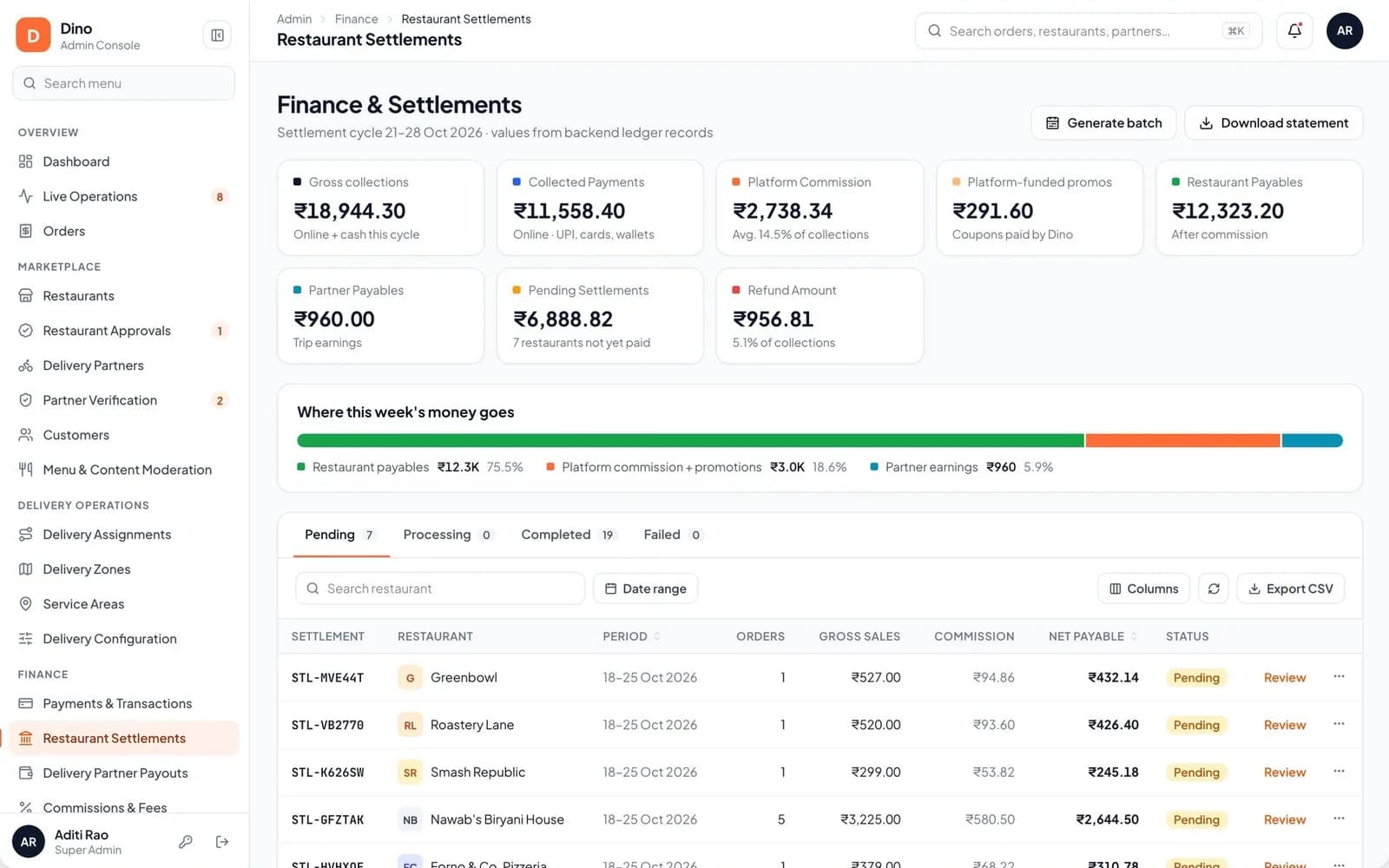
Restaurant settlements in Dino Food Delivery: collections split into restaurant payables, commission, promotions and partner earnings.
Settlements: How the Money Moves
Customers pay the platform. Each week, the platform settles restaurants for food value minus commission and restaurant-funded offers, and pays riders their trip earnings minus cash they collected on delivery. In Dino Food Delivery, money is stored in whole paise and every payment, refund, settlement and payout posts to a balanced ledger, so the reconciliation report shows exactly where each rupee went. Commission and fee changes are effective-dated and need a second approver, which keeps restaurant statements consistent with the agreement.
Owning the Platform vs Paying per Order
Renting delivery software per order or per outlet adds a cost that grows with every order you deliver. Buying a white-label food delivery app with source code turns that into a one-time cost plus your own hosting, so the contribution line keeps the difference. The trade-off is that you run the servers and the app-store listings yourself. For India-specific licences and GST, read how to start a food delivery business in India.
Frequently Asked Questions
How do food delivery apps make money?
Mainly from restaurant commission on each order, plus delivery fees and a platform fee paid by customers. Mature platforms add advertising and featured placement for restaurants, customer subscriptions and restaurant-funded offers.
What commission do food delivery apps charge restaurants?
In India, aggregator commission averaged 24.6% in 2023 according to the NRAI India Food Services Report 2024, with reported ranges of roughly 16% to 30% by city and contract. A local marketplace usually competes with a lower rate and clearer terms.
What is a good contribution per order for a food delivery app?
Any positive contribution after rider pay, payment fees, discounts and refunds is the starting point; it then has to cover servers, marketing and salaries at your daily order volume. Order density and delivery distance move it most.
Who pays the delivery partner in a food delivery marketplace?
The platform. Riders earn base pay per trip, pay per km, incentives and tips, and are paid weekly after approval, with cash they collected on delivery deducted from the payout.
Is it cheaper to own food delivery software than to rent it?
Over time, usually yes, if you have steady order volume: owning removes per-order or per-outlet software fees. You take on hosting, app-store accounts and maintenance, so compare the total cost over two to three years.
The software in this article
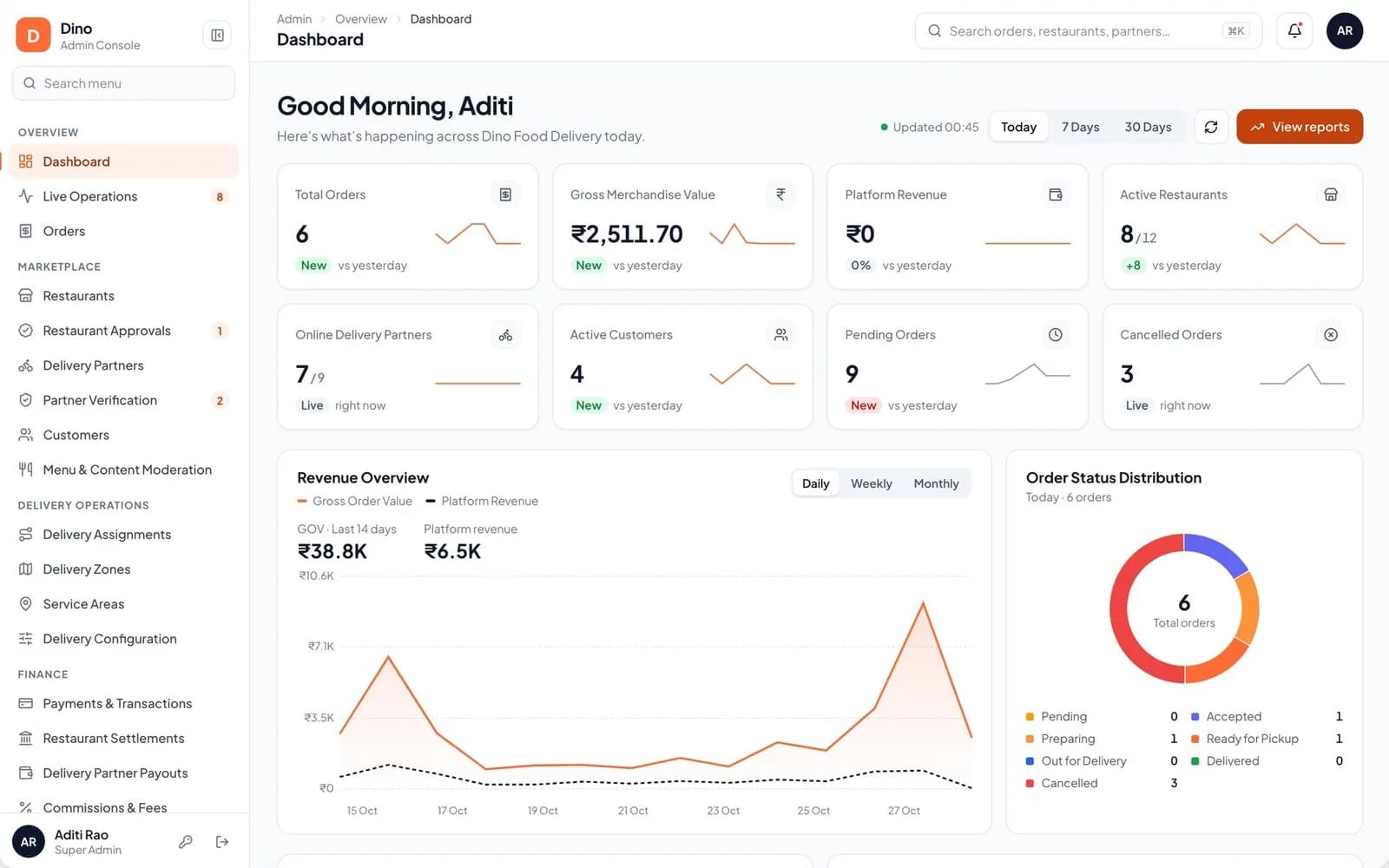
Dino Food Delivery
Dino Food Delivery is a white-label, multi-restaurant food delivery platform with an admin console, a restaurant portal, a Flutter customer app and a Flutter delivery partner app on one backend, with auto-dispatch, OTP handover, maker-checker finance controls and weekly settlements, sold with the source code.
Want Dino Food Delivery Under Your Brand?
Rebrand Dino Food Delivery with your logo and domain, or have it customized for your workflow. All quotes are customized and private.
Related Articles
Food Delivery App Features: The Complete Checklist for Customer, Restaurant, Rider and Admin Apps
Every feature a multi-restaurant food delivery platform needs, app by app: customer ordering, restaurant operations, rider dispatch and the admin controls for money, support and audit.
How to Start a Food Delivery Business in India: Licences, GST, Payments and Riders
A step-by-step plan for launching a food delivery app in an Indian city: picking the market, FSSAI and GST obligations, UPI and cash on delivery, rider pay, restaurant commission and launch costs.