
How Vector Databases Power Enterprise AI Knowledge Bases
Short answer
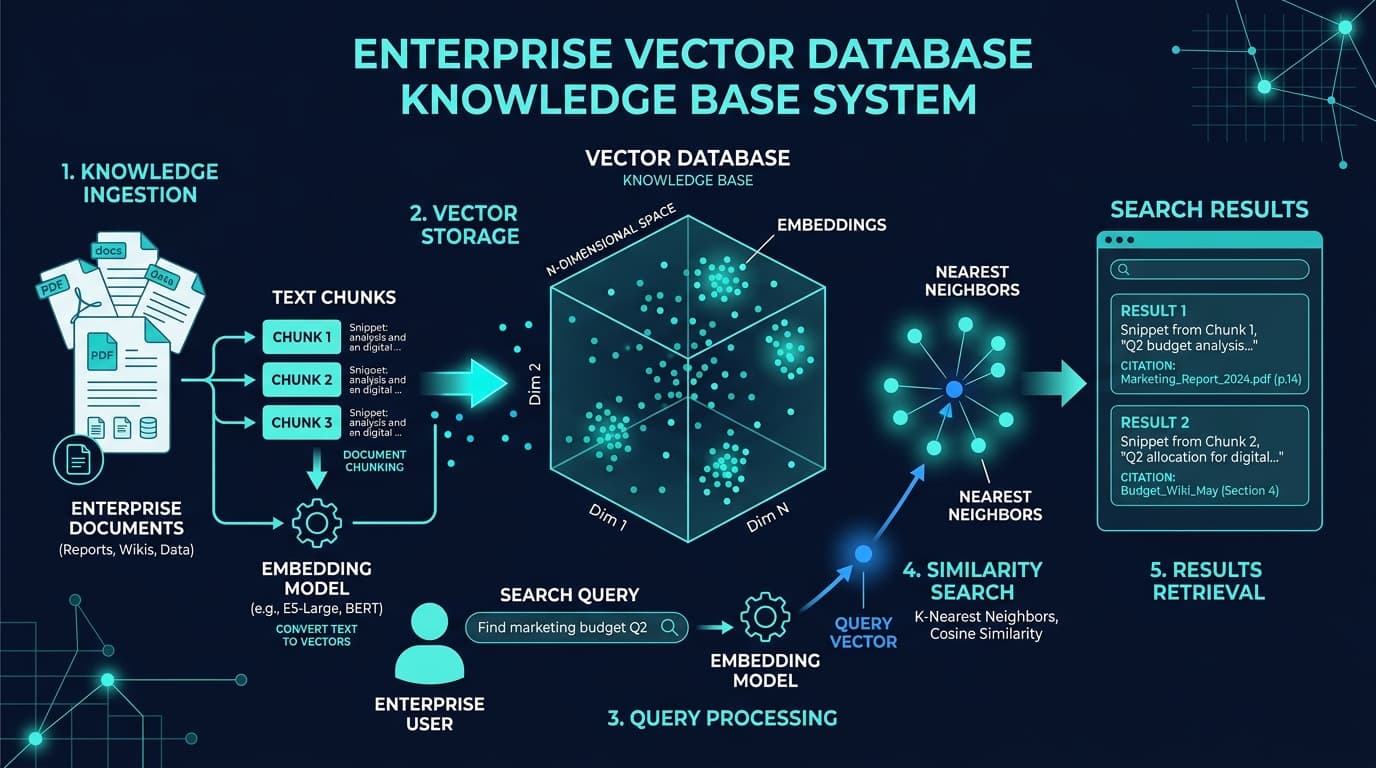
Vector databases power enterprise AI knowledge bases by converting company documents into numerical embeddings stored in high-dimensional space. When a user asks a question, the query is embedded and matched against stored vectors using cosine similarity. The nearest matches — policy paragraphs, SOP sections, manual entries — are returned with citations, enabling AI assistants to answer from company-specific knowledge rather than generic training data.
Why Traditional Keyword Search Fails for Policy Documents
Traditional relational databases rely on exact string matching or simple full-text lexical search. When an employee asks 'How many days of bereavement leave am I entitled to?', a keyword query searches for the word 'bereavement'. If the company policy handbook describes this under the heading 'Compassionate Family Absence Policy', traditional search fails completely and returns zero results. Semantic vector search solves this by indexing the conceptual meaning of phrases rather than literal character sequences.
The End-to-End Vector Ingestion and Retrieval Pipeline
Building a reliable, cited knowledge base requires an orderly multi-stage processing pipeline:
- Unstructured document ingestion: Corporate handbooks, safety manuals, compliance policies, and technical SOPs in PDF, Markdown, or text format are uploaded
- Intelligent text chunking: Long documents are split into overlapping passages of 300 to 500 tokens, preserving complete sentences and paragraph context
- Vector embedding computation: Each chunk passes through a dedicated embedding model (such as text-embedding-3-small) to generate a high-dimensional vector coordinate
- Index storage in Qdrant: Vector coordinates are stored alongside payload metadata including document title, revision version, department tag, and page number
- Query embedding and similarity lookup: User natural language queries are embedded and compared against stored vectors using cosine similarity distance
- Optional cross-encoder reranking: High-scoring matches are reranked by relevance to select the top factual context passages for synthesis
- Cited answer synthesis: The language model answers the inquiry using only the retrieved passages, providing clickable source citations
Why Qdrant Is Ideal for Self-Hosted Enterprise Knowledge
| Architecture Feature | Practical Enterprise Value |
|---|---|
| Self-hosted Docker deployment | Sensitive company policies and procedural manuals stay strictly on your private server infrastructure |
| Payload metadata filtering | Combines semantic vector search with hard relational filters like department='HR' or branch='Dubai' |
| Sub-second search latency | Retrieves nearest neighbor matches across tens of thousands of document chunks in milliseconds |
| Deterministic fallback | Gracefully degrades to keyword database search if the vector engine is undergoing maintenance |
| Scalable memory footprint | Runs efficiently within containerized environments without requiring massive GPU cluster investments |
Frequently Asked Questions
Frequently Asked Questions
What types of documents can be indexed in the knowledge base?
Corporate policy manuals, employee handbooks, standard operating procedures, compliance guidelines, safety protocols, and technical onboarding wikis can all be ingested.
Does the knowledge base replace the transactional relational database?
No. The vector database stores unstructured text documents like policies, while transactional business data (customers, orders, invoices) is stored in MySQL.
What embedding models are supported?
Administrators can select from OpenAI embeddings, OpenRouter models, or local open-source embedding models compatible with standard API interfaces.
How are updated documents handled?
When a revised policy is uploaded, older chunks are purged and the updated text is re-embedded, ensuring the AI assistant always cites the latest version.
Need Setup or Custom Coding?
Get in touch to rebrand or customize our ready-made products, or discuss custom development services. All quotes are customized and private.
Related Articles
How AI Assistants Answer Business Questions from Live Company Data
A practical explanation of how AI assistants retrieve invoices, leads, employees and policy documents from live business records, enforce permissions, and cite their sources.
How LangGraph Multi-Agent AI Assistants Work in Business Software
A technical overview of how LangGraph orchestrates specialist AI agents for CRM, finance, HR and operations to answer business questions from live records with permission-scoped retrieval.