
Cash on Delivery for Kirana Delivery Apps: How Collection, Deposits and Payouts Reconcile

Short answer
Cash on delivery reconciles when every trip records the exact amount collected, the platform tracks how much cash each delivery partner is holding, and that balance is deducted before the next payout. Dino Kiranam follows this model: partners record cash or UPI per trip, deposits are logged, and shop settlements carry a UTR reference.
Software discussed: Dino Kiranam · Try the live demo
In many neighbourhoods, households still prefer to pay the delivery partner in cash. For a kirana marketplace that is a real money-handling problem. Cash moves from customer to rider, from rider to the platform, and from the platform to the shop, and each hand-off is a chance for figures to drift.
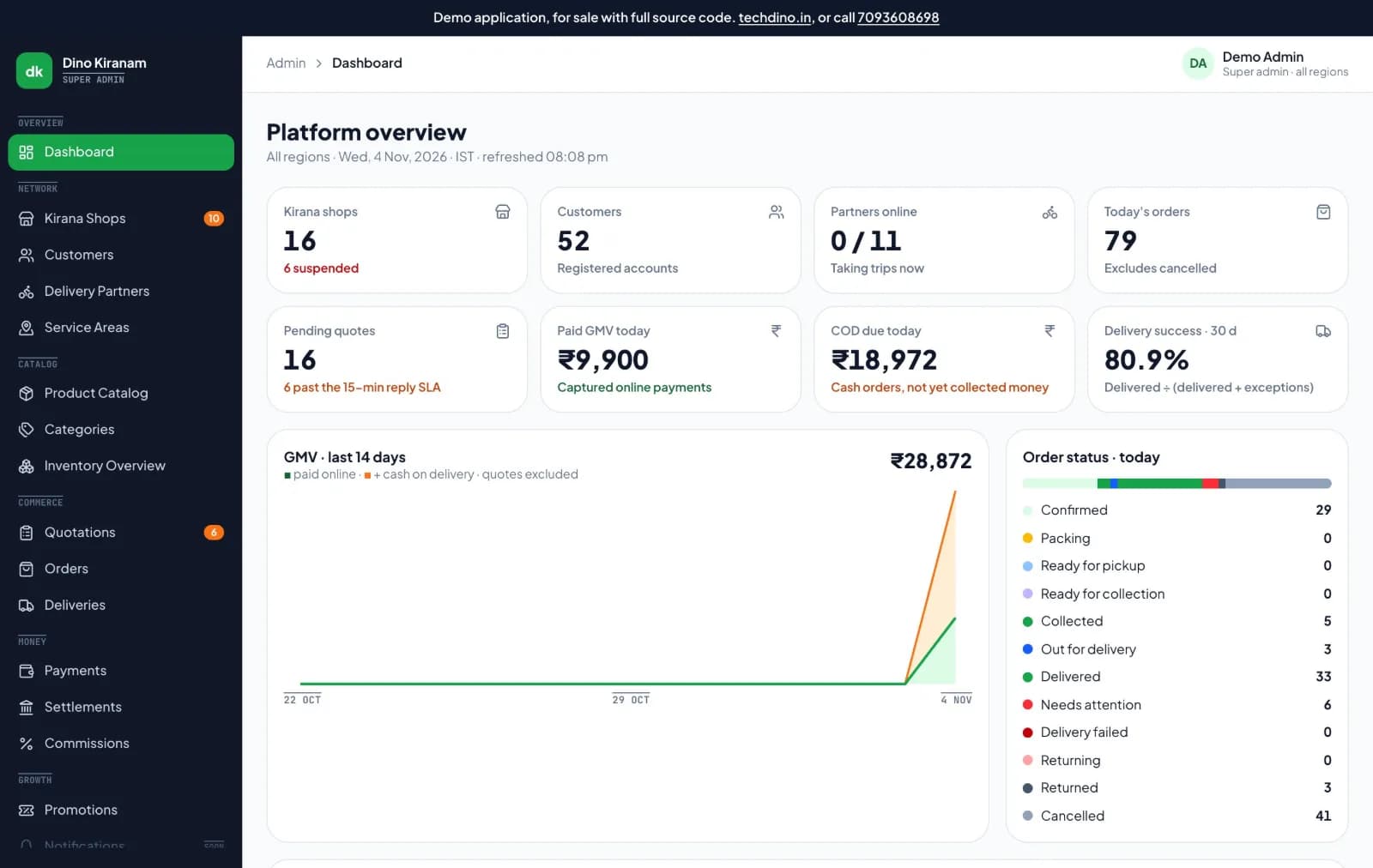
Dino Kiranam is a quote-first kirana marketplace from TechDino with customer, shop and delivery partner apps, a shop web portal and an admin console. This article looks only at how it handles cash on delivery from collection to payout.
Where cash on delivery goes wrong
- The rider collects a rounded amount and the difference is never recorded.
- Cash sits with riders for days because nobody tracks the running balance.
- Shops are paid for orders whose cash has not yet reached the platform.
- A refused order returns to the shop, but the cash entry stays open.
Step 1: The total is locked before packing
In a quote-first flow, the shop prices the list and the customer approves the final total. The server calculates items, discount and delivery, and that approved amount is what the rider collects. Because the shop cannot change a paid order on its own, the cash figure does not move after approval.
Step 2: Exact cash or UPI recorded per trip
At the door, the delivery partner confirms the customer's delivery code and records exactly what was collected, in cash or by UPI. The partner app shows the amount to collect before the trip is accepted, so the rider knows in advance whether a cash trip is involved. Trip actions work offline and sync once the connection returns.
Step 3: Cash held is tracked as a balance
Each cash trip adds to the partner's cash-held balance, which the partner and the finance team can both see. When the partner deposits cash, the deposit is recorded against that balance. Finance can see at any time how much cash is outstanding across all partners.
Step 4: Payouts deduct cash still held
When partner earnings are paid out, any cash the partner still holds is deducted first. A partner who earned more in fares than they hold in cash receives the difference; a partner holding more cash than they earned receives nothing until the balance is deposited. This removes the need for manual chasing.
| Party | What they see | What closes the loop |
|---|---|---|
| Customer | Approved total and delivery code | Paying the approved amount at the door |
| Delivery partner | Cash to collect, cash held, earnings | Recorded deposit or deduction from payout |
| Shop | Per-order earnings with commission shown | Settlement with a UTR reference |
| Finance | Payments, deposits, journal and settlement cycles | Approving settlements and recording the UTR |
Step 5: Shop settlements with UTR tracking
Shop settlements run in cycles. Finance calculates a cycle, approves it, records the bank UTR once the transfer is made, and retries any failed transfer. Large refunds need a second admin to approve. Every movement posts to a journal, so the payments, deposits and settlement figures can be checked against each other.
Frequently asked questions about cash on delivery
Frequently Asked Questions
Can a kirana marketplace work without cash on delivery?
Yes. Dino Kiranam supports online payment through your own Razorpay account, and cash on delivery can be turned on or off for each shop.
What happens when the customer refuses the order at the door?
The partner reports a refused order, follows a guided return to the shop, and the order is recorded as a delivery exception for operations to resolve.
How does the shop know what it will be paid?
The shop portal shows per-order earnings with the commission shown, and each settlement lists the orders it covers with a UTR once paid.
The software in this article
Dino Kiranam
Dino Kiranam is a white-label, quote-first kirana marketplace with Flutter customer, shop and delivery partner apps, a shop web portal, a super admin console and one Node.js backend, where shops price each list and customers approve the total before paying, sold with the source code.
Explore Next
- Learn about our mobile app development services
Want Dino Kiranam Under Your Brand?
Rebrand Dino Kiranam with your logo and domain, or have it customized for your workflow. All quotes are customized and private.
Related Articles
White-Label Kirana Marketplace App: How Quote-First Grocery Ordering Works
Examine how Dino Kiranam replaces stale grocery catalogs with a quote-first kirana marketplace workflow: photographed lists, line-by-line shop pricing, customer substitute approval, OTP handovers, and double-entry ledger settlements.
Global Multi-Tenant E-Commerce SaaS Platform: Launching Scalable Storefronts Worldwide
Learn how modern digital agencies and enterprise operators launch multi-tenant e-commerce platforms powering thousands of global storefronts with complete source code.